

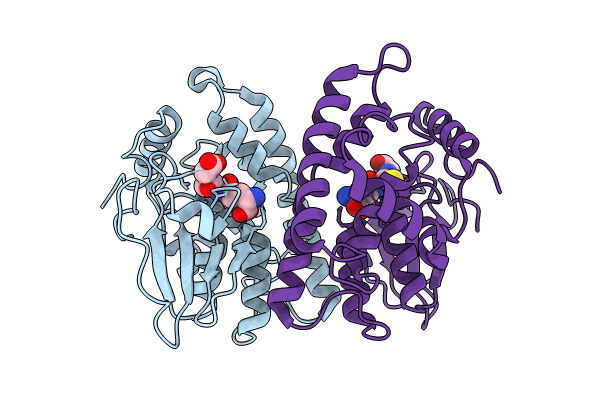
8QLL image
Deposition Date 2023-09-20
Release Date 2024-07-31
Last Version Date 2024-07-31
Entry Detail
PDB ID:
8QLL
Keywords:
Title:
Crystal structure of rat glutathione transferase Omega 1 bound to glutathione
Biological Source:
Source Organism(s):
Expression System(s):
Method Details:
Experimental Method:
Resolution:
2.40 Å
R-Value Free:
0.29
R-Value Work:
0.25
R-Value Observed:
0.25
Space Group:
I 4
Macromolecular Entities
Structures with similar UniProt ID
Protein Blast
Polymer Type:polypeptide(L)
Molecule:Glutathione S-transferase ome
Gene (Uniprot):Gsto1
Chain IDs:A, B
Chain Length:247
Number of Molecules:2
Biological Source:Rattus norvegicus
Ligand Molecules
Primary Citation
Rattus norvegicus Glutathione Transferase Omega 1 Localization in Oral Tissues and Interactions with Food Phytochemicals.
J. Agric. Food Chem. 72 5887 5897 (2024)
PMID: 38441878 DOI: 10.1021/acs.jafc.4c00483

Abstact

Glutathione transferases are xenobiotic-metabolizing enzymes with both glutathione-conjugation and ligandin roles. GSTs are present in chemosensory tissues and fluids of the nasal/oral cavities where they protect tissues from exogenous compounds, including food molecules. In the present study, we explored the presence of the omega-class glutathione transferase (GSTO1) in the rat oral cavity. Using immunohistochemistry, GSTO1 expression was found in taste bud cells of the tongue epithelium and buccal cells of the oral epithelium. Buccal and lingual extracts exhibited thiol-transferase activity (4.9 ± 0.1 and 1.8 ± 0.1 μM/s/mg, respectively). A slight reduction from 4.9 ± 0.1 to 4.2 ± 0.1 μM/s/mg (p < 0.05; Student's t test) was observed in the buccal extract with 100 μM GSTO1-IN-1, a specific inhibitor of GSTO1. RnGSTO1 exhibited the usual activities of omega GSTs, i.e., thiol-transferase (catalytic efficiency of 8.9 × 10⁴ M-1·s-1), and phenacyl-glutathione reductase (catalytic efficiency of 8.9 × 10⁵ M-1·s-1) activities, similar to human GSTO1. RnGSTO1 interacts with food phytochemicals, including bitter compounds such as luteolin (Ki = 3.3 ± 1.9 μM). Crystal structure analysis suggests that luteolin most probably binds to RnGSTO1 ligandin site. Our results suggest that GSTO1 could interact with food phytochemicals in the oral cavity.

Legend

Protein

Chemical

Disease

Primary Citation of related structures
Feedback Form
Name
Email
Institute
Feedback