

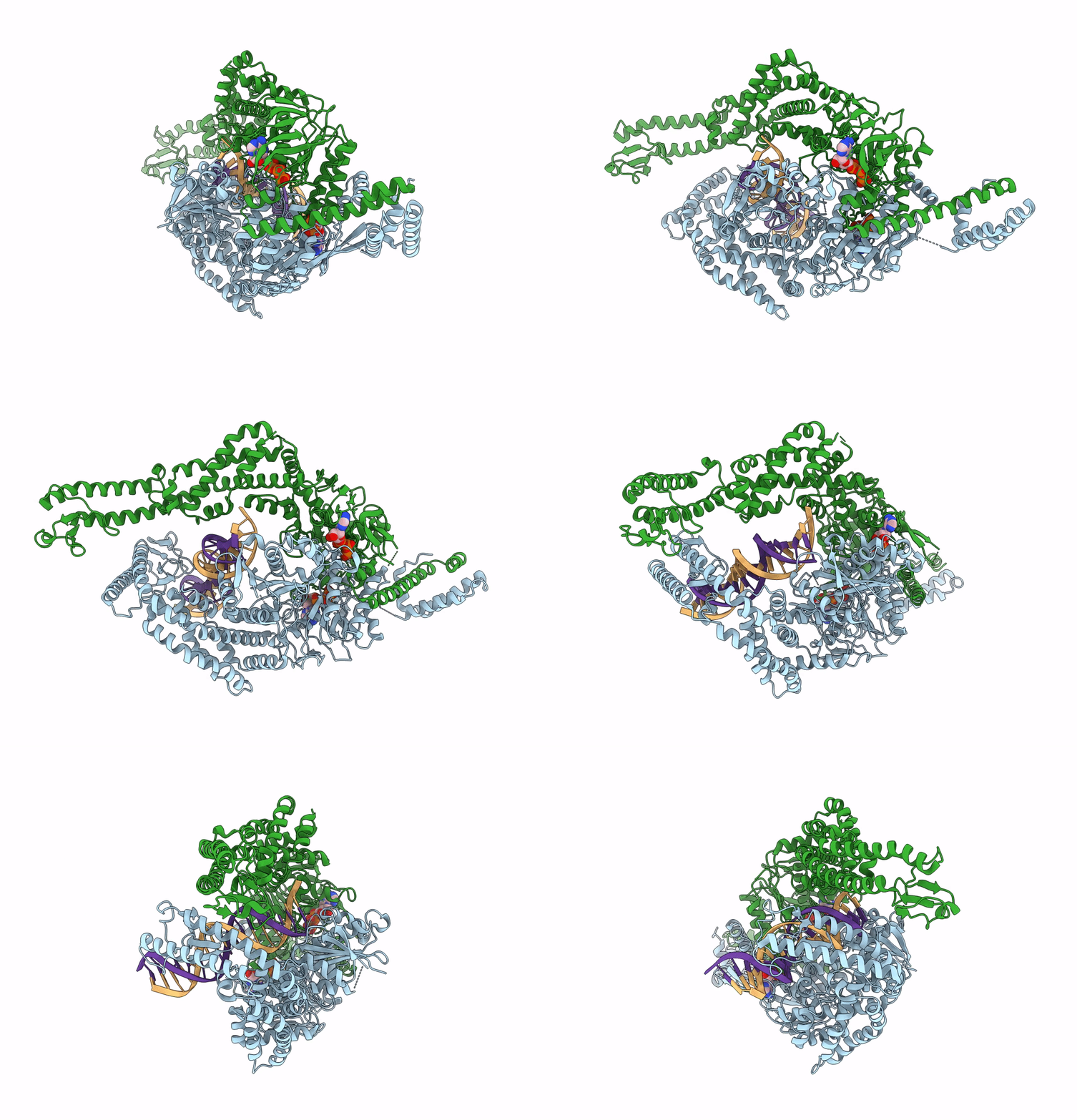
8OMA image
Deposition Date 2023-03-31
Release Date 2023-05-24
Last Version Date 2026-05-27
Entry Detail
PDB ID:
8OMA
Title:
MutSbeta bound to 61bp homoduplex DNA
Biological Source:
Source Organism(s):
Homo sapiens (Taxon ID: 9606)
Expression System(s):
Method Details:
Experimental Method:
Resolution:
3.29 Å
Aggregation State:
PARTICLE
Reconstruction Method:
SINGLE PARTICLE

Macromolecular Entities
Structures with similar UniProt ID
Protein Blast
Polymer Type:polypeptide(L)
Molecule:DNA mismatch repair protein M
Gene (Uniprot):MSH2
Chain IDs:C (auth: A)
Chain Length:934
Number of Molecules:1
Biological Source:Homo sapiens
Structures with similar UniProt ID
Protein Blast
Polymer Type:polypeptide(L)
Molecule:DNA mismatch repair protein M
Gene (Uniprot):MSH3
Chain IDs:D (auth: B)
Chain Length:1137
Number of Molecules:1
Biological Source:Homo sapiens
Polymer Type:polydeoxyribonucleotide
Molecule:DNA1
Chain IDs:A (auth: C)
Chain Length:17
Number of Molecules:1
Biological Source:Homo sapiens
Polymer Type:polydeoxyribonucleotide
Molecule:DNA2
Chain IDs:B (auth: D)
Chain Length:17
Number of Molecules:1
Biological Source:Homo sapiens
Primary Citation
Elucidation of multiple high-resolution states of human MutS beta by cryo-EM reveals interplay between ATP/ADP binding and heteroduplex DNA recognition.
Nucleic Acids Res. 53 ? ? (2025)
PMID: 40613711 DOI: 10.1093/nar/gkaf604

Abstact

Human and mouse genetic studies have demonstrated a role for DNA mismatch repair (MMR) molecular machines in modulating the rate of somatic expansion of the huntingtin (HTT) CAG repeats, and onset and progression of Huntington's Disease (HD). MutSbeta, a key component of the MMR pathway, is a heterodimeric protein of MSH2 and MSH3 that recognizes and initiates the repair of extrahelical DNA extrusions. Loss-of-function of mouse Msh3 and reduced-expression alleles of human MSH3 lead to slower rates of somatic expansion and delayed disease onset in humans, signifying MSH3 as a promising therapeutic target for HD. Here we report biochemical and cryo-electron microscopy analyses of human MutSbeta, demonstrating MutSbeta undergoes conformational changes induced by nucleotide and DNA binding. We present multiple conformations of MutSbeta including the DNA-free MutSbeta compatible with precisely complementary base-paired homoduplex DNA binding, two distinct structures of MutSbeta bound to (CAG)2 DNA, a sliding clamp form and a DNA-unbound, ATP-bound conformation. Along with evidence for novel conformational states adopted by MutSbeta to initiate the MMR cascade, these structures provide a foundation for structure-guided drug discovery.

Legend

Protein

Chemical

Disease

Primary Citation of related structures
Feedback Form
Name
Email
Institute
Feedback