

8KB7 image
Deposition Date 2023-08-04
Release Date 2024-08-07
Last Version Date 2026-09-23
Entry Detail
PDB ID:
8KB7
Keywords:
Title:
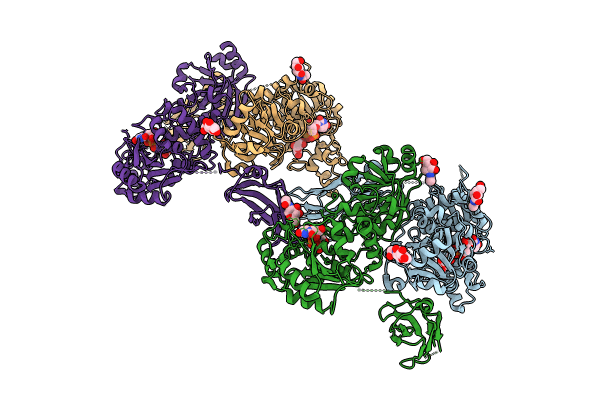
Crystal structure of UDP/mannose-bound AGO61/beta-1,4-N-Acetylglucosaminyltransferase 2 (POMGNT2)
Biological Source:
Source Organism(s):
Homo sapiens (Taxon ID: 9606)
Expression System(s):
Method Details:
Experimental Method:
Resolution:
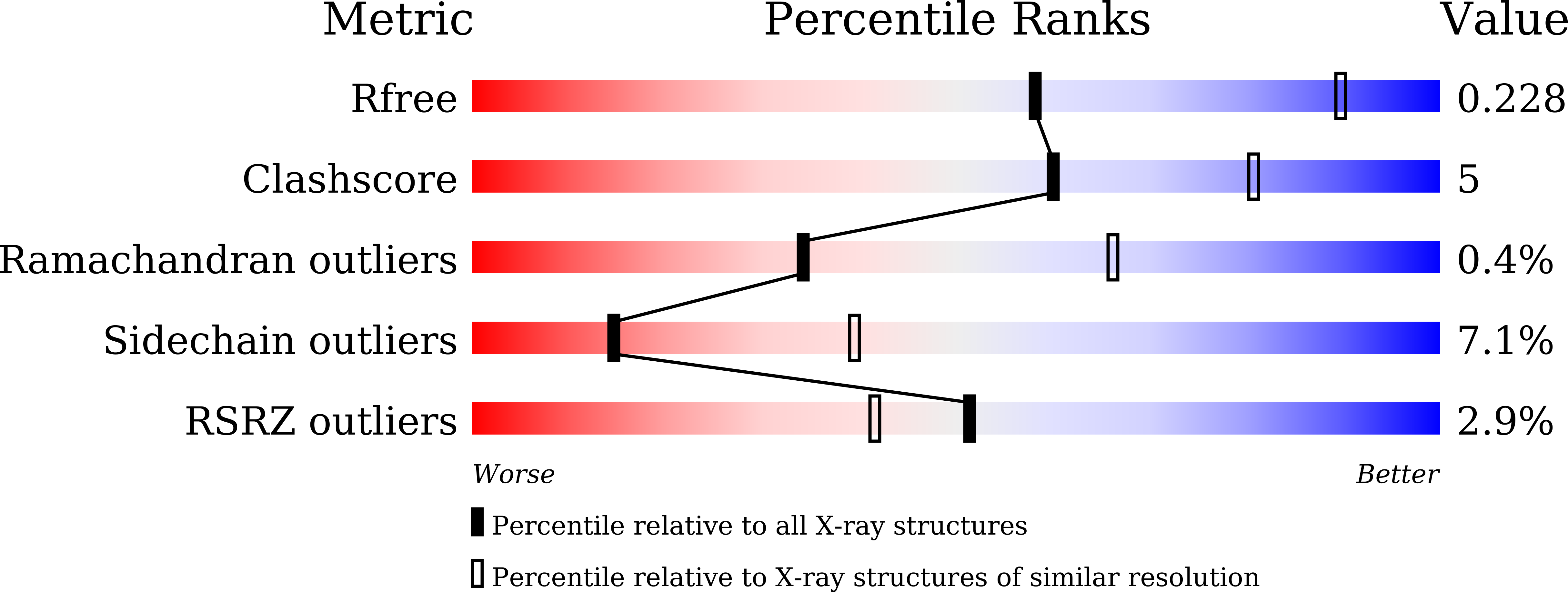
2.80 Å
R-Value Free:
0.22
R-Value Work:
0.19
R-Value Observed:
0.19
Space Group:
P 21 21 21
Macromolecular Entities
Polymer Type:polypeptide(L)
Molecule:Protein O-linked-mannose beta
Gene (Uniprot):POMGNT2
Chain IDs:A, B, C, D
Chain Length:0
Number of Molecules:4
Biological Source:Homo sapiens
Primary Citation
Dynamic Organizational Strategies of Multidomain Glycosyltransferases Revealed by High-Speed AFM and Solution Biophysics.
Int J Mol Sci 27 ? ? (2026)
PMID: 42511766 DOI: 10.3390/ijms27146423

Abstact

Glycosyltransferases often contain multiple structural modules that contribute to substrate recognition, catalytic coordination, and higher-order molecular organization. However, how multidomain glycosyltransferases dynamically organize their catalytic domains in solution remains poorly understood. Here, we investigated the assembly states and conformational dynamics of POMGNT2, LARGE1, K4CP, and L137 using high-speed atomic force microscopy (HS-AFM) integrated with complementary solution biophysical analyses. This multi-technique approach extends previous static structural studies by enabling a parallel comparison of solution-state dynamics among multiple glycosyltransferases. POMGNT2 formed a stable dimeric architecture with limited large-scale conformational fluctuation, consistent with its role in site-selective substrate recognition. In contrast, LARGE1 and K4CP exhibited concentration-dependent and heterogeneous assembly behavior. K4CP displayed pronounced open-closed interdomain motion and a tendency toward more compact conformations in the presence of substrate, suggesting dynamic catalytic-domain reorganization during glycan elongation. By comparison, the mimivirus glycosyltransferase candidate L137 predominantly behaved as a monomeric species under the tested conditions. These findings demonstrate that multidomain glycosyltransferases employ diverse dynamic organizational strategies ranging from rigid recognition architectures to highly flexible and reversible catalytic assemblies. Our results further suggest that glycosyltransferase function is governed not only by catalytic-domain structure, but also by dynamic conformational coordination adapted to distinct catalytic demands.

Legend

Protein

Chemical

Disease

Primary Citation of related structures
Feedback Form
Name
Email
Institute
Feedback