

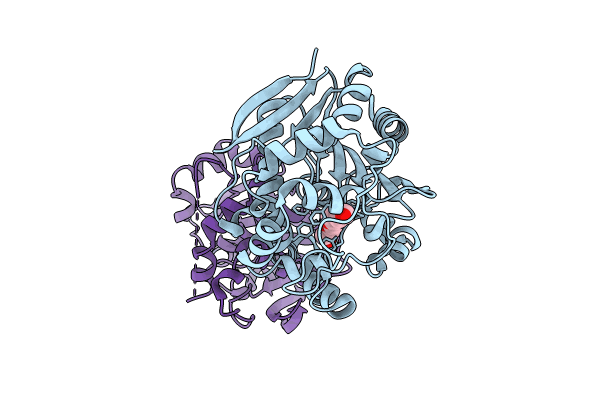
8JY1 image
Deposition Date 2023-07-02
Release Date 2024-08-07
Last Version Date 2026-02-25
Entry Detail
PDB ID:
8JY1
Keywords:
Title:
Structure of Mangifera Indica Epoxide hydrolase 2
Biological Source:
Source Organism(s):
Expression System(s):
Method Details:
Experimental Method:
Resolution:
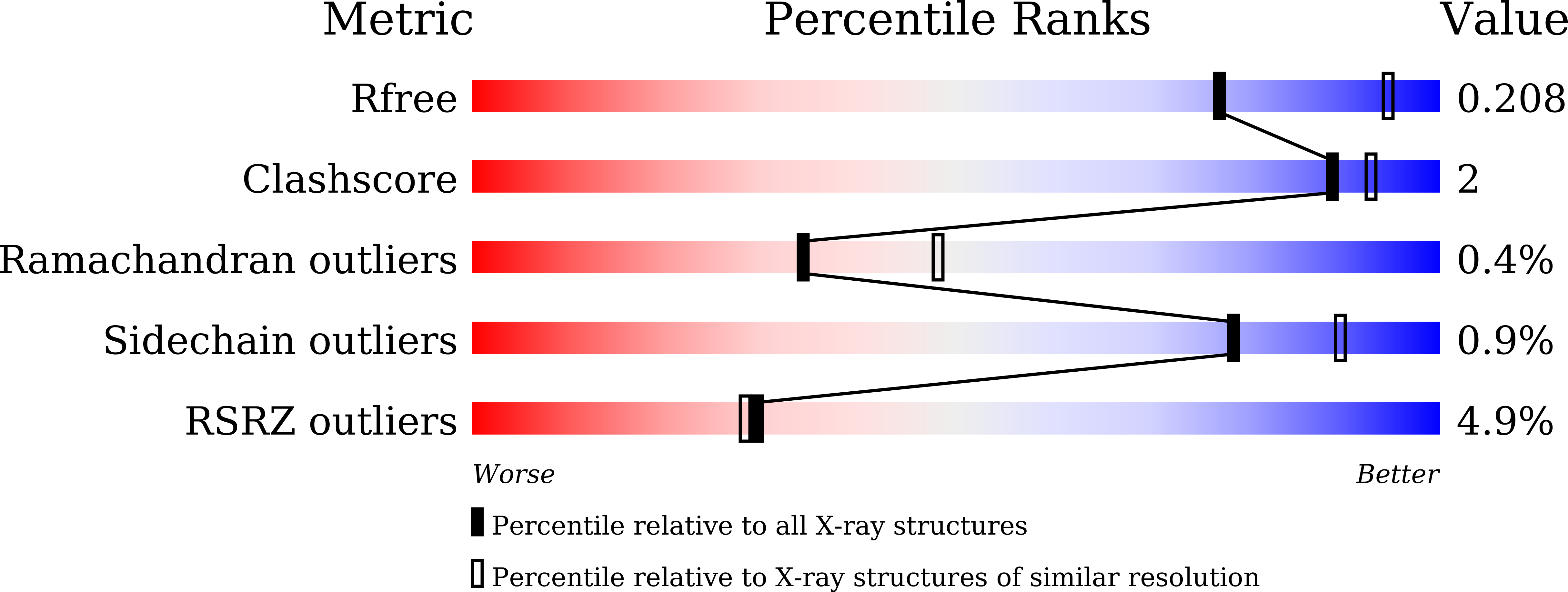
2.40 Å
R-Value Free:
0.20
R-Value Work:
0.17
R-Value Observed:
0.17
Space Group:
P 43 21 2
Macromolecular Entities
Structures with similar UniProt ID
Protein Blast
Polymer Type:polypeptide(L)
Molecule:Epoxide hydrolase-2
Gene (Uniprot):EH2
Chain IDs:A, B
Chain Length:324
Number of Molecules:2
Biological Source:Mangifera indica
Ligand Molecules
Primary Citation
Structure of epoxide hydrolase 2 from Mangifera indica throws light on the substrate specificity determinants of plant epoxide hydrolases
Biochem.Biophys.Res.Commun. 733 150444 150444 (2024)
PMID: 39067247 DOI: 10.1016/j.bbrc.2024.150444

Abstact

Epoxide hydrolases (EHs) are a group of ubiquitous enzymes that catalyze hydrolysis of chemically reactive epoxides to yield corresponding dihydrodiols. Despite extensive studies on EHs from different clades, generic rules governing their substrate specificity determinants have remained elusive. Here, we present structural, biochemical and molecular dynamics simulation studies on MiEH2, a plant epoxide hydrolase from Mangifera indica. Comparative structure-function analysis of nine homologs of MiEH2, which include a few AlphaFold structural models, show that the two conserved tyrosines (MiEH2(Y152) and MiEH2(Y232)) from the lid domain dissect substrate binding tunnel into two halves, forming substrate-binding-pocket one (BP1) and two (BP2). This compartmentalization offers diverse binding modes to their substrates, as exemplified by the binding of smaller aromatic substrates, such as styrene oxide (SO). Docking and molecular dynamics simulations reveal that the linear epoxy fatty acid substrates predominantly occupy BP1, while the aromatic substrates can bind to either BP1 or BP2. Furthermore, SO preferentially binds to BP2, by stacking against catalytically important histidine (MiEH2(H297)) with the conserved lid tyrosines engaging its epoxide oxygen. Residue (MiEH2(L263)) next to the catalytic aspartate (MiEH2(D262)) modulates substrate binding modes. Thus, the divergent binding modes correlate with the differential affinities of the EHs for their substrates. Furthermore, long-range dynamical coupling between the lid and core domains critically influences substrate enantioselectivity in plant EHs.

Legend

Protein

Chemical

Disease

Primary Citation of related structures
Feedback Form
Name
Email
Institute
Feedback