

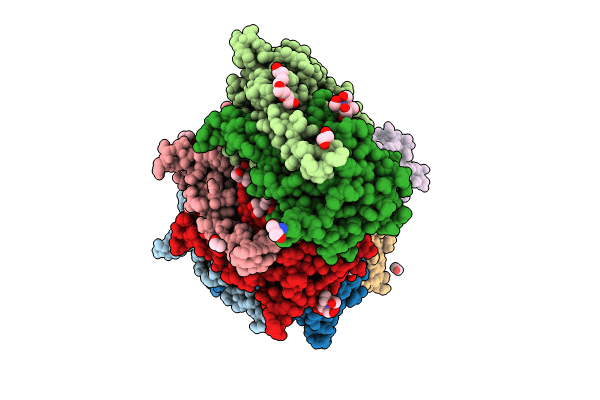
8F9X image
Deposition Date 2022-11-24
Release Date 2023-12-06
Last Version Date 2025-01-29
Entry Detail
PDB ID:
8F9X
Keywords:
Title:
Cyclase-Phosphotriesterase from Ruegeria pomeroyi DSS-3
Biological Source:
Source Organism(s):
Expression System(s):
Method Details:
Experimental Method:
Resolution:
2.32 Å
R-Value Free:
0.25
R-Value Work:
0.21
R-Value Observed:
0.23
Space Group:
P 32

Macromolecular Entities
Structures with similar UniProt ID
Protein Blast
Polymer Type:polypeptide(L)
Molecule:Cyclase family protein
Gene (Uniprot):SPO0761
Chain IDs:A, B, C, D, E, F, G, H, I, J
Chain Length:230
Number of Molecules:10
Biological Source:Ruegeria pomeroyi DSS-3
Primary Citation
A Thermostable Bacterial Metallohydrolase that Degrades Organophosphate Plasticizers.
Chembiochem 26 e202500055 e202500055 (2025)
PMID: 40364453 DOI: 10.1002/cbic.202500055

Abstact

A cyclase-phosphotriesterase (C-PTE) from Ruegeria pomeroyi DSS-3 has recently been identified for its capacity to detoxify several organophosphate compounds. However, several aspects of this enzyme remain unexplored, such as its activity with industrial organophosphates, its molecular structure, and its thermostability. In this work, the crystal structure of C-PTE is reported, which is solved to 2.3 Å resolution, providing insight into the enzyme's mechanism of action, revealing a binuclear Zn2+ active site and distant similarity to other phosphotriesterases from the amidohydrolase superfamily. It is shown that C-PTE catalyzes the hydrolysis of the OP plasticizers triphenyl phosphate (TPhP) and tris(2-chloropropyl) phosphate (TCPP), albeit with low efficiency, but not the sterically bulkier tri-o-tolyl phosphate (ToTP). Finally, it is demonstrated that, even though Ruegeria pomeroyi DSS-3 is not a thermophile, C-PTE exhibits remarkable thermostability and retains structure up to 90 °C. Overall, these findings advance the understanding of C-PTE, suggesting that it is a good candidate for engineering owing to its thermostability and that it could contribute to bioremediation strategies to reduce the impact of pollution by industrial organophosphates.

Legend

Protein

Chemical

Disease

Primary Citation of related structures
Feedback Form
Name
Email
Institute
Feedback