

7XBR image
Deposition Date 2022-03-22
Release Date 2023-02-08
Last Version Date 2024-10-16
Entry Detail
PDB ID:
7XBR
Keywords:
Title:
Crystal structure of phosphorylated AtMKK5
Biological Source:
Source Organism(s):
Expression System(s):
Method Details:
Experimental Method:
Resolution:
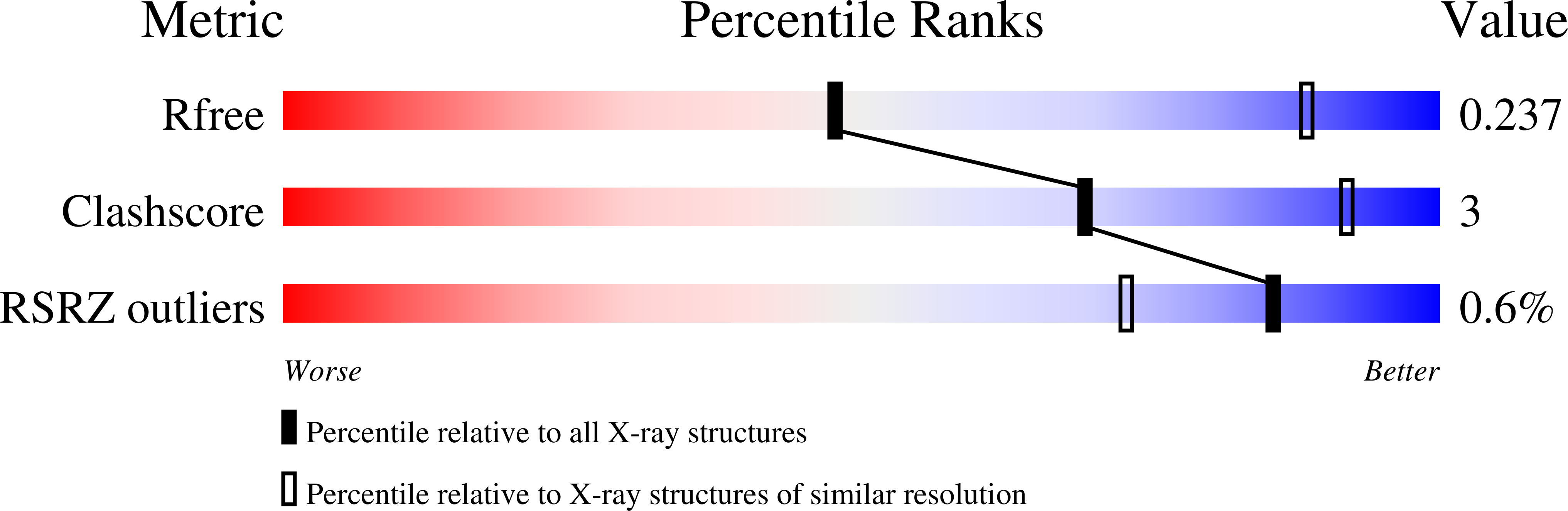
3.20 Å
R-Value Free:
0.24
R-Value Work:
0.20
R-Value Observed:
0.21
Space Group:
P 21 21 21
Macromolecular Entities
Polymer Type:polypeptide(L)
Molecule:Mitogen-activated protein kin
Gene (Uniprot):MKK5
Chain IDs:A, B, C, D, E, G
Chain Length:295
Number of Molecules:6
Biological Source:Arabidopsis thaliana
Polymer Type:polypeptide(L)
Molecule:Mitogen-activated protein kin
Gene (Uniprot):MKK5
Chain IDs:F, H
Chain Length:295
Number of Molecules:2
Biological Source:Arabidopsis thaliana
Modified Residue
Compound ID Chain ID Parent Comp ID Details 2D Image
SEP A SER modified residue
TPO A THR modified residue
Ligand Molecules
Primary Citation
Crystal structure of the phosphorylated Arabidopsis MKK5 reveals activation mechanism of MAPK kinases.
Acta Biochim. Biophys. Sin. (Shanghai) 54 1159 1170 (2022)
PMID: 35866601 DOI: 10.3724/abbs.2022089

Abstact

The mitogen-activated protein kinase (MAPK) signaling pathways are highly conserved in eukaryotes, regulating various cellular processes. The MAPK kinases (MKKs) are dual specificity kinases, serving as convergence and divergence points of the tripartite MAPK cascades. Here, we investigate the biochemical characteristics and three-dimensional structure of MKK5 in Arabidopsis (AtMKK5). The recombinant full-length AtMKK5 is phosphorylated and can activate its physiological substrate AtMPK6. There is a conserved kinase interacting motif (KIM) at the N-terminus of AtMKK5, indispensable for specific recognition of AtMPK6. The kinase domain of AtMKK5 adopts active conformation, of which the extended activation segment is stabilized by the phosphorylated Ser221 and Thr215 residues. In line with sequence divergence from other MKKs, the αD and αK helices are missing in AtMKK5, suggesting that the AtMKK5 may adopt distinct modes of upstream kinase/substrate binding. Our data shed lights on the molecular mechanisms of MKK activation and substrate recognition, which may help design specific inhibitors targeting human and plant MKKs.

Legend

Protein

Chemical

Disease

Primary Citation of related structures
Feedback Form
Name
Email
Institute
Feedback