

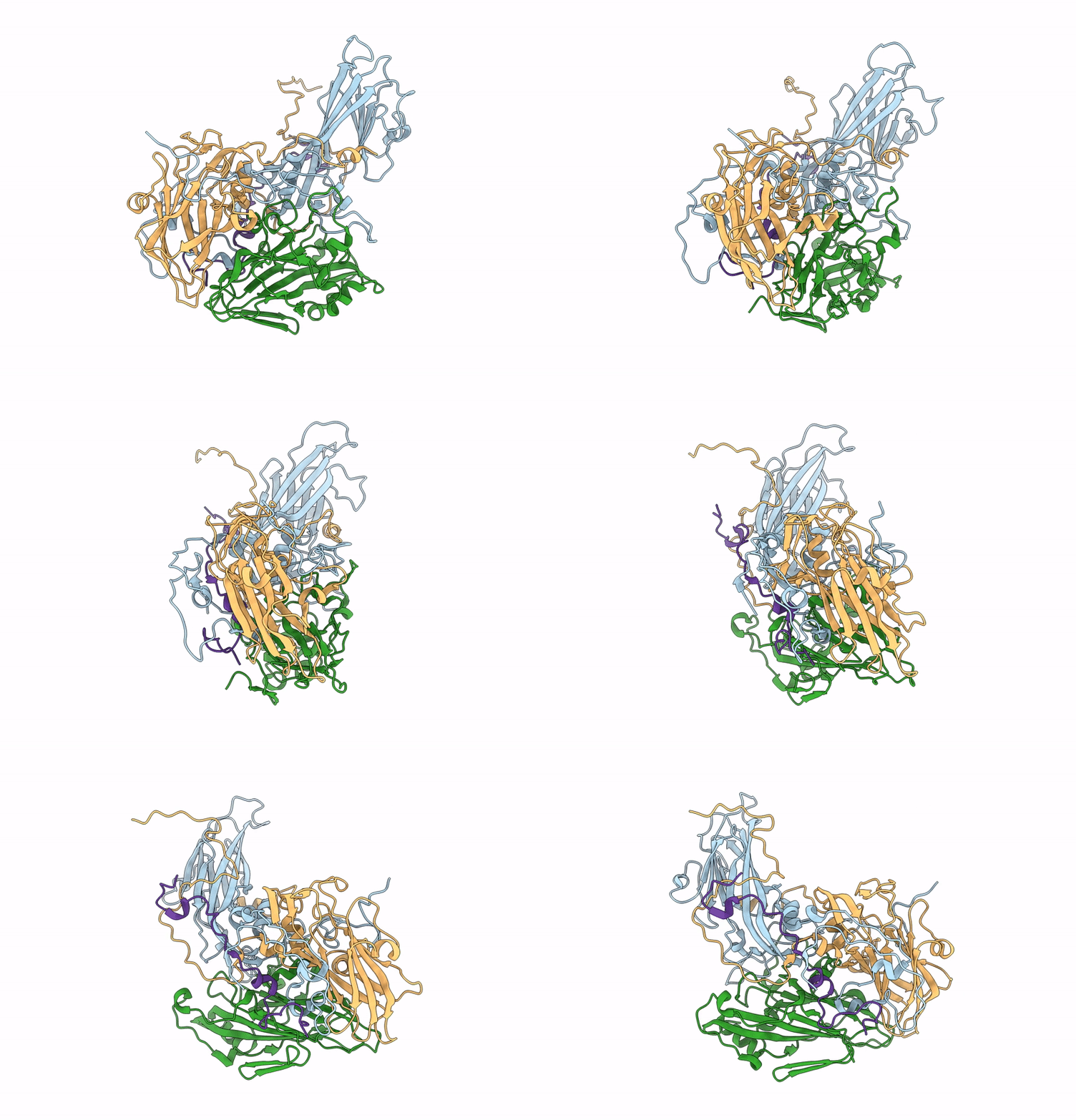
7TAJ image
Deposition Date 2021-12-20
Release Date 2023-01-25
Last Version Date 2026-03-25
Entry Detail
PDB ID:
7TAJ
Keywords:
Title:
Cryo-EM structure of Human Enterovirus D68 US/MO/14-18947 strain in complex with inhibitor 11526093 (no/low occupancy-no inhibitor modeled)
Biological Source:
Source Organism(s):
Method Details:
Experimental Method:
Resolution:
2.00 Å
Aggregation State:
PARTICLE
Reconstruction Method:
SINGLE PARTICLE
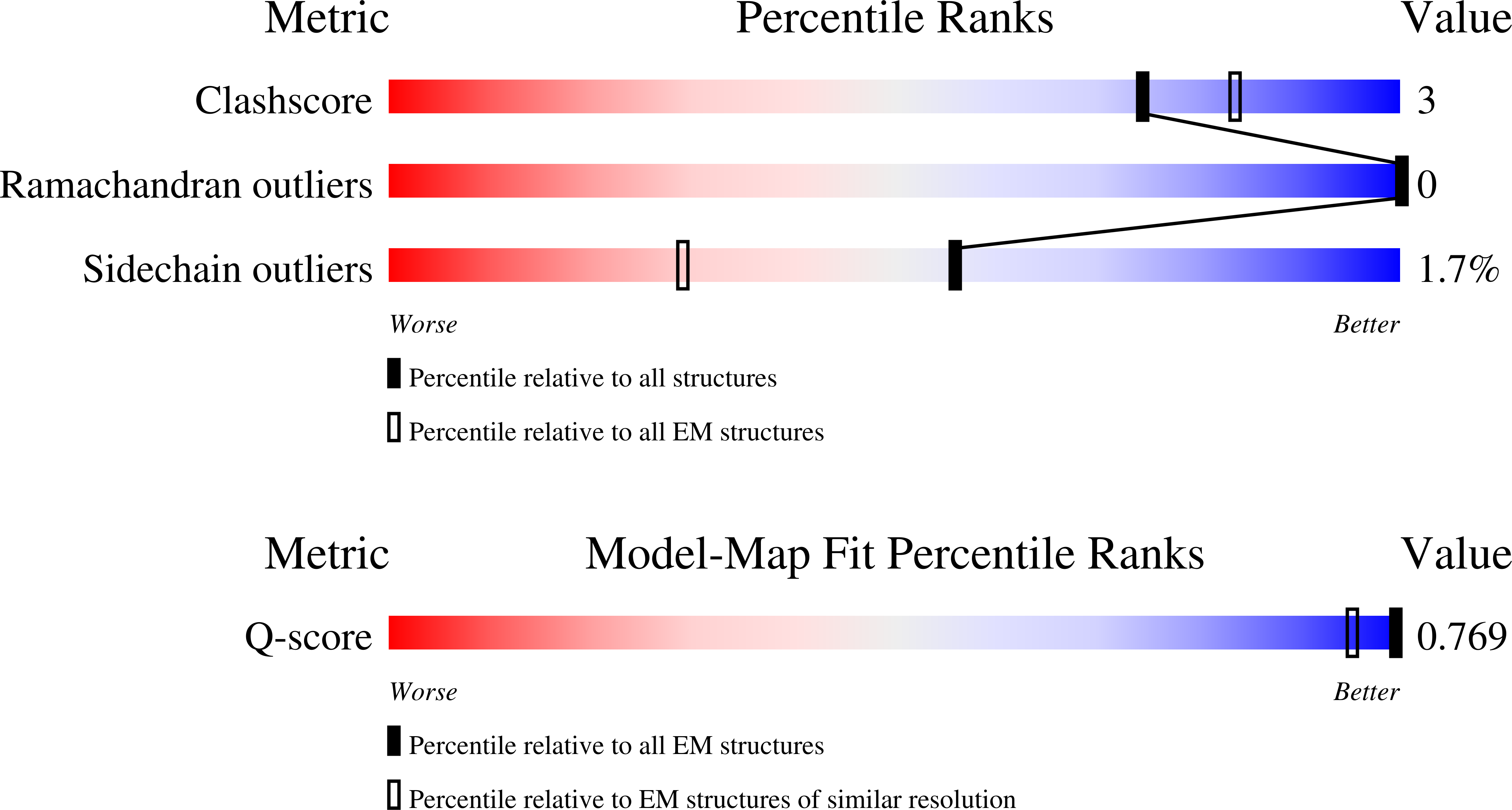
Macromolecular Entities
Structures with similar UniProt ID
Protein Blast
Polymer Type:polypeptide(L)
Molecule:viral protein 1
Chain IDs:A
Chain Length:296
Number of Molecules:1
Biological Source:enterovirus D68
Structures with similar UniProt ID
Protein Blast
Polymer Type:polypeptide(L)
Molecule:viral protein 2
Chain IDs:C (auth: B)
Chain Length:238
Number of Molecules:1
Biological Source:enterovirus D68
Structures with similar UniProt ID
Protein Blast
Polymer Type:polypeptide(L)
Molecule:viral protein 3
Chain IDs:B (auth: C)
Chain Length:247
Number of Molecules:1
Biological Source:enterovirus D68
Structures with similar UniProt ID
Protein Blast
Polymer Type:polypeptide(L)
Molecule:viral protein 4
Chain IDs:D
Chain Length:68
Number of Molecules:1
Biological Source:enterovirus D68
Ligand Molecules
Primary Citation
Efficacy of an isoxazole-3-carboxamide analog of pleconaril in mouse models of Enterovirus-D68 and Coxsackie B5.
Antiviral Res. 216 105654 105654 (2023)
PMID: 37327878 DOI: 10.1016/j.antiviral.2023.105654

Abstact

Enteroviruses (EV) cause a number of life-threatening infectious diseases. EV-D68 is known to cause respiratory illness in children that can lead to acute flaccid myelitis. Coxsackievirus B5 (CVB5) is commonly associated with hand-foot-mouth disease. There is no antiviral treatment available for either. We have developed an isoxazole-3-carboxamide analog of pleconaril (11526092) which displayed potent inhibition of EV-D68 (IC(50) 58 nM) as well as other enteroviruses including the pleconaril-resistant Coxsackievirus B3-Woodruff (IC(50) 6-20 nM) and CVB5 (EC(50) 1 nM). Cryo-electron microscopy structures of EV-D68 in complex with 11526092 and pleconaril demonstrate destabilization of the EV-D68 MO strain VP1 loop, and a strain-dependent effect. A mouse respiratory model of EV-D68 infection, showed 3-log decreased viremia, favorable cytokine response, as well as statistically significant 1-log reduction in lung titer reduction at day 5 after treatment with 11526092. An acute flaccid myelitis neurological infection model did not show efficacy. 11526092 was tested in a mouse model of CVB5 infection and showed a 4-log TCID(50) reduction in the pancreas. In summary, 11526092 represents a potent in vitro inhibitor of EV with in vivo efficacy in EV-D68 and CVB5 animal models suggesting it is worthy of further evaluation as a potential broad-spectrum antiviral therapeutic against EV.

Legend

Protein

Chemical

Disease

Primary Citation of related structures
Feedback Form
Name
Email
Institute
Feedback