

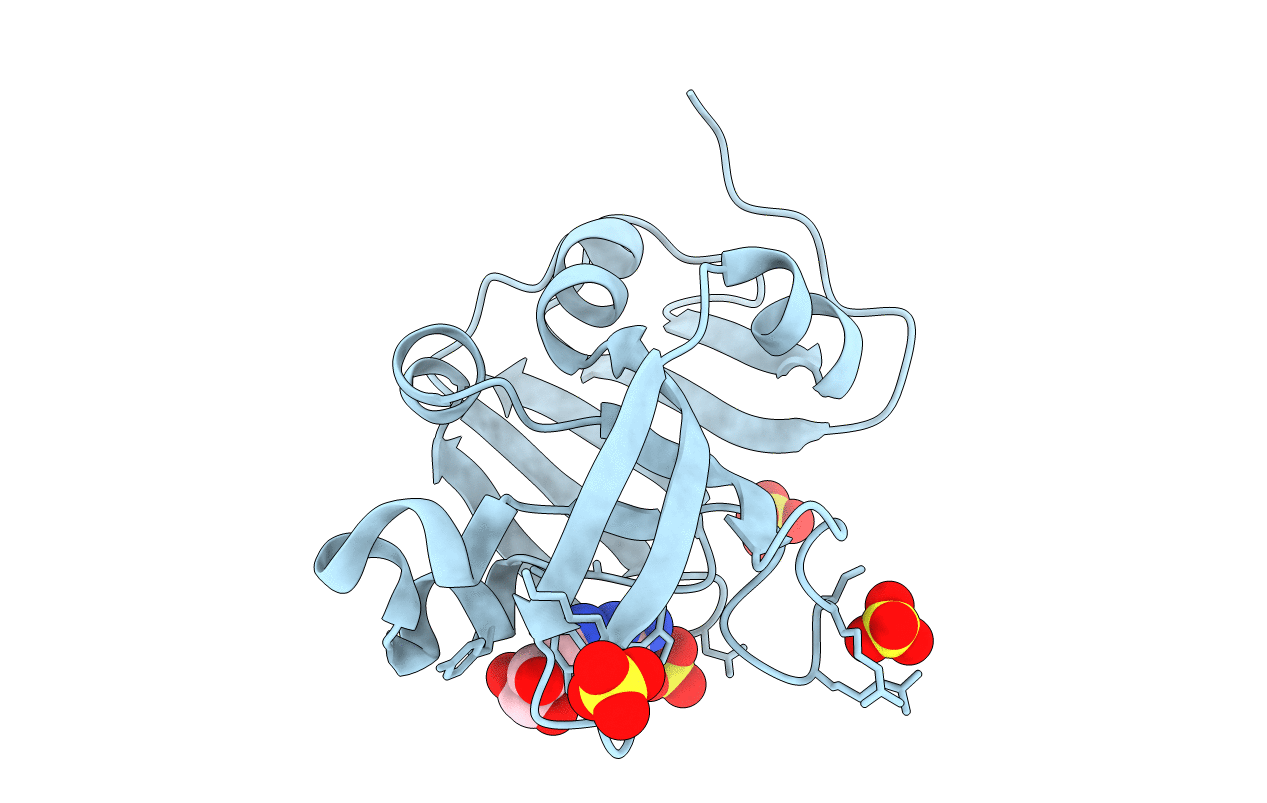
7RKB image
Deposition Date 2021-07-22
Release Date 2022-08-10
Last Version Date 2026-04-01
Entry Detail
PDB ID:
7RKB
Title:
Crystal Structure of Putative Pterin Binding Protein (PruR) from Klebsiella pneumoniae in Complex with Neopterin
Biological Source:
Expression System(s):
Method Details:
Experimental Method:
Resolution:
2.50 Å
R-Value Free:
0.23
R-Value Work:
0.18
R-Value Observed:
0.19
Space Group:
P 41 21 2

Macromolecular Entities
Polymer Type:polypeptide(L)
Molecule:Pterin Binding Protein
Chain IDs:A
Chain Length:149
Number of Molecules:1
Biological Source:Klebsiella pneumoniae subsp. pneumoniae SA1
Modified Residue
Compound ID Chain ID Parent Comp ID Details 2D Image
MSE A MET modified residue
Primary Citation
Control of biofilm formation by an Agrobacterium tumefaciens pterin-binding periplasmic protein conserved among diverse Proteobacteria.
Proc. Natl. Acad. Sci. U.S.A. 121 e2319903121 e2319903121 (2024)
PMID: 38870058 DOI: 10.1073/pnas.2319903121

Abstact

Biofilm formation and surface attachment in multiple Alphaproteobacteria is driven by unipolar polysaccharide (UPP) adhesins. The pathogen Agrobacterium tumefaciens produces a UPP adhesin, which is regulated by the intracellular second messenger cyclic diguanylate monophosphate (c-di-GMP). Prior studies revealed that DcpA, a diguanylate cyclase-phosphodiesterase, is crucial in control of UPP production and surface attachment. DcpA is regulated by PruR, a protein with distant similarity to enzymatic domains known to coordinate the molybdopterin cofactor (MoCo). Pterins are bicyclic nitrogen-rich compounds, several of which are produced via a nonessential branch of the folate biosynthesis pathway, distinct from MoCo. The pterin-binding protein PruR controls DcpA activity, fostering c-di-GMP breakdown and dampening its synthesis. Pterins are excreted, and we report here that PruR associates with these metabolites in the periplasm, promoting interaction with the DcpA periplasmic domain. The pteridine reductase PruA, which reduces specific dihydro-pterin molecules to their tetrahydro forms, imparts control over DcpA activity through PruR. Tetrahydromonapterin preferentially associates with PruR relative to other related pterins, and the PruR-DcpA interaction is decreased in a pruA mutant. PruR and DcpA are encoded in an operon with wide conservation among diverse Proteobacteria including mammalian pathogens. Crystal structures reveal that PruR and several orthologs adopt a conserved fold, with a pterin-specific binding cleft that coordinates the bicyclic pterin ring. These findings define a pterin-responsive regulatory mechanism that controls biofilm formation and related c-di-GMP-dependent phenotypes in A. tumefaciens and potentially acts more widely in multiple proteobacterial lineages.

Legend

Protein

Chemical

Disease

Primary Citation of related structures
Feedback Form
Name
Email
Institute
Feedback