

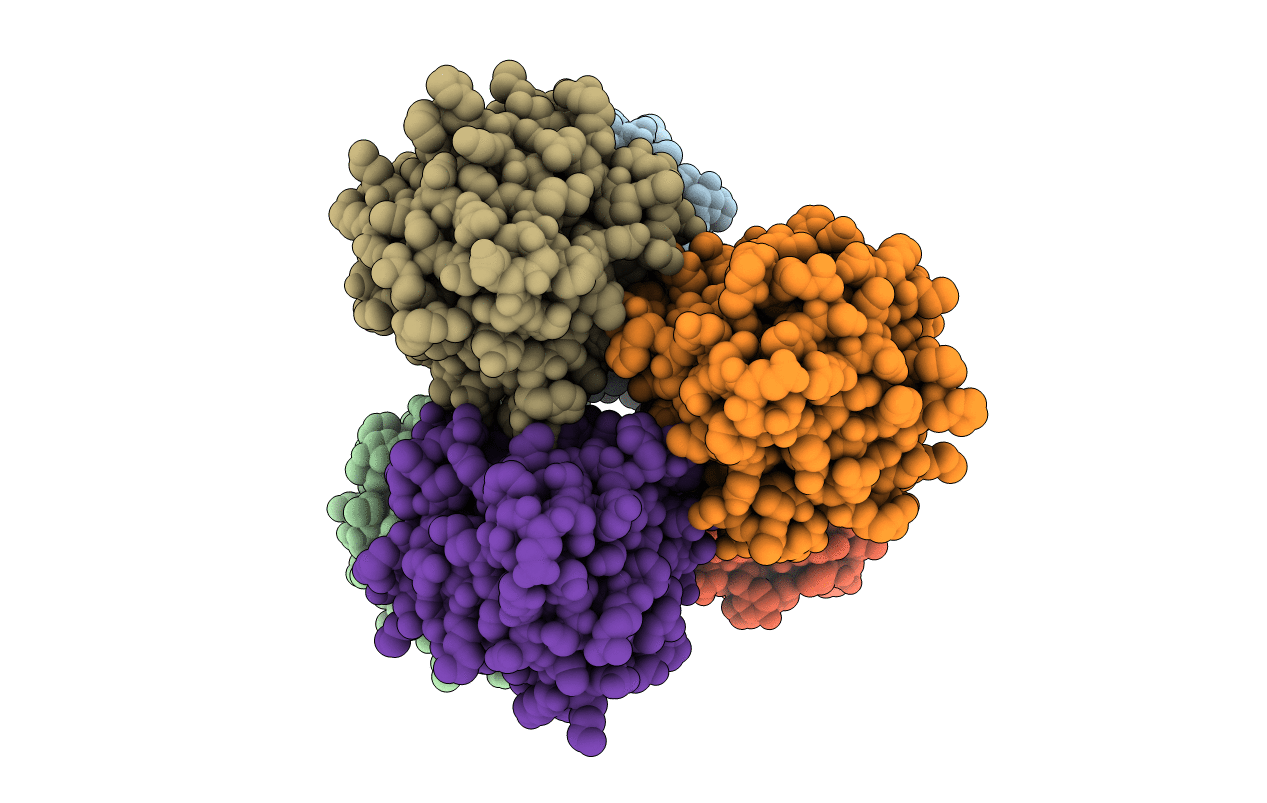
7OBP image
Deposition Date 2021-04-23
Release Date 2021-07-14
Last Version Date 2024-01-31
Entry Detail
PDB ID:
7OBP
Title:
Crystal structure of the human NCOA7-AS TLDc domain
Biological Source:
Source Organism(s):
Homo sapiens (Taxon ID: 9606)
Expression System(s):
Method Details:
Experimental Method:
Resolution:
1.80 Å
R-Value Free:
0.22
R-Value Work:
0.17
R-Value Observed:
0.17
Space Group:
P 21 21 21
Macromolecular Entities
Structures with similar UniProt ID
Protein Blast
Polymer Type:polypeptide(L)
Molecule:NCOA7-AS
Chain IDs:A, B, C, D, E, F
Chain Length:168
Number of Molecules:6
Biological Source:Homo sapiens
Primary Citation
Crystal structure of the TLDc domain of human NCOA7-AS.
Acta Crystallogr. Sect. F Struct. Biol. Cryst. Commun. 77 230 237 (2021)
PMID: 34341188 DOI: 10.1107/S2053230X21006853

Abstact

The TLDc [Tre2/Bub2/Cdc16 (TBC), lysin motif (LysM), domain catalytic] domain is associated with oxidation-resistance related functions and is well conserved among eukaryotes. Seven proteins possess a TLDc domain in humans, notably proteins belonging to the oxidation resistance protein (OXR), nuclear receptor coactivator 7 (NCOA7) and TBC1 domain family member 24 (TBC1D24) families. Although the mechanism is unknown, a protective role of TLDc proteins against oxidative stress, notably in the brain, has been demonstrated. Neurobiological disorders caused by mutations in the TLDc domain have also been reported. The human NCOA7 gene encodes several mRNA isoforms; among these, isoform 4, named NCOA7-AS, is up-regulated by type 1 interferon in response to viral infection. NCOA7 and NCOA7-AS both interact with several subunits of the vacuolar proton pump V-ATPase, which leads to increased acidification of the endolysosomal system and consequently impairs infection by viruses that enter their host cells through the endosomal pathway, such as influenza A virus and hepatitis C virus. Similarly to full-length NCOA7, NCOA7-AS possesses a TLDc domain in its C-terminus. Structures of TLDc domains have been reported from zebrafish and fly but not from humans. Here, the expression, purification and crystallization of the TLDc domain from NCOA7 and NCOA7-AS is reported. The crystal structure solved at 1.8 Å resolution is compared with previously solved three-dimensional structures of TLDc domains.

Legend

Protein

Chemical

Disease

Primary Citation of related structures
Feedback Form
Name
Email
Institute
Feedback