

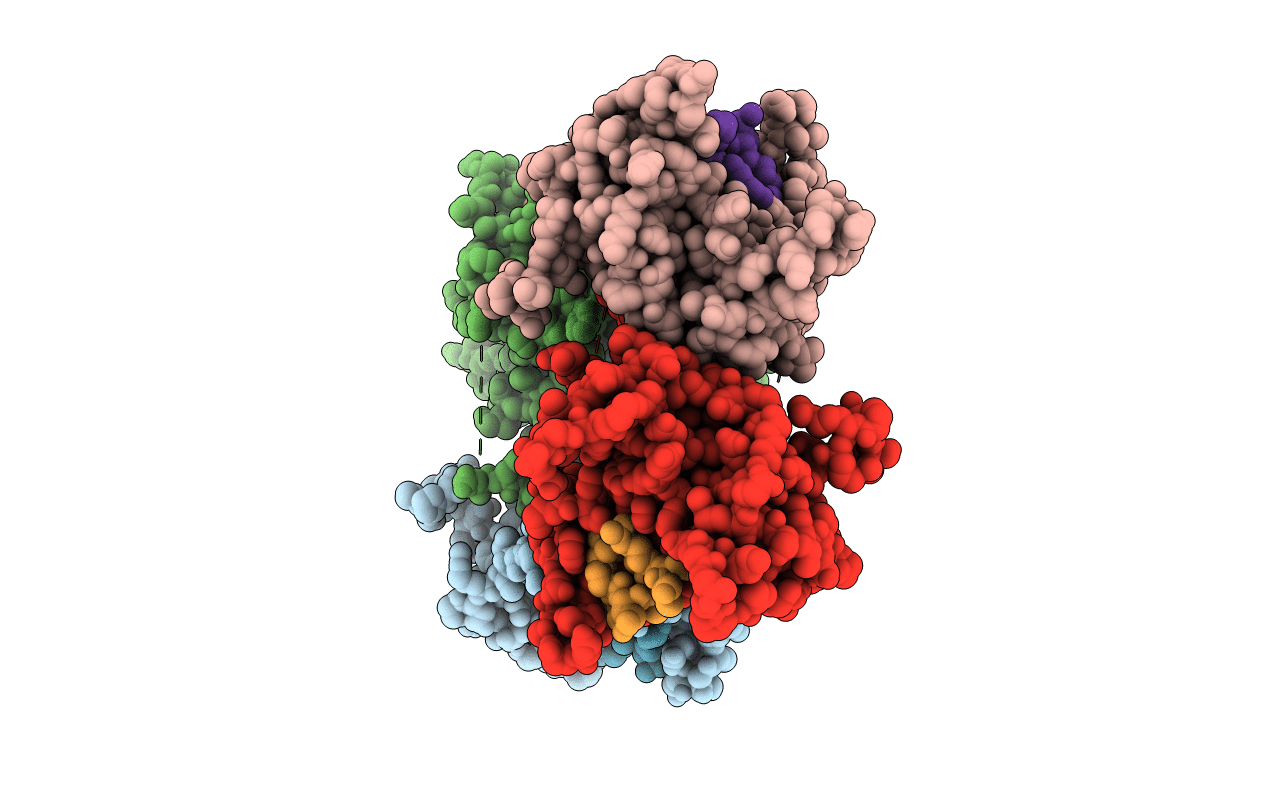
7BQZ image
Deposition Date 2020-03-26
Release Date 2020-10-14
Last Version Date 2023-11-29
Entry Detail
PDB ID:
7BQZ
Keywords:
Title:
Crystal Structure of Spindlin1 bound to H3(K4me3-K9me3) peptide
Biological Source:
Source Organism(s):
Homo sapiens (Taxon ID: 9606)
Expression System(s):
Method Details:
Experimental Method:
Resolution:
3.10 Å
R-Value Free:
0.26
R-Value Work:
0.22
R-Value Observed:
0.22
Space Group:
P 1 21 1

Macromolecular Entities
Structures with similar UniProt ID
Protein Blast
Polymer Type:polypeptide(L)
Molecule:Spindlin-1
Gene (Uniprot):SPIN1
Chain IDs:A, C, E, G
Chain Length:220
Number of Molecules:4
Biological Source:Homo sapiens
Structures with similar UniProt ID
Protein Blast
Polymer Type:polypeptide(L)
Molecule:H3(K4me3-K9me3) peptide
Gene (Uniprot):H3C15, H3C14, H3C13
Chain IDs:B, D, F, H
Chain Length:15
Number of Molecules:4
Biological Source:Homo sapiens
Modified Residue
Compound ID Chain ID Parent Comp ID Details 2D Image
M3L B LYS modified residue
Ligand Molecules
Primary Citation
Molecular basis for histone H3 "K4me3-K9me3/2" methylation pattern readout by Spindlin1.
J. Biol. Chem. 295 16877 16887 (2020)
PMID: 32994220 DOI: 10.1074/jbc.RA120.013649

Abstact

Histone recognition by "reader" modules serves as a fundamental mechanism in epigenetic regulation. Previous studies have shown that Spindlin1 is a reader of histone H3K4me3 as well as "K4me3-R8me2a" and promotes transcription of rDNA or Wnt/TCF4 target genes. Here we show that Spindlin1 also acts as a potent reader of histone H3 "K4me3-K9me3/2" bivalent methylation pattern. Calorimetric titration revealed a binding affinity of 16 nm between Spindlin1 and H3 "K4me3-K9me3" peptide, which is one to three orders of magnitude stronger than most other histone readout events at peptide level. Structural studies revealed concurrent recognition of H3K4me3 and H3K9me3/2 by aromatic pockets 2 and 1 of Spindlin1, respectively. Epigenomic profiling studies showed that Spindlin1 colocalizes with both H3K4me3 and H3K9me3 peaks in a subset of genes enriched in biological processes of transcription and its regulation. Moreover, the distribution of Spindlin1 peaks is primarily associated with H3K4me3 but not H3K9me3, which suggests that Spindlin1 is a downstream effector of H3K4me3 generated in heterochromatic regions. Collectively, our work calls attention to an intriguing function of Spindlin1 as a potent H3 "K4me3-K9me3/2" bivalent mark reader, thereby balancing gene expression and silencing in H3K9me3/2-enriched regions.

Legend

Protein

Chemical

Disease

Primary Citation of related structures
Feedback Form
Name
Email
Institute
Feedback