

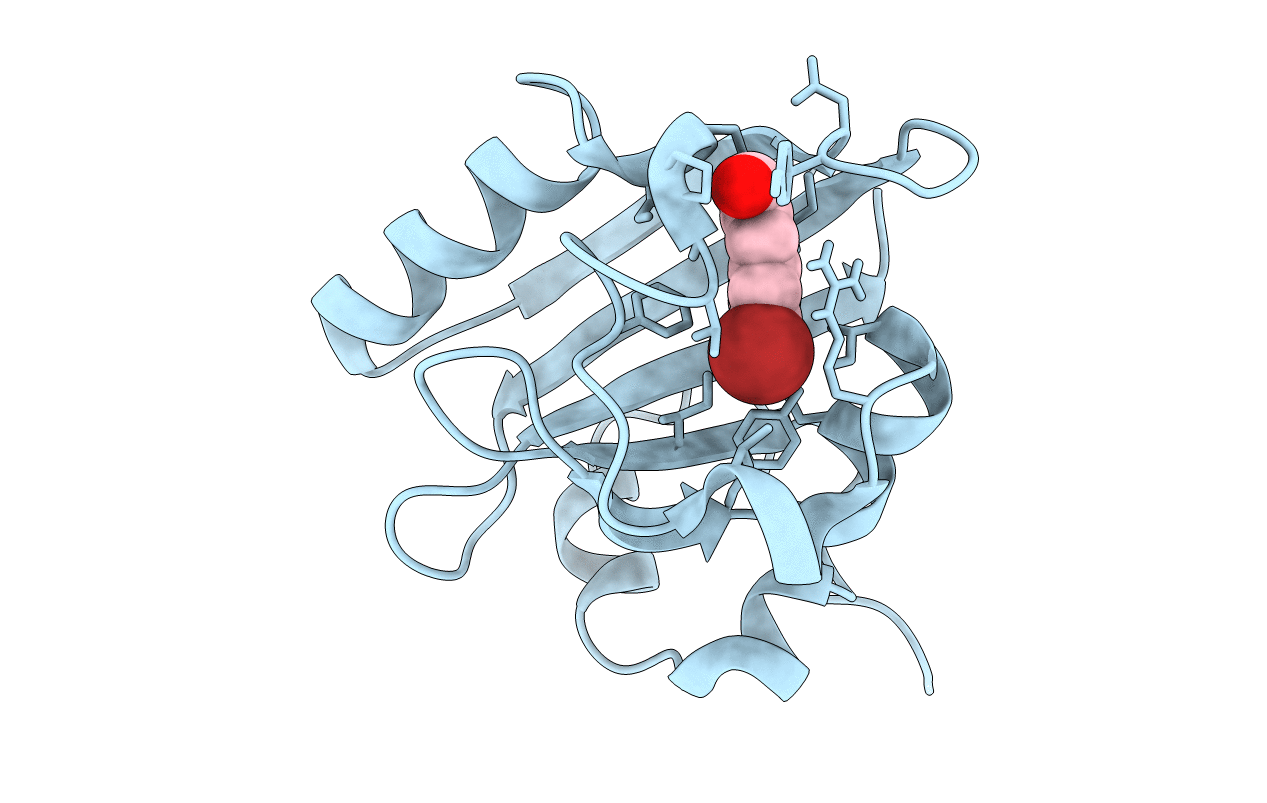
6UMZ image
Deposition Date 2019-10-10
Release Date 2020-07-15
Last Version Date 2024-11-13
Entry Detail
PDB ID:
6UMZ
Title:
Crystal structure of photoactive yellow protein (PYP); 3-Br-p-coumaric acid chromophore
Biological Source:
Source Organism(s):
Expression System(s):
Method Details:
Experimental Method:
Resolution:
0.90 Å
R-Value Free:
0.13
R-Value Work:
0.12
R-Value Observed:
0.12
Space Group:
P 63

Macromolecular Entities
Polymer Type:polypeptide(L)
Molecule:Photoactive yellow protein
Gene (Uniprot):pyp
Chain IDs:A
Chain Length:128
Number of Molecules:1
Biological Source:Halorhodospira halophila
Ligand Molecules
Primary Citation
Structural and spectroscopic characterization of photoactive yellow protein and photoswitchable fluorescent protein constructs containing heavy atoms.
J Photochem Photobiol A Chem 401 112738 ? (2020)
PMID: 32753830 DOI: 10.1016/j.jphotochem.2020.112738

Abstact

Photo-induced structural rearrangements of chromophore-containing proteins are essential for various light-dependent signaling pathways and optogenetic applications. Ultrafast structural and spectroscopic methods have offered insights into these structural rearrangements across many timescales. However, questions still remain about exact mechanistic details, especially regarding photoisomerization of the chromophore within these proteins femtoseconds to picoseconds after photoexcitation. Instrumentation advancements for time-resolved crystallography and ultrafast electron diffraction provide a promising opportunity to study these reactions, but achieving enough signal-to-noise is a constant challenge. Here we present four new photoactive yellow protein constructs and one new fluorescent protein construct that contain heavy atoms either within or around the chromophore and can be expressed with high yields. Structural characterization of these constructs, most at atomic resolution, show minimal perturbation caused by the heavy atoms compared to wild-type structures. Spectroscopic studies report the effects of the heavy atom identity and location on the chromophore's photophysical properties. None of the substitutions prevent photoisomerization, although certain rates within the photocycle may be affected. Overall, these new proteins containing heavy atoms are ideal samples for state-of-theart time-resolved crystallography and electron diffraction experiments to elucidate crucial mechanistic information of photoisomerization.

Legend

Protein

Chemical

Disease

Primary Citation of related structures
Feedback Form
Name
Email
Institute
Feedback