

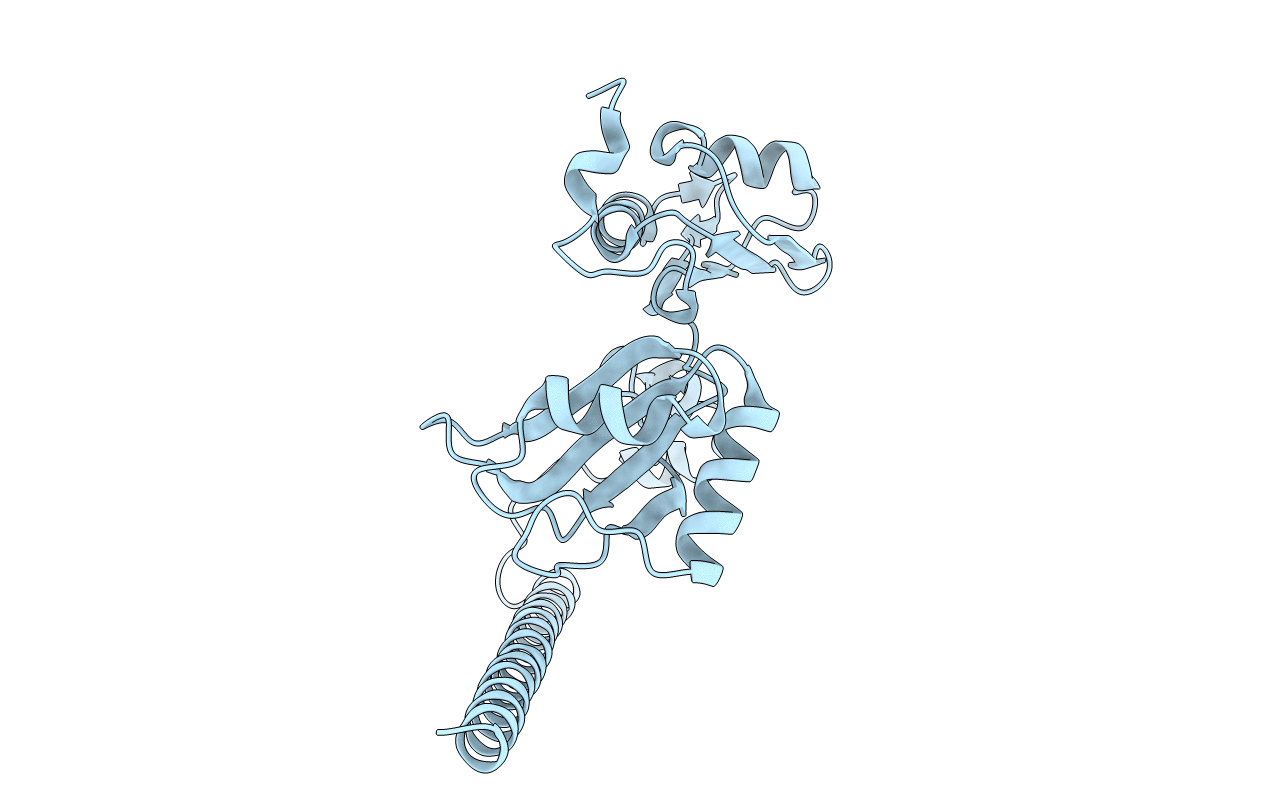
6NCQ image
Deposition Date 2018-12-12
Release Date 2019-06-26
Last Version Date 2023-10-11
Entry Detail
PDB ID:
6NCQ
Keywords:
Title:
The dimerization domain of human SFPQ in space group C2221
Biological Source:
Source Organism(s):
Homo sapiens (Taxon ID: 9606)
Expression System(s):
Method Details:
Experimental Method:
Resolution:
1.90 Å
R-Value Free:
0.24
R-Value Work:
0.20
R-Value Observed:
0.20
Space Group:
C 2 2 21

Macromolecular Entities
Polymer Type:polypeptide(L)
Molecule:Splicing factor, proline- and
Gene (Uniprot):SFPQ
Chain IDs:A
Chain Length:263
Number of Molecules:1
Biological Source:Homo sapiens
Primary Citation
A new crystal structure and small-angle X-ray scattering analysis of the homodimer of human SFPQ.
Acta Crystallogr. Sect. F Struct. Biol. Cryst. Commun. 75 439 449 (2019)
PMID: 31204691 DOI: 10.1107/S2053230X19006599

Abstact

Splicing factor proline/glutamine-rich (SFPQ) is an essential RNA-binding protein that is implicated in many aspects of nuclear function. The structures of SFPQ and two paralogs, non-POU domain-containing octamer-binding protein and paraspeckle component 1, from the Drosophila behavior human splicing protein family have previously been characterized. The unusual arrangement of the four domains, two RNA-recognition motifs (RRMs), a conserved region termed the NonA/paraspeckle (NOPS) domain and a C-terminal coiled coil, in the intertwined dimer provides a potentially unique RNA-binding surface. However, the molecular details of how the four RRMs in the dimeric SFPQ interact with RNA remain to be characterized. Here, a new crystal structure of the dimerization domain of human SFPQ in the C-centered orthorhombic space group C2221 with one monomer in the asymmetric unit is presented. Comparison of the new crystal structure with the previously reported structure of SFPQ and analysis of the solution small-angle X-scattering data revealed subtle domain movements in the dimerization domain of SFPQ, supporting the concept of multiple conformations of SFPQ in equilibrium in solution. The domain movement of RRM1, in particular, may reflect the complexity of the RNA substrates of SFPQ. Taken together, the crystal and solution structure analyses provide a molecular basis for further investigation into the plasticity of nucleic acid binding by SFPQ in the absence of the structure in complex with its cognate RNA-binding partners.

Legend

Protein

Chemical

Disease

Primary Citation of related structures
Feedback Form
Name
Email
Institute
Feedback