

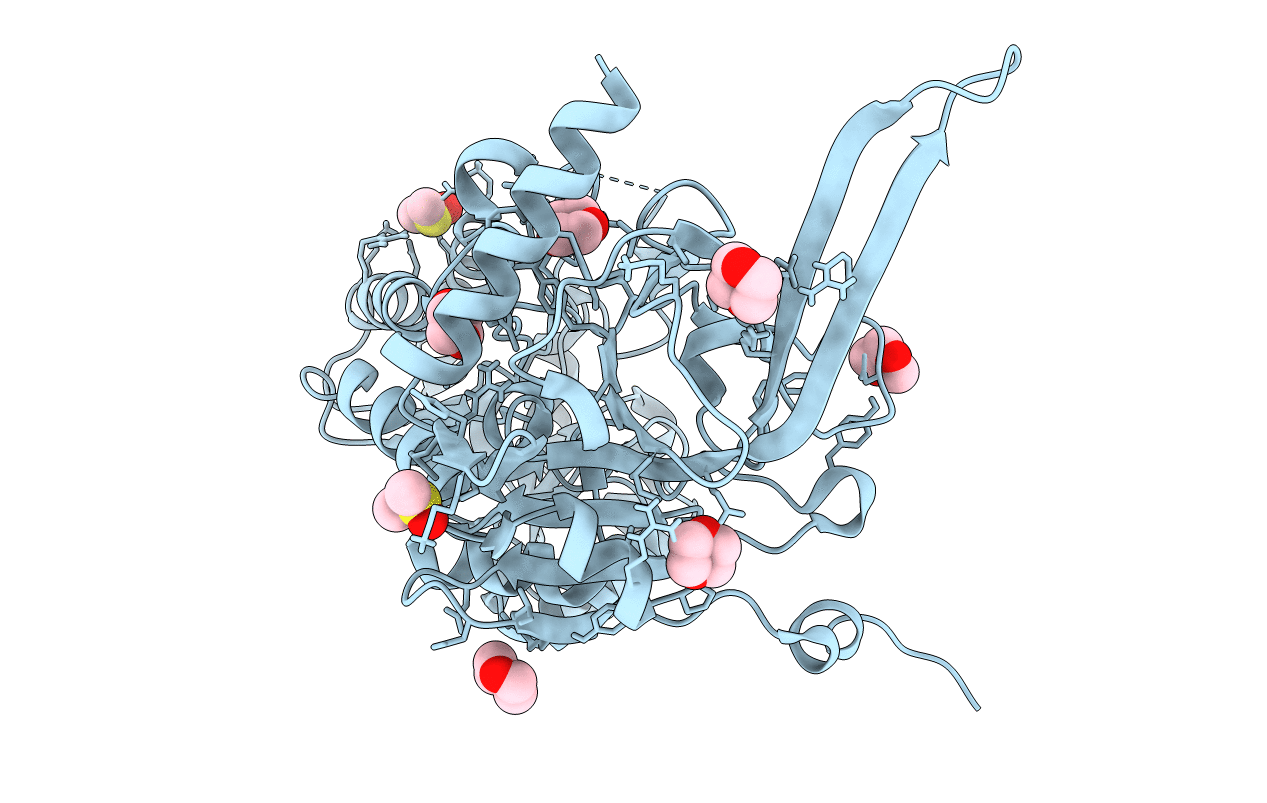
6N2H image
Deposition Date 2018-11-13
Release Date 2019-10-23
Last Version Date 2023-11-15
Entry Detail
PDB ID:
6N2H
Keywords:
Title:
Structure of D-ornithine/D-lysine decarboxylase from Salmonella typhimurium
Biological Source:
Source Organism(s):
Expression System(s):
Method Details:
Experimental Method:
Resolution:
1.72 Å
R-Value Free:
0.19
R-Value Work:
0.16
R-Value Observed:
0.16
Space Group:
C 1 2 1

Macromolecular Entities
Structures with similar UniProt ID
Protein Blast
Polymer Type:polypeptide(L)
Molecule:D-ornithine/D-lysine decarbox
Chain IDs:A
Chain Length:477
Number of Molecules:1
Biological Source:Salmonella typhimurium
Modified Residue
Compound ID Chain ID Parent Comp ID Details 2D Image
LLP A LYS modified residue
Primary Citation
Crystal Structure of d-Ornithine/d-Lysine Decarboxylase, a Stereoinverting Decarboxylase: Implications for Substrate Specificity and Stereospecificity of Fold III Decarboxylases.
Biochemistry 58 1038 1042 (2019)
PMID: 30699288 DOI: 10.1021/acs.biochem.8b01319

Abstact

A newly discovered Fold III pyridoxal 5'-phosphate (PLP)-dependent decarboxylase, d-ornithine/lysine decarboxylase (DOKDC), catalyzes decarboxylation of d-lysine and d-ornithine with inversion of stereochemistry. The X-ray crystal structure of DOKDC has been determined to 1.72 Å. DOKDC has a low level of sequence identity (<30%) with meso-diaminopimelate decarboxylase (DAPDC) and l-lysine/ornithine decarboxylase (LODC), but its three-dimensional structure is very similar. The distal binding site of DAPDC contains a conserved arginine that forms an ion pair with the l-carboxylate end of DAP. In both LODC and DOKDC, this distal site is modified by replacement of the arginine with aspartate, changing the substrate specificity. l-Ornithine decarboxylase (ODC) and LODC have a conserved phenylalanine on the re-face of the PLP complex that has been found to play a key role in the decarboxylation mechanism. We have found that both DAPDC and DOKDC have tyrosine instead of phenylalanine at this position, which precludes the binding of l-amino acids. Because the PLP-binding lysine in ODC, LODC, DAPDC, and DOKDC is located on the re-face of the PLP, we propose that this is the acid group responsible for protonation of the product, thus resulting in the observed retention of configuration for decarboxylation of l-amino acids and inversion for decarboxylation of d-amino acids. The reactions of DAPDC and DOKDC are likely accelerated by positive electrostatics on the re-face by the lysine ε-ammonium ion and on the si-face by closure of the lid over the active site, resulting in desolvation and destabilization of the d-amino acid carboxylate.

Legend

Protein

Chemical

Disease

Primary Citation of related structures
Feedback Form
Name
Email
Institute
Feedback