

5YHH image
Deposition Date 2017-09-28
Release Date 2018-03-07
Last Version Date 2023-11-22
Entry Detail
PDB ID:
5YHH
Keywords:
Title:
Crystal structure of YiiM from Geobacillus stearothermophilus
Biological Source:
Source Organism(s):
Expression System(s):
Method Details:
Experimental Method:
Resolution:
2.00 Å
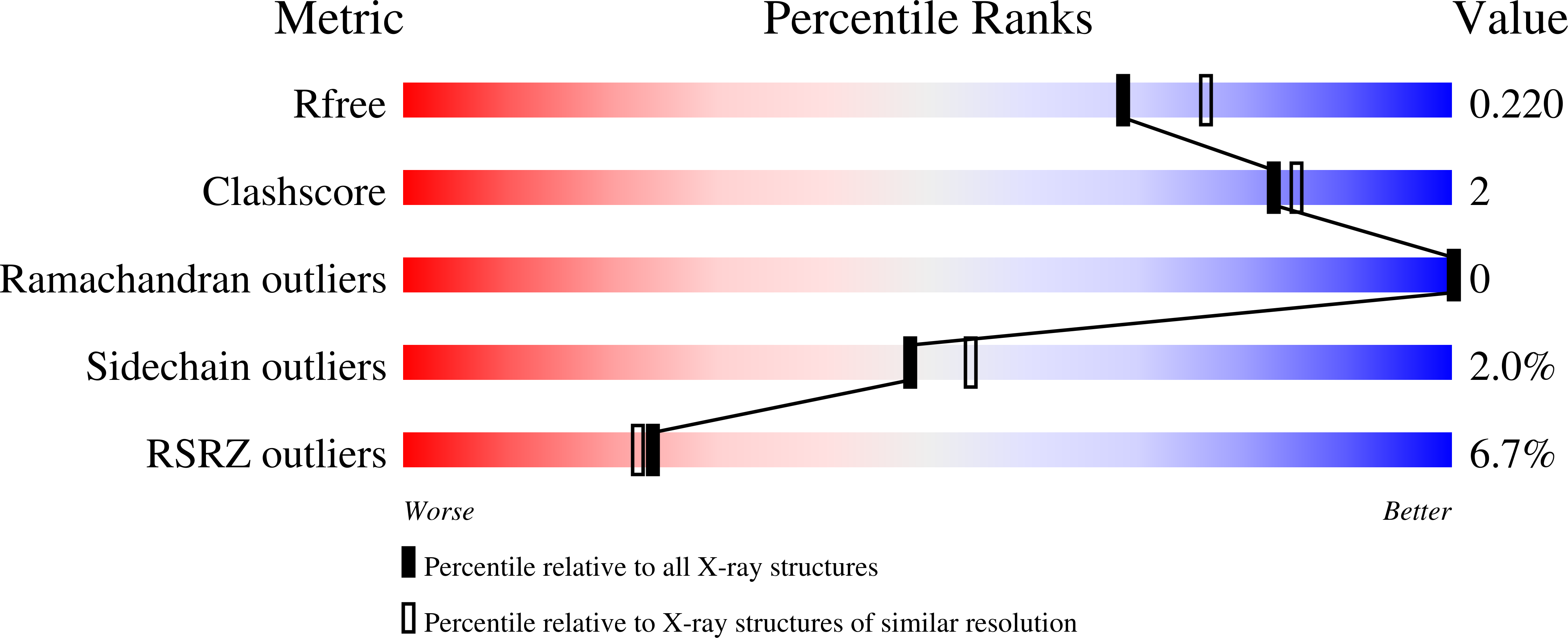
R-Value Free:
0.22
R-Value Work:
0.18
R-Value Observed:
0.18
Space Group:
P 21 21 21
Macromolecular Entities
Polymer Type:polypeptide(L)
Molecule:Uncharacterized conserved pro
Chain IDs:A
Chain Length:221
Number of Molecules:1
Biological Source:Geobacillus stearothermophilus
Modified Residue
Compound ID Chain ID Parent Comp ID Details 2D Image
OCS A CYS modified residue
Primary Citation
Crystal structure of the hydroxylaminopurine resistance protein, YiiM, and its putative molybdenum cofactor-binding catalytic site.
Sci Rep 8 3304 3304 (2018)
PMID: 29459651 DOI: 10.1038/s41598-018-21660-y

Abstact

The molybdenum cofactor (Moco) is a molybdenum-conjugated prosthetic group that is ubiquitously found in plants, animals, and bacteria. Moco is required for the nitrogen-reducing reaction of the Moco sulfurase C-terminal domain (MOSC) family. Despite the biological significance of MOSC proteins in the conversion of prodrugs and resistance against mutagens, their structural features and Moco-mediated catalysis mechanism have not been described in detail. YiiM is a MOSC protein that is involved in reducing mutagenic 6-N-hydroxylaminopurine to nontoxic adenine in bacteria. Here, we report two crystal structures of YiiM: one from Gram-positive Geobacillus stearothermophilus (gsYiiM) and the other from Gram-negative Escherichia coli (ecYiiM). Although gsYiiM and ecYiiM differ in oligomerization state and protein stability, both consist of three structural modules (a beta-barrel and two alpha-helix bundles) and feature a cavity surrounded by the three modules. The cavity is characterized by positive electrostatic potentials and high sequence conservation. Moreover, the ecYiiM cavity houses a phosphate group, which emulates a part of Moco, and contains a highly reactive invariant cysteine residue. We thus propose that the cavity is the catalytic site where Moco binds and the substrate is reduced. Moreover, our comparative structural analysis highlights the common but distinct structural features of MOSC proteins.

Legend

Protein

Chemical

Disease

Primary Citation of related structures
Feedback Form
Name
Email
Institute
Feedback