

5VQP image
Deposition Date 2017-05-09
Release Date 2017-11-15
Last Version Date 2024-12-25
Entry Detail
PDB ID:
5VQP
Keywords:
Title:
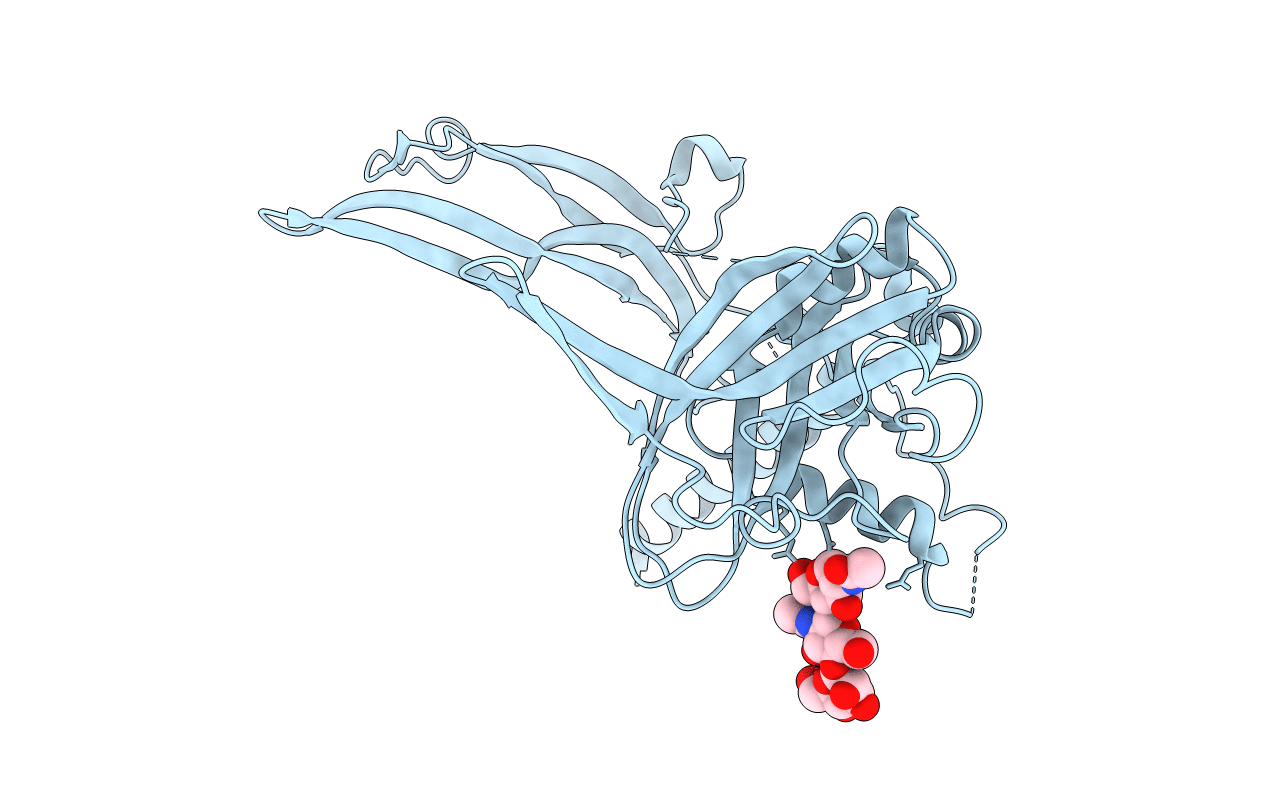
Crystal structure of human pro-TGF-beta1
Biological Source:
Source Organism(s):
Homo sapiens (Taxon ID: 9606)
Expression System(s):
Method Details:
Experimental Method:
Resolution:
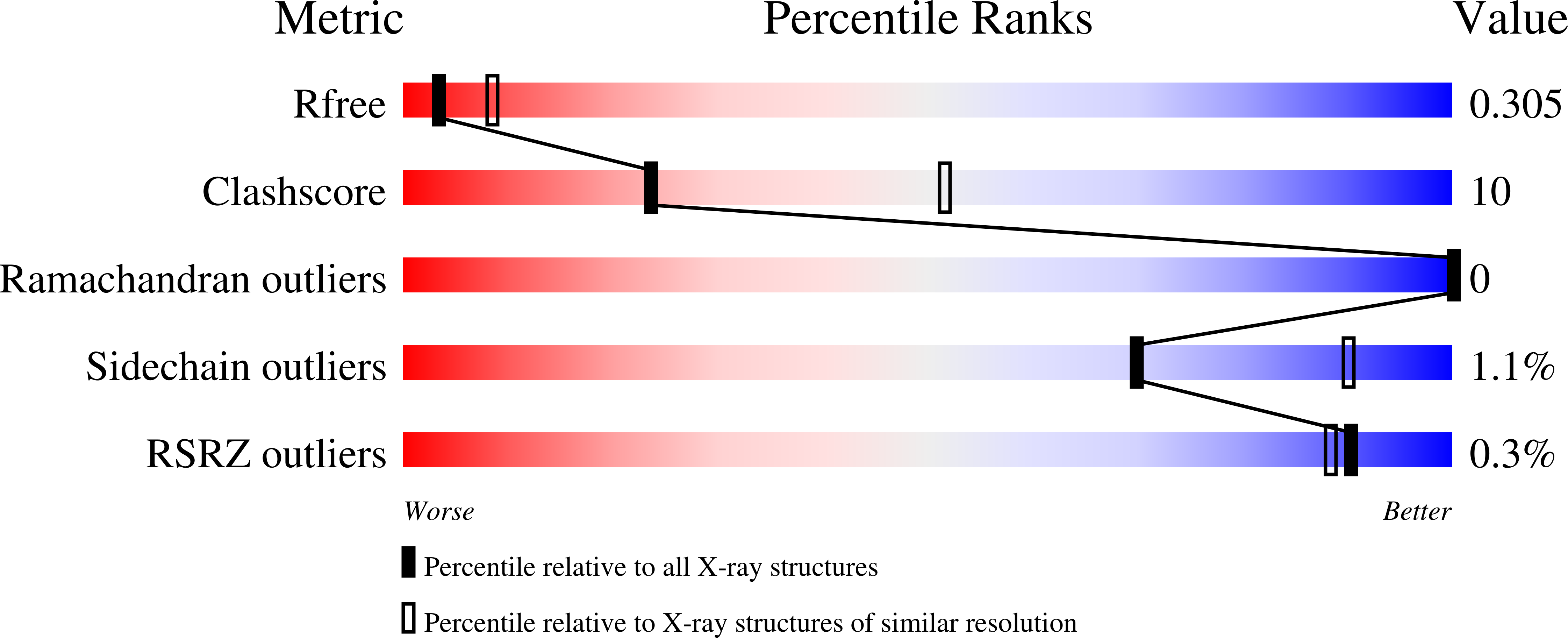
2.90 Å
R-Value Free:
0.29
R-Value Work:
0.25
R-Value Observed:
0.25
Space Group:
P 6 2 2
Macromolecular Entities
Polymer Type:polypeptide(L)
Molecule:Transforming growth factor be
Gene (Uniprot):TGFB1
Mutagens:C4S,N107Q,N147Q
Chain IDs:A
Chain Length:363
Number of Molecules:1
Biological Source:Homo sapiens
Ligand Molecules
Primary Citation
Prodomain-growth factor swapping in the structure of pro-TGF-beta 1.
J. Biol. Chem. 293 1579 1589 (2018)
PMID: 29109152 DOI: 10.1074/jbc.M117.809657

Abstact

TGF-β is synthesized as a proprotein that dimerizes in the endoplasmic reticulum. After processing in the Golgi to cleave the N-terminal prodomain from the C-terminal growth factor (GF) domain in each monomer, pro-TGF-β is secreted and stored in latent complexes. It is unclear which prodomain and GF monomer are linked before proprotein convertase cleavage and how much conformational change occurs following cleavage. We have determined a structure of pro-TGF-β1 with the proprotein convertase cleavage site mutated to mimic the structure of the TGF-β1 proprotein. Structure, mutation, and model building demonstrate that the prodomain arm domain in one monomer is linked to the GF that interacts with the arm domain in the other monomer in the dimeric structure (i.e. the prodomain arm domain and GF domain in each monomer are swapped). Swapping has important implications for the mechanism of biosynthesis in the TGF-β family and is relevant to the mechanism for preferential formation of heterodimers over homodimers for some members of the TGF-β family. Our structure, together with two previous ones, also provides insights into which regions of the prodomain-GF complex are highly structurally conserved and which are perturbed by crystal lattice contacts.

Legend

Protein

Chemical

Disease

Primary Citation of related structures
Feedback Form
Name
Email
Institute
Feedback