

5V9X image
Deposition Date 2017-03-23
Release Date 2017-12-06
Last Version Date 2024-03-06
Entry Detail
PDB ID:
5V9X
Keywords:
Title:
Structure of Mycobacterium smegmatis helicase Lhr bound to ssDNA and AMP-PNP
Biological Source:
Source Organism(s):
Expression System(s):
Method Details:
Experimental Method:
Resolution:
2.80 Å
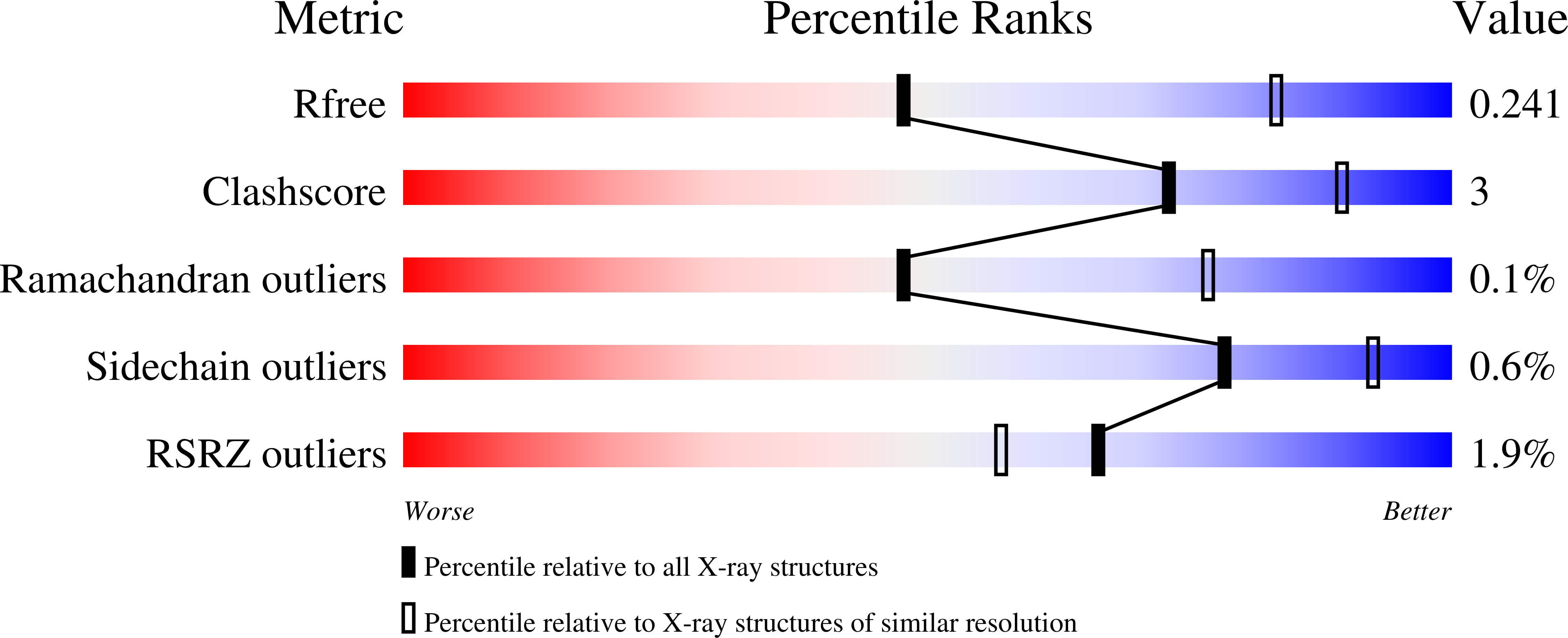
R-Value Free:
0.24
R-Value Work:
0.19
R-Value Observed:
0.19
Space Group:
C 1 2 1
Macromolecular Entities
Polymer Type:polypeptide(L)
Molecule:ATP-dependent DNA helicase
Chain IDs:A
Chain Length:877
Number of Molecules:1
Biological Source:Mycobacterium smegmatis
Polymer Type:polydeoxyribonucleotide
Molecule:ssDNA
Chain IDs:B
Chain Length:16
Number of Molecules:1
Biological Source:unidentified
Primary Citation
Structure of mycobacterial 3'-to-5' RNA:DNA helicase Lhr bound to a ssDNA tracking strand highlights distinctive features of a novel family of bacterial helicases.
Nucleic Acids Res. 46 442 455 (2018)
PMID: 29165676 DOI: 10.1093/nar/gkx1163

Abstact

Mycobacterial Lhr is a DNA damage-inducible superfamily 2 helicase that uses adenosine triphosphate (ATP) hydrolysis to drive unidirectional 3'-to-5' translocation along single-stranded DNA (ssDNA) and to unwind RNA:DNA duplexes en route. ATPase, translocase and helicase activities are encompassed within the N-terminal 856-amino acid segment. The crystal structure of Lhr-(1-856) in complex with AMPPNP•Mg2+ and ssDNA defines a new helicase family. The enzyme comprises two N-terminal RecA-like modules, a winged helix (WH) domain and a unique C-terminal domain. The 3' ssDNA end binds in a crescent-shaped groove at the interface between the first RecA domain and the WH domain and tracks 5' into a groove between the second RecA and C domains. A kissing interaction between the second RecA and C domains forms an aperture that demarcates a putative junction between the loading strand tail and the duplex, with the first duplex nucleoside bookended by stacking on Trp597. Intercalation of Ile528 between nucleosides of the loading strand creates another bookend. Coupling of ATP hydrolysis to RNA:DNA unwinding is dependent on Trp597 and Ile528, and on Thr145 and Arg279 that contact phosphates of the loading strand. The structural and functional data suggest a ratchet mechanism of translocation and unwinding coupled to ATP-driven domain movements.

Legend

Protein

Chemical

Disease

Primary Citation of related structures
Feedback Form
Name
Email
Institute
Feedback