

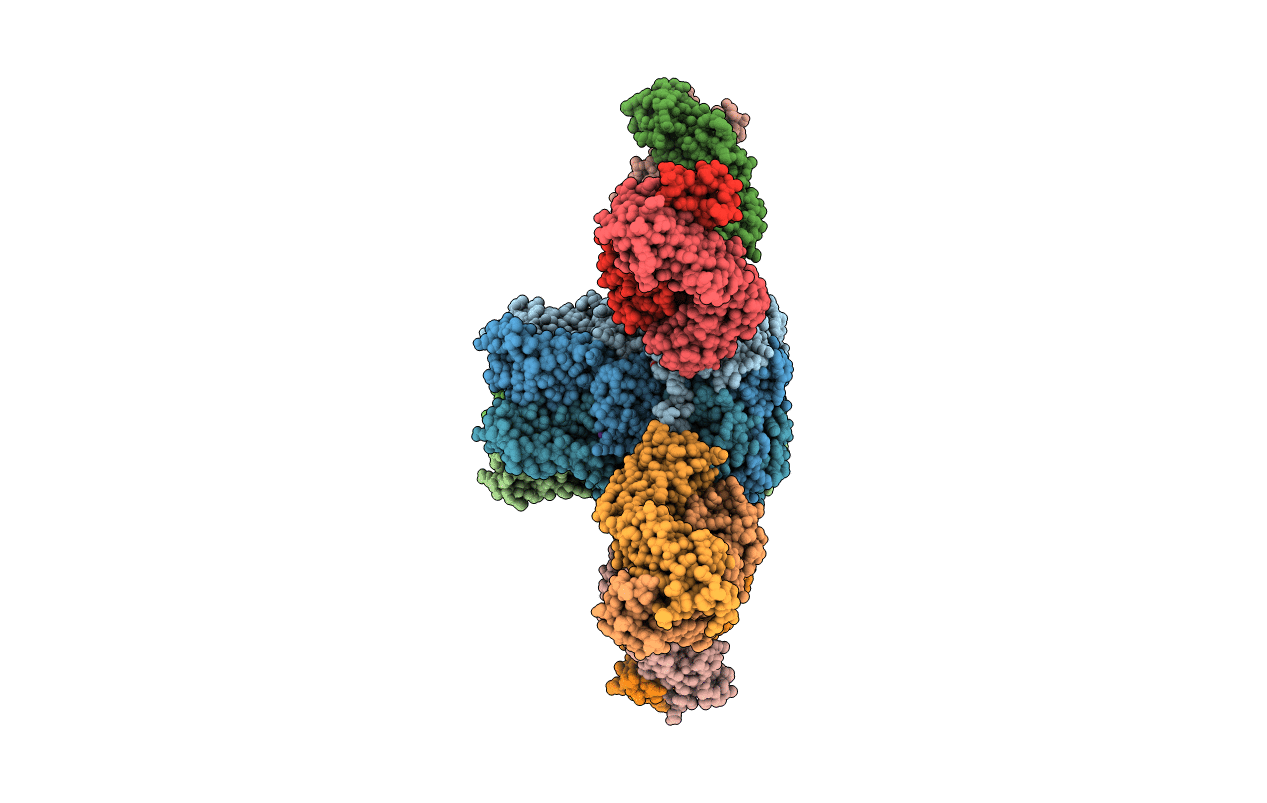
5T5N image
Deposition Date 2016-08-31
Release Date 2016-11-30
Last Version Date 2024-11-20
Entry Detail
PDB ID:
5T5N
Title:
Calcium-activated chloride channel bestrophin-1 (BEST1), triple mutant: I76A, F80A, F84A; in complex with an Fab antibody fragment, chloride, and calcium
Biological Source:
Source Organism(s):
Gallus gallus (Taxon ID: 9031)
Mus musculus (Taxon ID: 10090)
Expression System(s):
Method Details:
Experimental Method:
Resolution:
3.10 Å
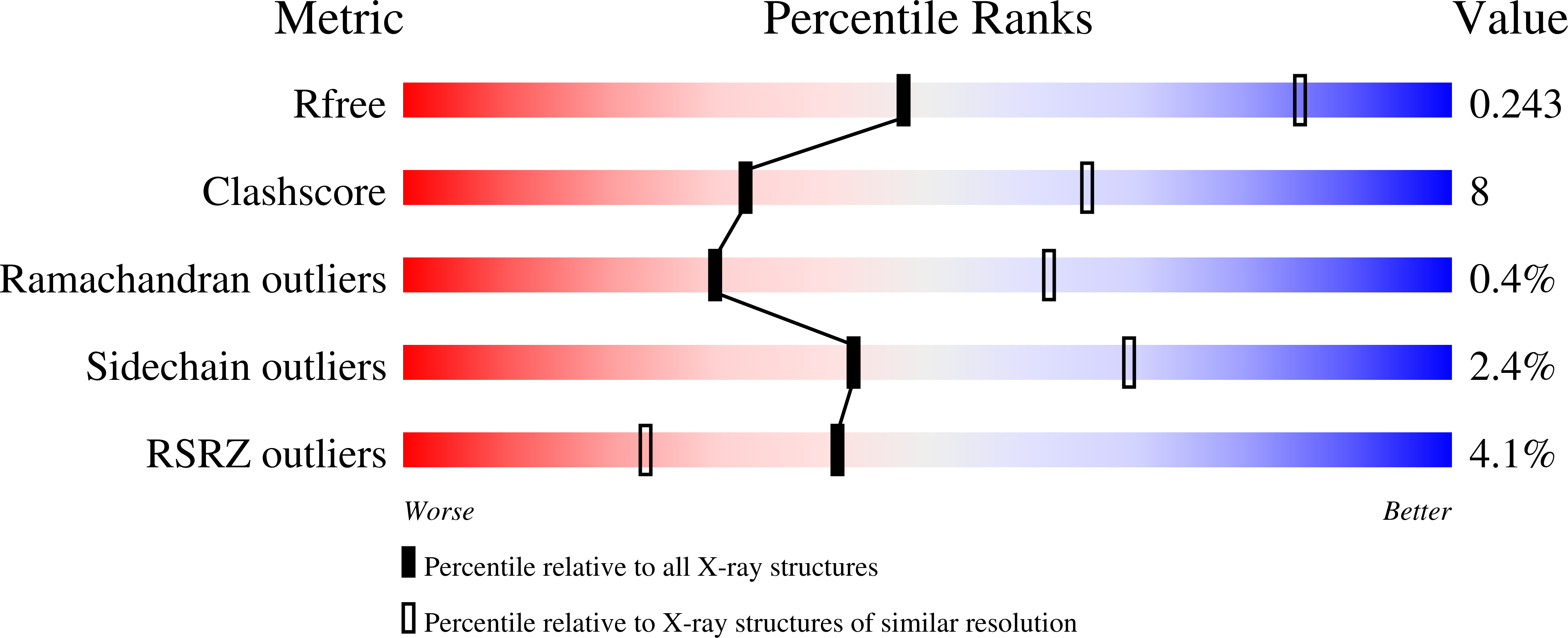
R-Value Free:
0.24
R-Value Work:
0.21
Space Group:
P 1 21 1
Macromolecular Entities
Polymer Type:polypeptide(L)
Molecule:bestrophin-1 (BEST1)
Mutagens:I76A, F80A, F84A
Chain IDs:A, B, C, D, E
Chain Length:409
Number of Molecules:5
Biological Source:Gallus gallus
Polymer Type:polypeptide(L)
Molecule:Fab antibody fragment, light
Chain IDs:F, H, J, L, N
Chain Length:212
Number of Molecules:5
Biological Source:Mus musculus
Polymer Type:polypeptide(L)
Molecule:Fab antibody fragment, heavy
Chain IDs:G, I, K, M, O
Chain Length:217
Number of Molecules:5
Biological Source:Mus musculus
Primary Citation
Distinct regions that control ion selectivity and calcium-dependent activation in the bestrophin ion channel.
Proc. Natl. Acad. Sci. U.S.A. 113 E7399 E7408 (2016)
PMID: 27821745 DOI: 10.1073/pnas.1614688113

Abstact

Cytoplasmic calcium (Ca2+) activates the bestrophin anion channel, allowing chloride ions to flow down their electrochemical gradient. Mutations in bestrophin 1 (BEST1) cause macular degenerative disorders. Previously, we determined an X-ray structure of chicken BEST1 that revealed the architecture of the channel. Here, we present electrophysiological studies of purified wild-type and mutant BEST1 channels and an X-ray structure of a Ca2+-independent mutant. From these experiments, we identify regions of BEST1 responsible for Ca2+ activation and ion selectivity. A "Ca2+ clasp" within the channel's intracellular region acts as a sensor of cytoplasmic Ca2+. Alanine substitutions within a hydrophobic "neck" of the pore, which widen it, cause the channel to be constitutively active, irrespective of Ca2+. We conclude that the primary function of the neck is as a "gate" that controls chloride permeation in a Ca2+-dependent manner. In contrast to what others have proposed, we find that the neck is not a major contributor to the channel's ion selectivity. We find that mutation of a cytosolic "aperture" of the pore does not perturb the Ca2+ dependence of the channel or its preference for anions over cations, but its mutation dramatically alters relative permeabilities among anions. The data suggest that the aperture functions as a size-selective filter that permits the passage of small entities such as partially dehydrated chloride ions while excluding larger molecules such as amino acids. Thus, unlike ion channels that have a single "selectivity filter," in bestrophin, distinct regions of the pore govern anion-vs.-cation selectivity and the relative permeabilities among anions.

Legend

Protein

Chemical

Disease

Primary Citation of related structures
Feedback Form
Name
Email
Institute
Feedback