

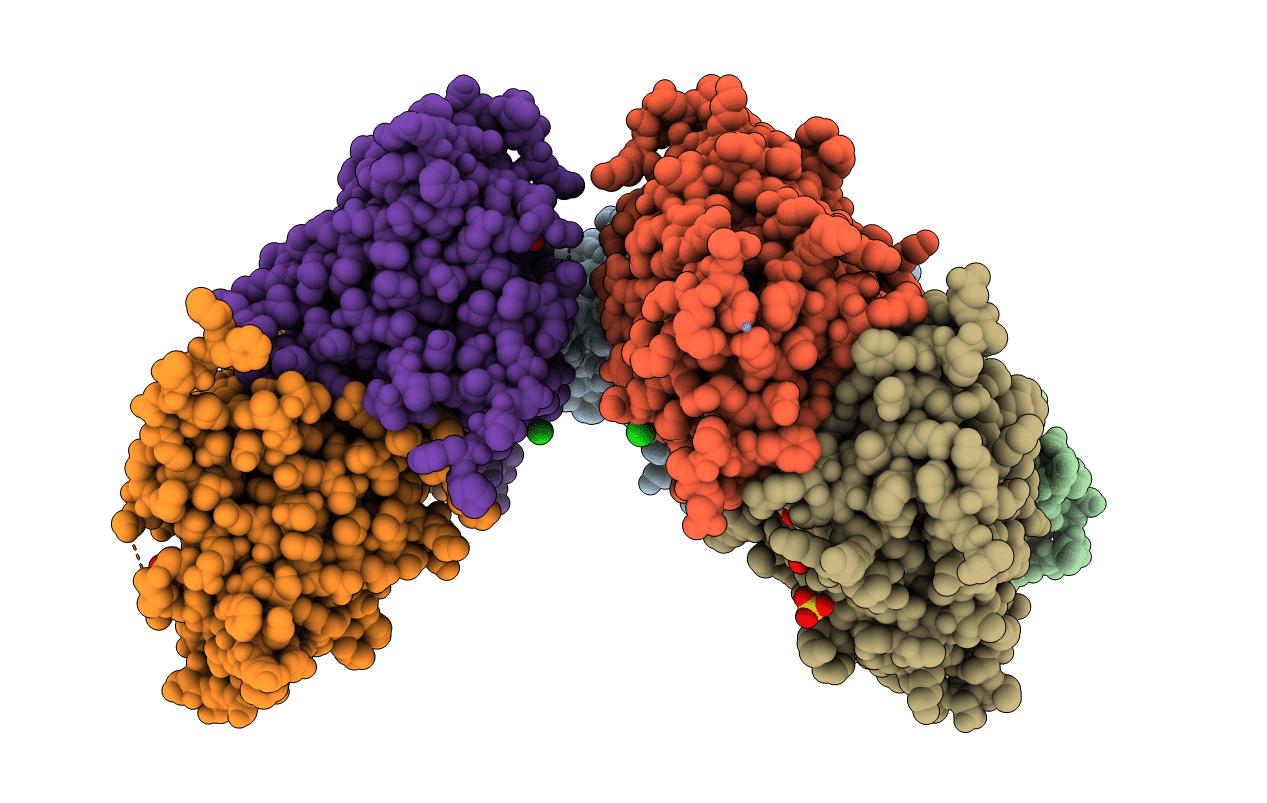
5LDZ image
Deposition Date 2016-06-29
Release Date 2016-10-26
Last Version Date 2024-05-01
Entry Detail
PDB ID:
5LDZ
Keywords:
Title:
Quadruple space group ambiguity due to rotational and translational non-crystallographic symmetry in human liver fructose-1,6-bisphosphatase
Biological Source:
Source Organism(s):
Homo sapiens (Taxon ID: 9606)
Expression System(s):
Method Details:
Experimental Method:
Resolution:
2.20 Å
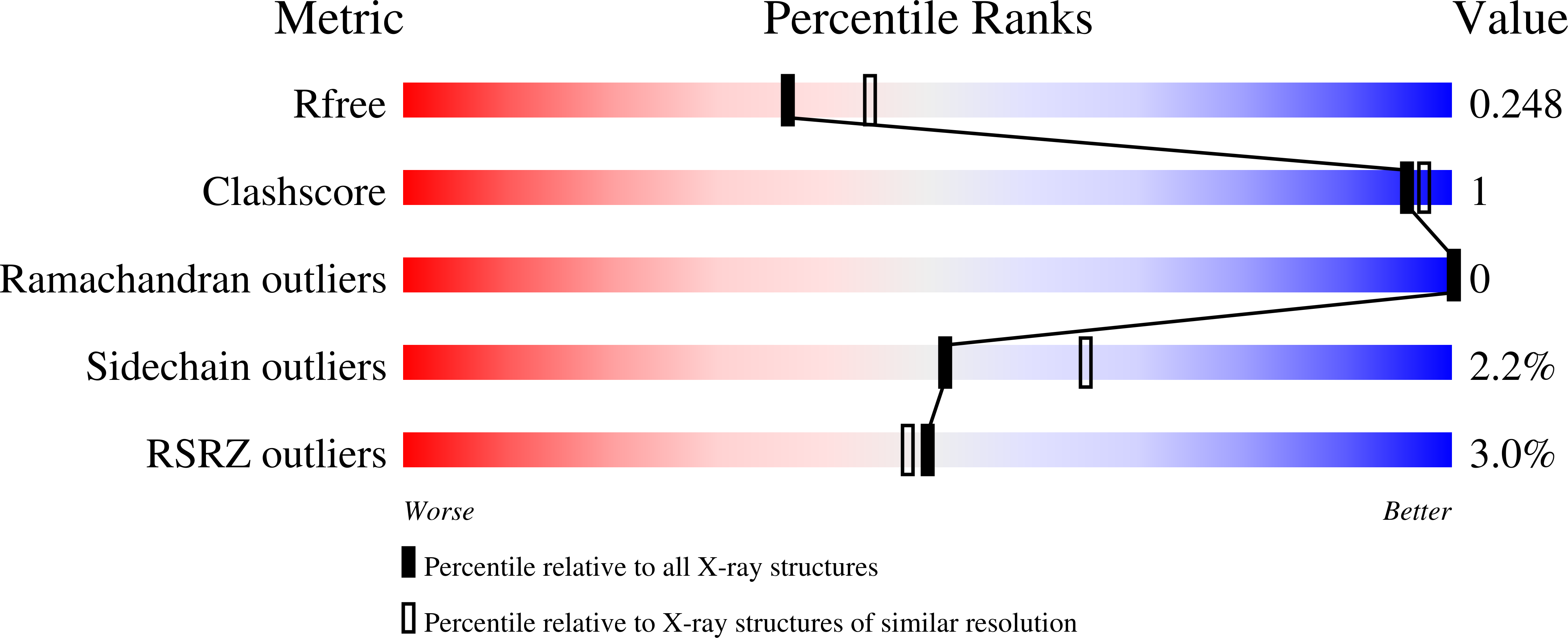
R-Value Free:
0.23
R-Value Work:
0.20
R-Value Observed:
0.20
Space Group:
P 41 21 2
Macromolecular Entities
Structures with similar UniProt ID
Protein Blast
Polymer Type:polypeptide(L)
Molecule:Fructose-1,6-bisphosphatase 1
Gene (Uniprot):FBP1
Chain IDs:A, B, C, D, E, F
Chain Length:338
Number of Molecules:6
Biological Source:Homo sapiens
Primary Citation
Quadruple space-group ambiguity owing to rotational and translational noncrystallographic symmetry in human liver fructose-1,6-bisphosphatase.
Acta Crystallogr D Struct Biol 72 1212 1224 (2016)
PMID: 27841754 DOI: 10.1107/S2059798316016715

Abstact

Fructose-1,6-bisphosphatase (FBPase) is a key regulator of gluconeogenesis and a potential drug target for type 2 diabetes. FBPase is a homotetramer of 222 symmetry with a major and a minor dimer interface. The dimers connected via the minor interface can rotate with respect to each other, leading to the inactive T-state and active R-state conformations of FBPase. Here, the first crystal structure of human liver FBPase in the R-state conformation is presented, determined at a resolution of 2.2 Å in a tetragonal setting that exhibits an unusual arrangement of noncrystallographic symmetry (NCS) elements. Self-Patterson function analysis and various intensity statistics revealed the presence of pseudo-translation and the absence of twinning. The space group is P41212, but structure determination was also possible in space groups P43212, P4122 and P4322. All solutions have the same arrangement of three C2-symmetric dimers spaced by 1/3 along an NCS axis parallel to the c axis located at (1/4, 1/4, z), which is therefore invisible in a self-rotation function analysis. The solutions in the four space groups are related to one another and emulate a body-centred lattice. If all NCS elements were crystallographic, the space group would be I4122 with a c axis three times shorter and a single FBPase subunit in the asymmetric unit. I4122 is a minimal, non-isomorphic supergroup of the four primitive tetragonal space groups, explaining the space-group ambiguity for this crystal.

Legend

Protein

Chemical

Disease

Primary Citation of related structures
Feedback Form
Name
Email
Institute
Feedback