

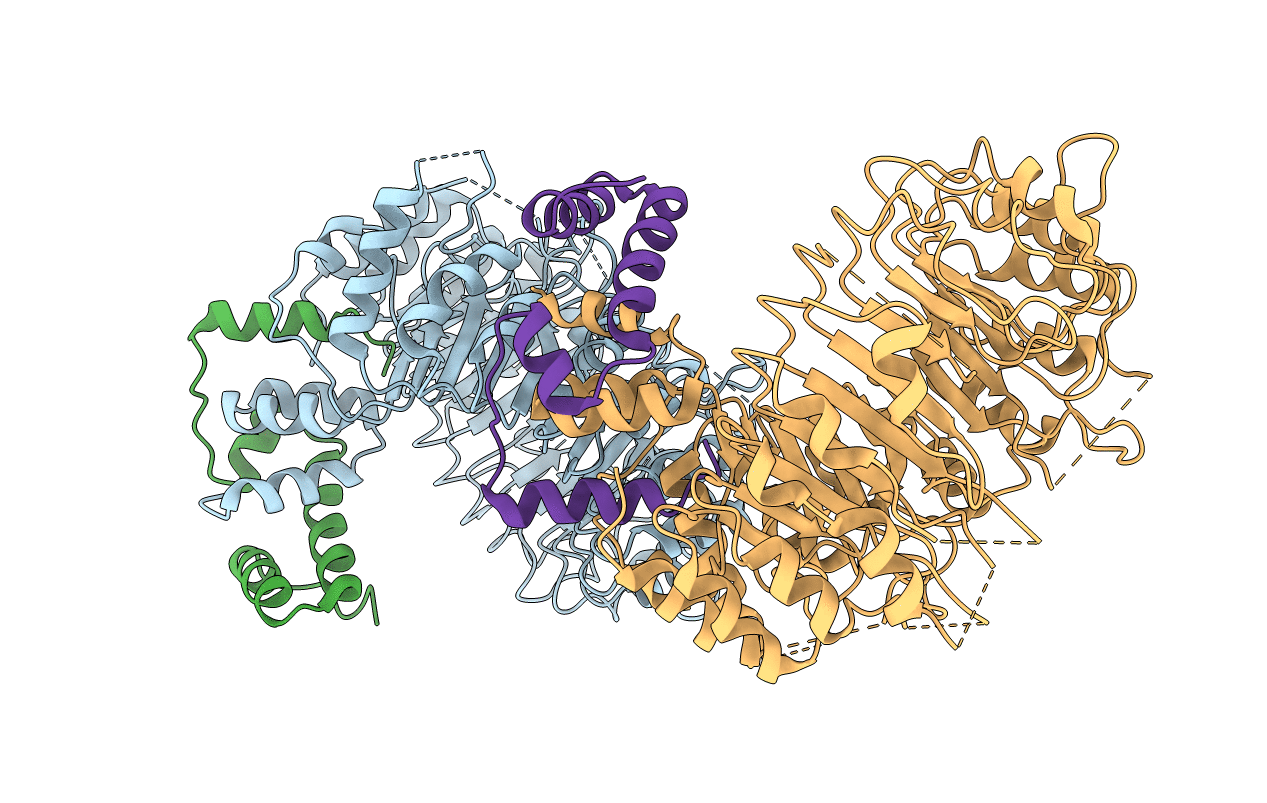
5HYW image
Deposition Date 2016-02-02
Release Date 2016-08-03
Last Version Date 2023-11-08
Entry Detail
PDB ID:
5HYW
Title:
The crystal structure of the D3-ASK1 complex
Biological Source:
Source Organism(s):
Method Details:
Experimental Method:
Resolution:
3.01 Å
R-Value Free:
0.31
R-Value Work:
0.23
R-Value Observed:
0.23
Space Group:
P 43

Macromolecular Entities
Polymer Type:polypeptide(L)
Molecule:F-box/LRR-repeat MAX2 homolog
Gene (Uniprot):D3
Chain IDs:A, C
Chain Length:740
Number of Molecules:2
Biological Source:Oryza sativa subsp. japonica
Polymer Type:polypeptide(L)
Molecule:SKP1-like protein 1A
Gene (Uniprot):SKP1A
Chain IDs:B, D
Chain Length:169
Number of Molecules:2
Biological Source:Arabidopsis thaliana
Ligand Molecules
Primary Citation
DWARF14 is a non-canonical hormone receptor for strigolactone
Nature 536 469 473 (2016)
PMID: 27479325 DOI: 10.1038/nature19073

Abstact

Classical hormone receptors reversibly and non-covalently bind active hormone molecules, which are generated by biosynthetic enzymes, to trigger signal transduction. The α/β hydrolase DWARF14 (D14), which hydrolyses the plant branching hormone strigolactone and interacts with the F-box protein D3/MAX2, is probably involved in strigolactone detection. However, the active form of strigolactone has yet to be identified and it is unclear which protein directly binds the active form of strigolactone, and in which manner, to act as the genuine strigolactone receptor. Here we report the crystal structure of the strigolactone-induced AtD14-D3-ASK1 complex, reveal that Arabidopsis thaliana (At)D14 undergoes an open-to-closed state transition to trigger strigolactone signalling, and demonstrate that strigolactone is hydrolysed into a covalently linked intermediate molecule (CLIM) to initiate a conformational change of AtD14 to facilitate interaction with D3. Notably, analyses of a highly branched Arabidopsis mutant d14-5 show that the AtD14(G158E) mutant maintains enzyme activity to hydrolyse strigolactone, but fails to efficiently interact with D3/MAX2 and loses the ability to act as a receptor that triggers strigolactone signalling in planta. These findings uncover a mechanism underlying the allosteric activation of AtD14 by strigolactone hydrolysis into CLIM, and define AtD14 as a non-canonical hormone receptor with dual functions to generate and sense the active form of strigolactone.

Legend

Protein

Chemical

Disease

Primary Citation of related structures
Feedback Form
Name
Email
Institute
Feedback