

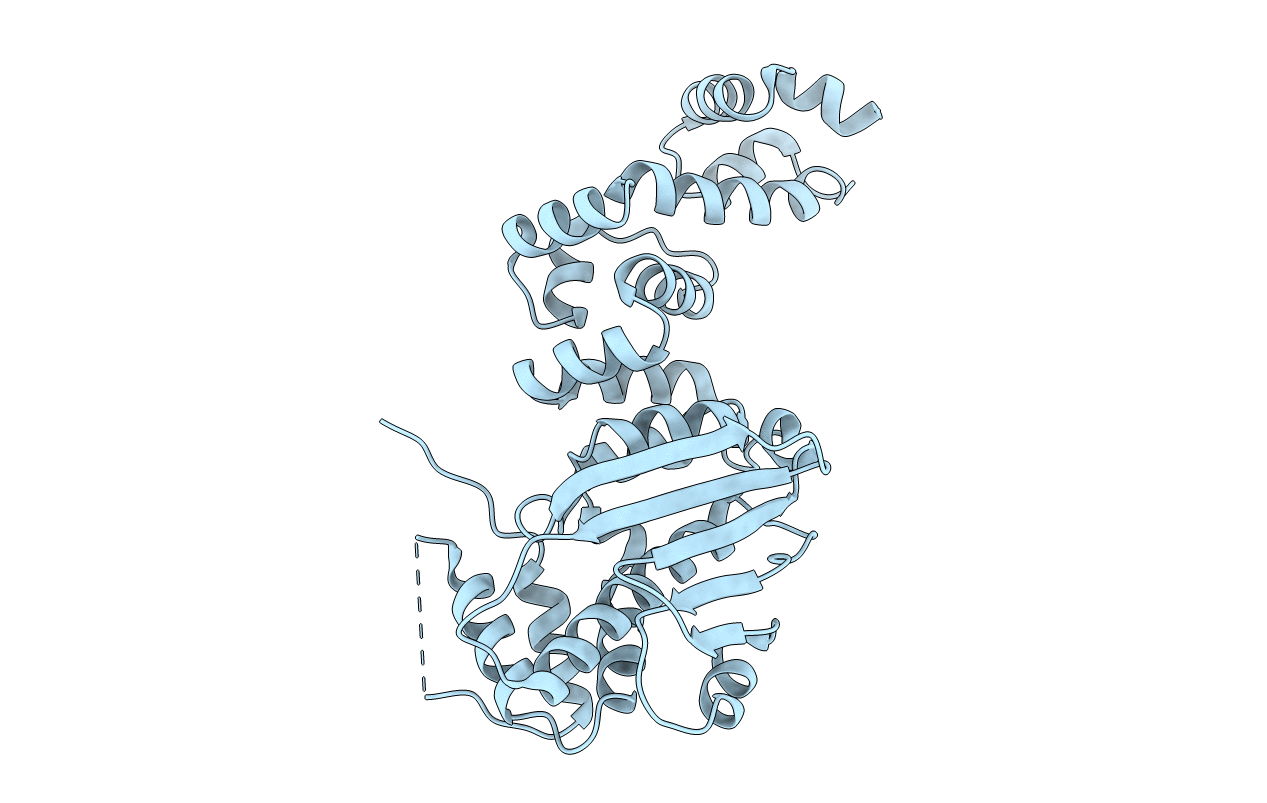
5CHH image
Deposition Date 2015-07-10
Release Date 2016-05-18
Last Version Date 2024-10-23
Entry Detail
PDB ID:
5CHH
Keywords:
Title:
Crystal structure of transcriptional regulator CdpR from Pseudomonas aeruginosa
Biological Source:
Source Organism(s):
Expression System(s):
Method Details:
Experimental Method:
Resolution:
1.85 Å
R-Value Free:
0.23
R-Value Work:
0.18
R-Value Observed:
0.19
Space Group:
P 41 21 2

Macromolecular Entities
Structures with similar UniProt ID
Protein Blast
Polymer Type:polypeptide(L)
Molecule:AraC family transcriptional r
Chain IDs:A
Chain Length:341
Number of Molecules:1
Biological Source:Pseudomonas aeruginosa
Modified Residue
Compound ID Chain ID Parent Comp ID Details 2D Image
MSE A MET modified residue
Primary Citation
Structural and Molecular Mechanism of CdpR Involved in Quorum-Sensing and Bacterial Virulence in Pseudomonas aeruginosa
PLoS Biol. 14 e1002449 e1002449 (2016)
PMID: 27119725 DOI: 10.1371/journal.pbio.1002449

Abstact

Although quorum-sensing (QS) systems are important regulators of virulence gene expression in the opportunistic human pathogen Pseudomonas aeruginosa, their detailed regulatory mechanisms have not been fully characterized. Here, we show that deletion of PA2588 resulted in increased production of pyocyanin and biofilm, as well as enhanced pathogenicity in a mouse model. To gain insights into the function of PA2588, we performed a ChIP-seq assay and identified 28 targets of PA2588, including the intergenic region between PA2588 and pqsH, which encodes the key synthase of Pseudomonas quinolone signal (PQS). Though the C-terminal domain was similar to DNA-binding regions of other AraC family members, structural studies revealed that PA2588 has a novel fold at the N-terminal region (NTR), and its C-terminal HTH (helix-turn-helix) domain is also unique in DNA recognition. We also demonstrated that the adaptor protein ClpS, an essential regulator of ATP-dependent protease ClpAP, directly interacted with PA2588 before delivering CdpR to ClpAP for degradation. We named PA2588 as CdpR (ClpAP-degradation and pathogenicity Regulator). Moreover, deletion of clpP or clpS/clpA promotes bacterial survival in a mouse model of acute pneumonia infection. Taken together, this study uncovered that CdpR is an important QS regulator, which can interact with the ClpAS-P system to regulate the expression of virulence factors and pathogenicity.

Legend

Protein

Chemical

Disease

Primary Citation of related structures
Feedback Form
Name
Email
Institute
Feedback