

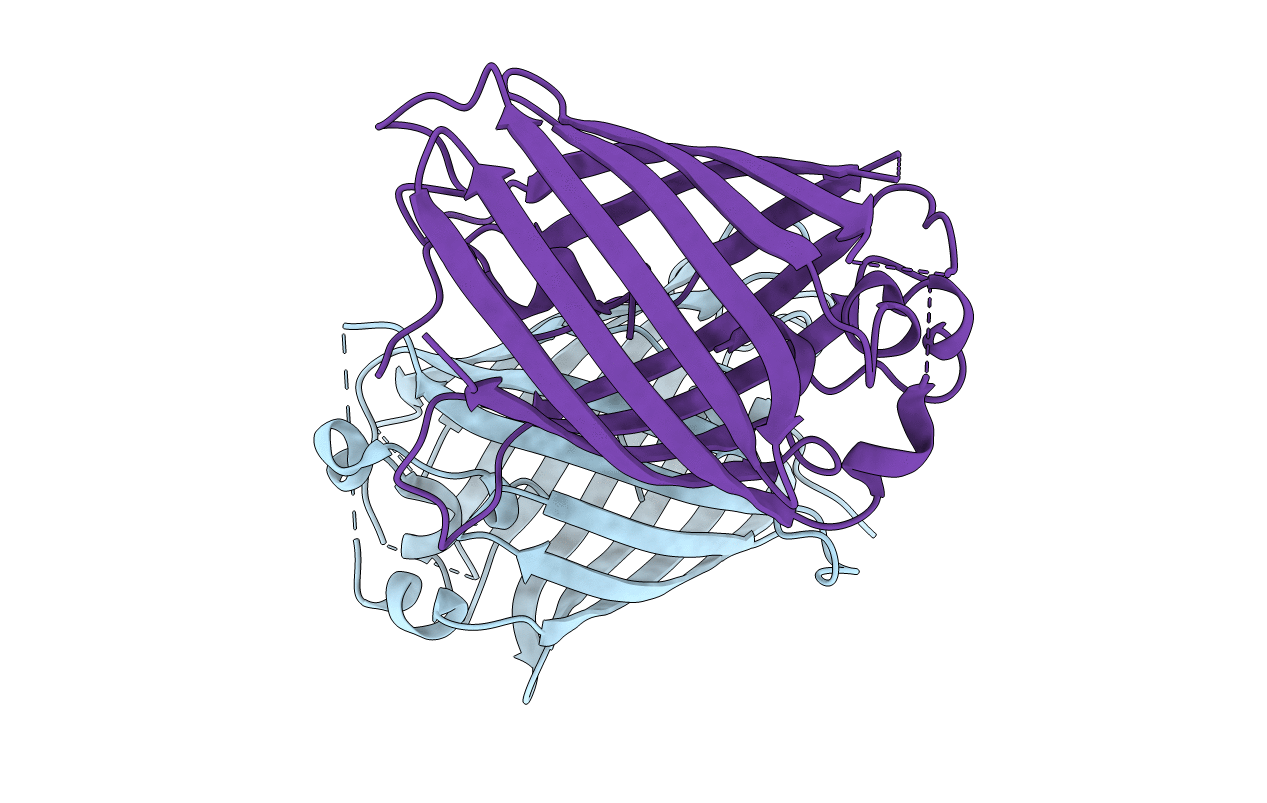
4ZF3 image
Deposition Date 2015-04-21
Release Date 2015-06-10
Last Version Date 2024-10-23
Entry Detail
PDB ID:
4ZF3
Title:
Crystal structure of Green Fluorescent Protein (GFP); S65T, H148D; circular permutant ( 50-51)
Biological Source:
Source Organism(s):
Expression System(s):
Method Details:
Experimental Method:
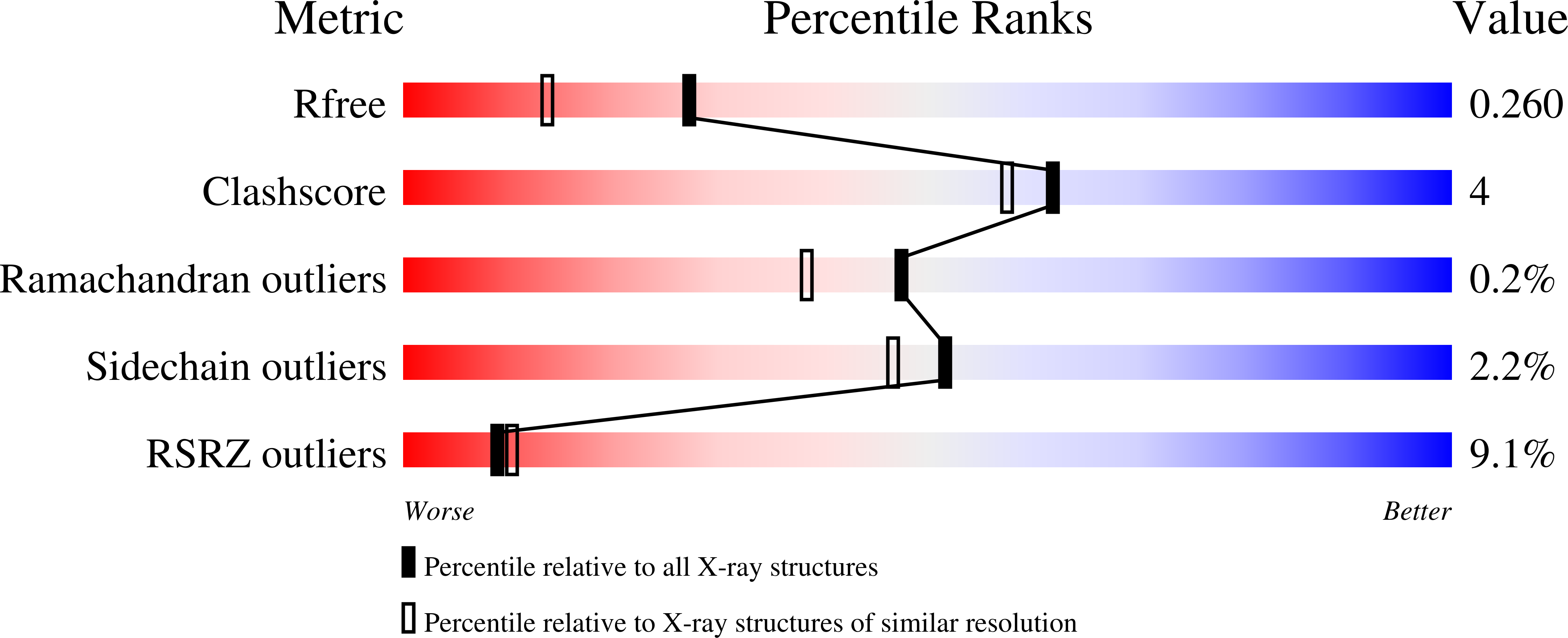
Resolution:
1.90 Å
R-Value Free:
0.26
R-Value Work:
0.21
R-Value Observed:
0.21
Space Group:
P 1 21 1
Macromolecular Entities
Protein Blast
Polymer Type:polypeptide(L)
Molecule:Green fluorescent protein
Gene (Uniprot):GFP
Mutagens:S30R, Y39I, C48S, F64L, S65T, Q80R, F99S, N105K, E111V, I128Y, Y145F, H148D, M153T, K156N, V163A, K166T, I167V, I171V, S205T, A206V
Chain IDs:A, B
Chain Length:254
Number of Molecules:2
Biological Source:Aequorea victoria
Modified Residue
Compound ID Chain ID Parent Comp ID Details 2D Image
CRO A SER chromophore
Primary Citation
Short Hydrogen Bonds and Proton Delocalization in Green Fluorescent Protein (GFP).
Acs Cent.Sci. 1 148 156 (2015)
PMID: 27162964 DOI: 10.1021/acscentsci.5b00160

Abstact

Short hydrogen bonds and specifically low-barrier hydrogen bonds (LBHBs) have been the focus of much attention and controversy for their possible role in enzymatic catalysis. The green fluorescent protein (GFP) mutant S65T, H148D has been found to form a very short hydrogen bond between Asp148 and the chromophore resulting in significant spectral perturbations. Leveraging the unique autocatalytically formed chromophore and its sensitivity to this interaction we explore the consequences of proton affinity matching across this putative LBHB. Through the use of noncanonical amino acids introduced through nonsense suppression or global incorporation, we systematically modify the acidity of the GFP chromophore with halogen substituents. X-ray crystal structures indicated that the length of the interaction with Asp148 is unchanged at ∼2.45 Å while the absorbance spectra demonstrate an unprecedented degree of color tuning with increasing acidity. We utilized spectral isotope effects, isotope fractionation factors, and a simple 1D model of the hydrogen bond coordinate in order to gain insight into the potential energy surface and particularly the role that proton delocalization may play in this putative short hydrogen bond. The data and model suggest that even with the short donor-acceptor distance (∼2.45 Å) and near perfect affinity matching there is not a LBHB, that is, the barrier to proton transfer exceeds the H zero-point energy.

Legend

Protein

Chemical

Disease

Primary Citation of related structures
Feedback Form
Name
Email
Institute
Feedback