

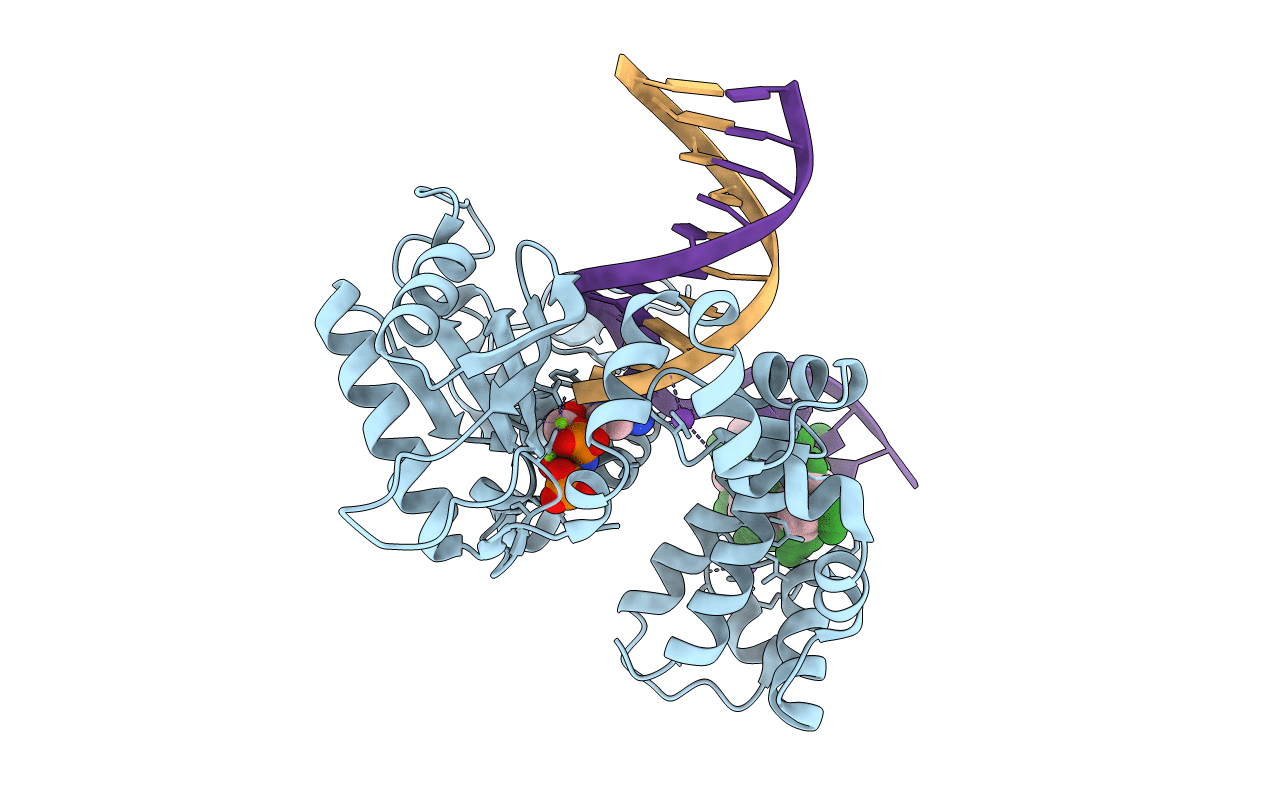
4TUQ image
Deposition Date 2014-06-24
Release Date 2014-10-01
Last Version Date 2024-03-13
Entry Detail
PDB ID:
4TUQ
Title:
Human DNA polymerase beta inserting dCMPNPP opposite GG template (GG0b).
Biological Source:
Source Organism(s):
Homo sapiens (Taxon ID: 9606)
Expression System(s):
Method Details:
Experimental Method:
Resolution:
2.37 Å
R-Value Free:
0.25
R-Value Work:
0.19
R-Value Observed:
0.20
Space Group:
P 1 21 1

Macromolecular Entities
Polymer Type:polypeptide(L)
Molecule:DNA polymerase beta
Gene (Uniprot):POLB
Chain IDs:A
Chain Length:326
Number of Molecules:1
Biological Source:Homo sapiens
Polymer Type:polydeoxyribonucleotide
Molecule:DNA (5'-D(P*GP*TP*GP*GP*G)-3'
Chain IDs:D
Chain Length:5
Number of Molecules:1
Biological Source:Homo sapiens
Polymer Type:polydeoxyribonucleotide
Molecule:DNA (5'-D(*GP*GP*TP*GP*AP*TP*
Chain IDs:C (auth: P)
Chain Length:10
Number of Molecules:1
Biological Source:Homo sapiens
Polymer Type:polydeoxyribonucleotide
Molecule:DNA (5'-D(*CP*CP*CP*AP*CP*GP*
Chain IDs:B (auth: T)
Chain Length:16
Number of Molecules:1
Biological Source:Homo sapiens
Primary Citation
Structural Basis for the Inefficient Nucleotide Incorporation Opposite Cisplatin-DNA Lesion by Human DNA Polymerase beta.
J. Biol. Chem. 289 31341 31348 (2014)
PMID: 25237188 DOI: 10.1074/jbc.M114.605451

Abstact

Human DNA polymerase β (polβ) has been suggested to play a role in cisplatin resistance, especially in polβ-overexpressing cancer cells. Polβ has been shown to accurately albeit slowly bypass the cisplatin-1,2-d(GpG) (Pt-GG) intramolecular cross-link in vitro. Currently, the structural basis for the inefficient Pt-GG bypass mechanism of polβ is unknown. To gain structural insights into the mechanism, we determined two ternary structures of polβ incorporating dCTP opposite the templating Pt-GG lesion in the presence of the active site Mg(2+) or Mn(2+). The Mg(2+)-bound structure shows that the bulky Pt-GG adduct is accommodated in the polβ active site without any steric hindrance. In addition, both guanines of the Pt-GG lesion form Watson-Crick base pairing with the primer terminus dC and the incoming dCTP, providing the structural basis for the accurate bypass of the Pt-GG adduct by polβ. The Mn(2+)-bound structure shows that polβ adopts a catalytically suboptimal semiclosed conformation during the insertion of dCTP opposite the templating Pt-GG, explaining the inefficient replication across the Pt-GG lesion by polβ. Overall, our studies provide the first structural insights into the mechanism of the potential polβ-mediated cisplatin resistance.

Legend

Protein

Chemical

Disease

Primary Citation of related structures
Feedback Form
Name
Email
Institute
Feedback