

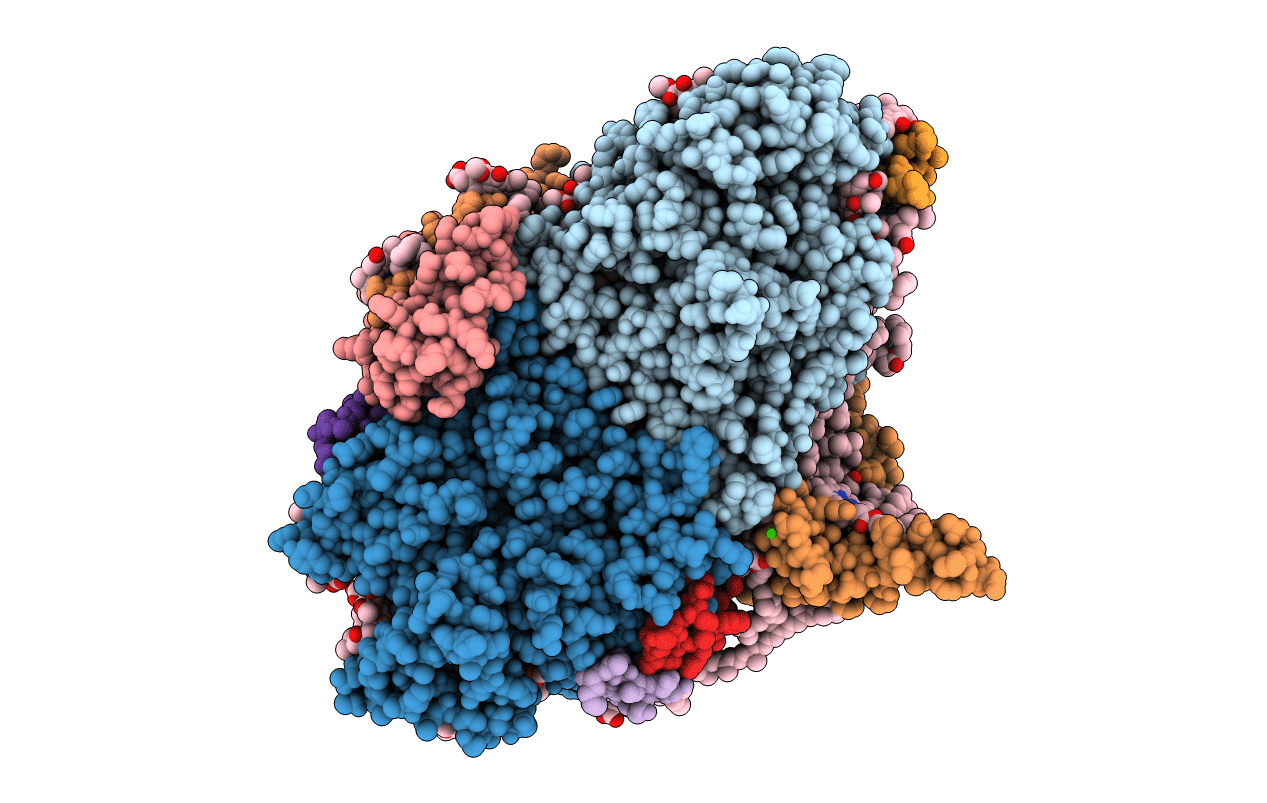
4FE1 image
Deposition Date 2012-05-29
Release Date 2012-08-15
Last Version Date 2024-11-20
Entry Detail
PDB ID:
4FE1
Keywords:
Title:
Improving the Accuracy of Macromolecular Structure Refinement at 7 A Resolution
Biological Source:
Source Organism(s):
Method Details:
Experimental Method:
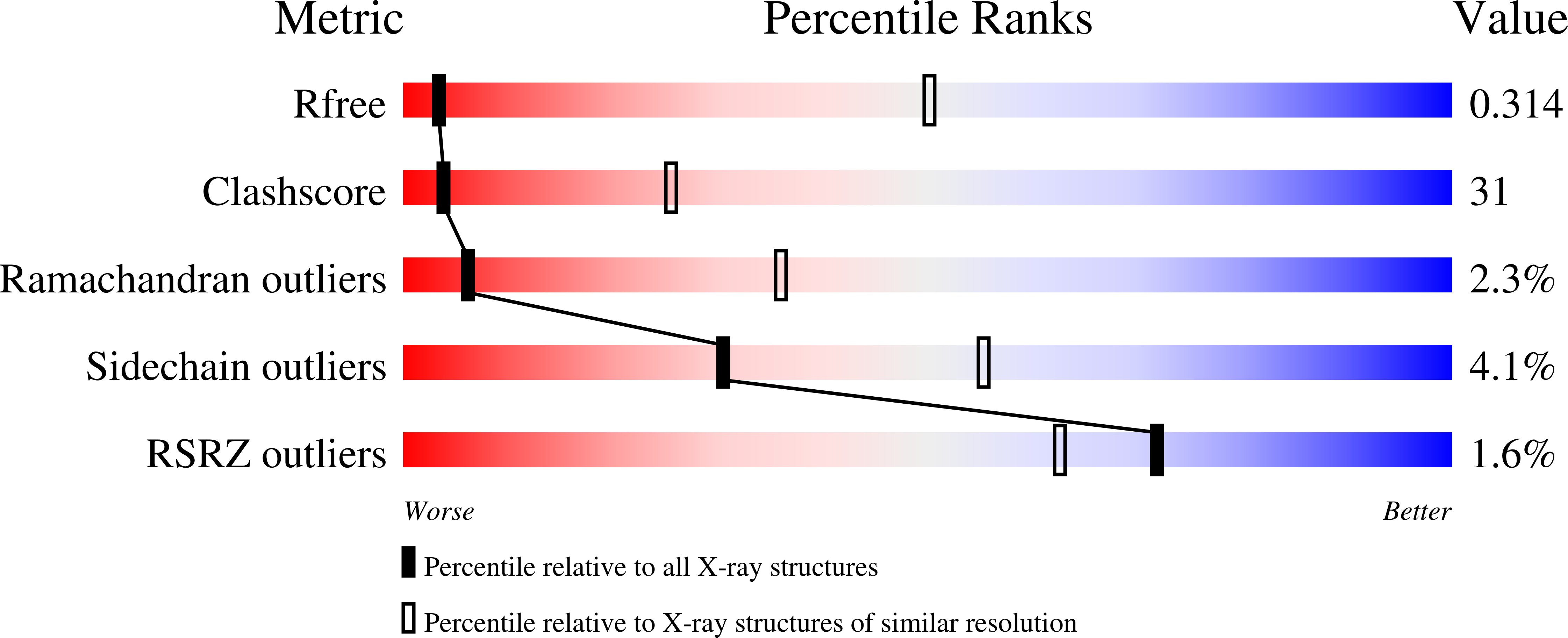
Resolution:
4.92 Å
R-Value Free:
0.31
R-Value Work:
0.27
R-Value Observed:
0.27
Space Group:
P 63
Macromolecular Entities
Structures with similar UniProt ID
Protein Blast
Polymer Type:polypeptide(L)
Molecule:Photosystem I P700 chlorophyl
Gene (Uniprot):psaA
Chain IDs:A
Chain Length:755
Number of Molecules:1
Biological Source:Thermosynechococcus elongatus
Structures with similar UniProt ID
Protein Blast
Polymer Type:polypeptide(L)
Molecule:Photosystem I P700 chlorophyl
Gene (Uniprot):psaB
Chain IDs:B
Chain Length:740
Number of Molecules:1
Biological Source:Thermosynechococcus elongatus
Structures with similar UniProt ID
Protein Blast
Polymer Type:polypeptide(L)
Molecule:Photosystem I iron-sulfur cen
Gene (Uniprot):psaC
Chain IDs:C
Chain Length:80
Number of Molecules:1
Biological Source:Thermosynechococcus elongatus
Structures with similar UniProt ID
Protein Blast
Polymer Type:polypeptide(L)
Molecule:Photosystem I reaction center
Gene (Uniprot):psaD
Chain IDs:D
Chain Length:138
Number of Molecules:1
Biological Source:Thermosynechococcus elongatus
Structures with similar UniProt ID
Protein Blast
Polymer Type:polypeptide(L)
Molecule:Photosystem I reaction center
Gene (Uniprot):psaE
Chain IDs:E
Chain Length:75
Number of Molecules:1
Biological Source:Thermosynechococcus elongatus
Structures with similar UniProt ID
Protein Blast
Polymer Type:polypeptide(L)
Molecule:Photosystem I reaction center
Gene (Uniprot):psaF
Chain IDs:F
Chain Length:164
Number of Molecules:1
Biological Source:Thermosynechococcus elongatus
Structures with similar UniProt ID
Protein Blast
Polymer Type:polypeptide(L)
Molecule:Photosystem I reaction center
Gene (Uniprot):psaI
Chain IDs:G (auth: I)
Chain Length:38
Number of Molecules:1
Biological Source:Thermosynechococcus elongatus
Structures with similar UniProt ID
Protein Blast
Polymer Type:polypeptide(L)
Molecule:Photosystem I reaction center
Gene (Uniprot):psaJ
Chain IDs:H (auth: J)
Chain Length:41
Number of Molecules:1
Biological Source:Thermosynechococcus elongatus
Structures with similar UniProt ID
Protein Blast
Polymer Type:polypeptide(L)
Molecule:Photosystem I reaction center
Gene (Uniprot):psaK
Chain IDs:I (auth: K)
Chain Length:83
Number of Molecules:1
Biological Source:Thermosynechococcus elongatus
Structures with similar UniProt ID
Protein Blast
Polymer Type:polypeptide(L)
Molecule:Photosystem I reaction center
Gene (Uniprot):psaL
Chain IDs:J (auth: L)
Chain Length:154
Number of Molecules:1
Biological Source:Thermosynechococcus elongatus
Structures with similar UniProt ID
Protein Blast
Polymer Type:polypeptide(L)
Molecule:Photosystem I reaction center
Gene (Uniprot):psaM
Chain IDs:K (auth: M)
Chain Length:31
Number of Molecules:1
Biological Source:Thermosynechococcus elongatus
Structures with similar UniProt ID
Protein Blast
Polymer Type:polypeptide(L)
Molecule:Photosystem I 4.8K protein
Gene (Uniprot):tsr0813
Chain IDs:L (auth: X)
Chain Length:35
Number of Molecules:1
Biological Source:Thermosynechococcus elongatus
Primary Citation
Improving the accuracy of macromolecular structure refinement at 7 A resolution.
Structure 20 957 966 (2012)
PMID: 22681901 DOI: 10.1016/j.str.2012.04.020

Abstact

In X-ray crystallography, molecular replacement and subsequent refinement is challenging at low resolution. We compared refinement methods using synchrotron diffraction data of photosystem I at 7.4 Å resolution, starting from different initial models with increasing deviations from the known high-resolution structure. Standard refinement spoiled the initial models, moving them further away from the true structure and leading to high R(free)-values. In contrast, DEN refinement improved even the most distant starting model as judged by R(free), atomic root-mean-square differences to the true structure, significance of features not included in the initial model, and connectivity of electron density. The best protocol was DEN refinement with initial segmented rigid-body refinement. For the most distant initial model, the fraction of atoms within 2 Å of the true structure improved from 24% to 60%. We also found a significant correlation between R(free) values and the accuracy of the model, suggesting that R(free) is useful even at low resolution.

Legend

Protein

Chemical

Disease

Primary Citation of related structures
Feedback Form
Name
Email
Institute
Feedback