

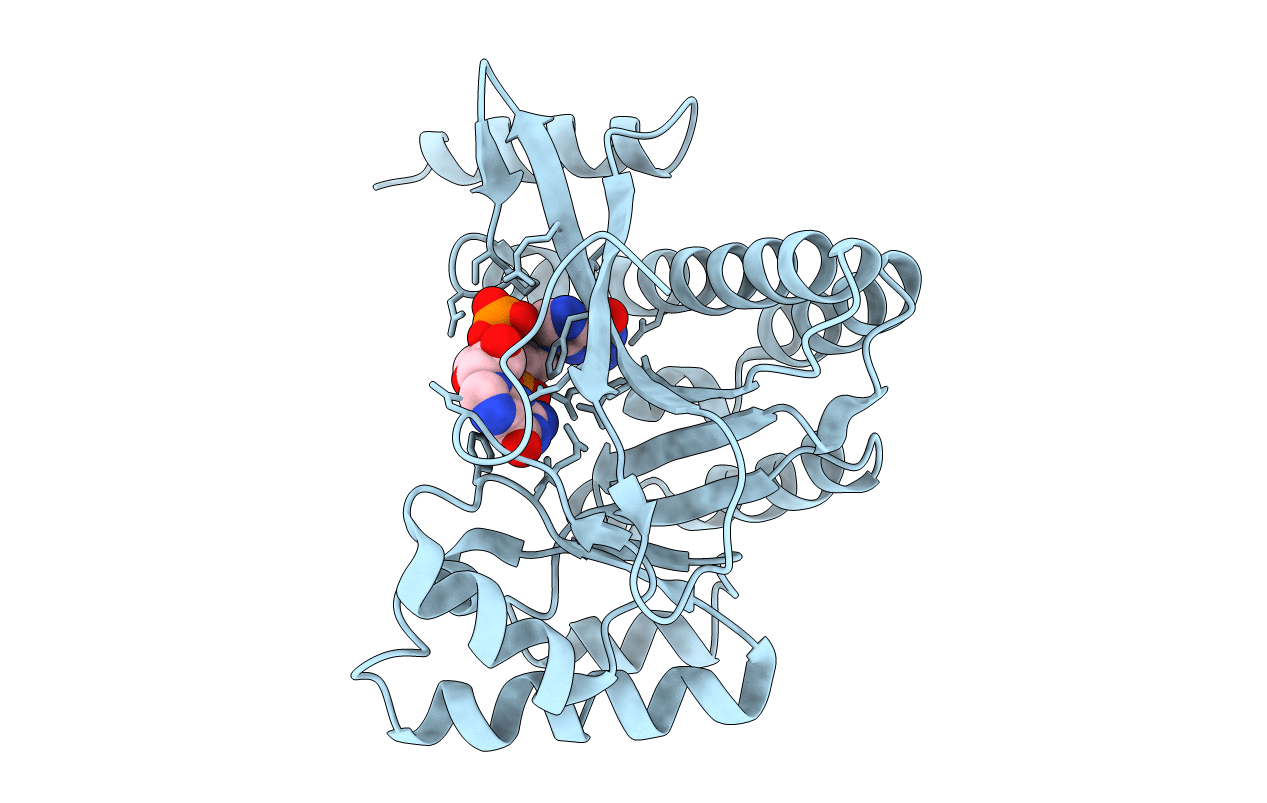
4F3H image
Deposition Date 2012-05-09
Release Date 2012-11-14
Last Version Date 2023-11-08
Entry Detail
PDB ID:
4F3H
Title:
The structural of FimXEAL-c-di-GMP from Xanthomonas campestris
Biological Source:
Source Organism(s):
Expression System(s):
Method Details:
Experimental Method:
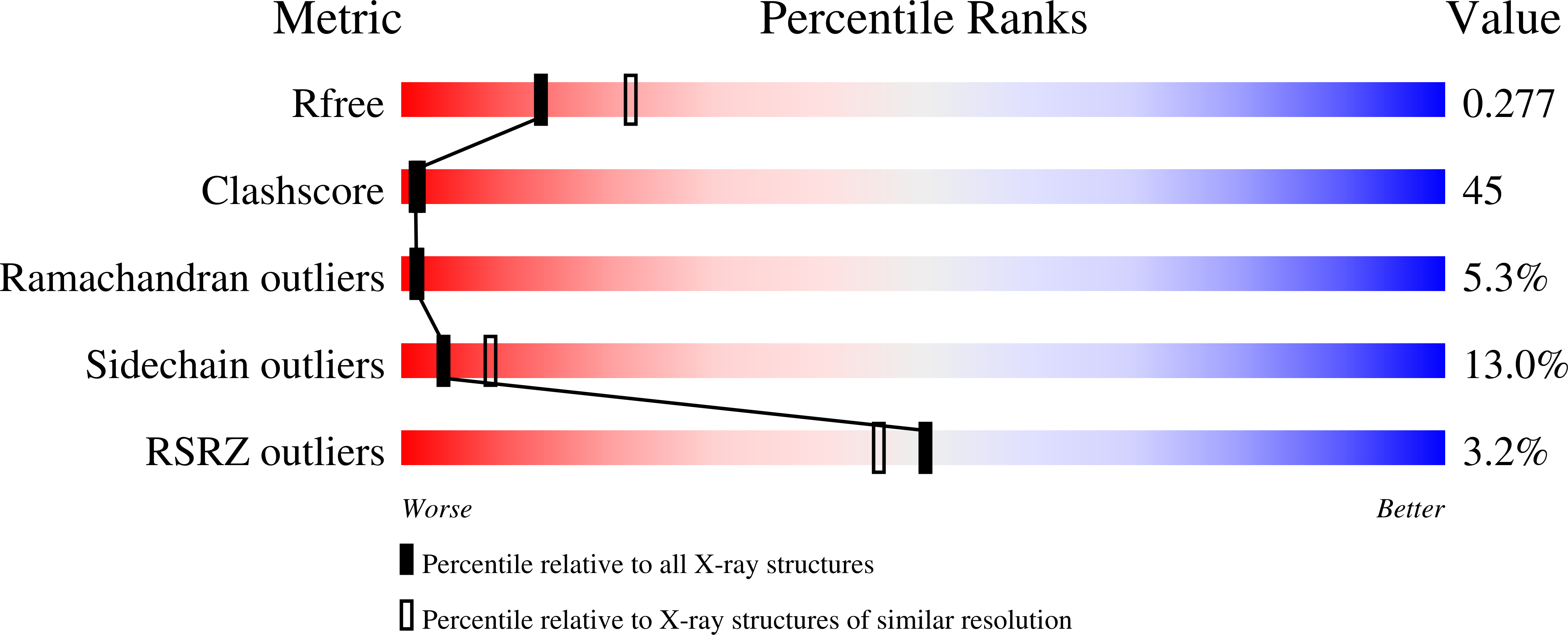
Resolution:
2.50 Å
R-Value Free:
0.25
R-Value Work:
0.23
R-Value Observed:
0.23
Space Group:
P 32 2 1
Macromolecular Entities
Polymer Type:polypeptide(L)
Molecule:Putative uncharacterized prot
Gene (Uniprot):XCC2291
Chain IDs:A
Chain Length:250
Number of Molecules:1
Biological Source:Xanthomonas campestris pv. campestris
Ligand Molecules
Primary Citation
Structural polymorphism of c-di-GMP bound to an EAL domain and in complex with a type II PilZ-domain protein.
Acta Crystallogr. D Biol. Crystallogr. 68 1380 1392 (2012)
PMID: 22993092 DOI: 10.1107/S0907444912030594

Abstact

Cyclic di-GMP (c-di-GMP) is a novel secondary-messenger molecule that is involved in regulating a plethora of important bacterial activities through binding to an unprecedented array of effectors. Proteins with a canonical PilZ domain that bind c-di-GMP play crucial roles in regulating flagellum-based motility. In contrast, noncanonical type II PilZ domains that do not effectively bind c-di-GMP regulate twitching motility, which is dependent on type IV pili (T4P). Recent data indicate that T4P biogenesis is initiated via the interaction of a noncanonical type II PilZ protein with the GGDEF/EAL-domain protein FimX and the pilus motor protein PilB at high c-di-GMP concentrations. However, the molecular details of such interactions remain to be elucidated. In this manuscript, the first hetero-complex crystal structure between a type II PilZ protein and the EAL domain of the FimX protein (FimX(EAL)) from Xanthomonas campestris pv. campestris (Xcc) in the presence of c-di-GMP is reported. This work reveals two novel conformations of monomeric c-di-GMP in the XccFimX(EAL)-c-di-GMP and XccFimX(EAL)-c-di-GMP-XccPilZ complexes, as well as a unique interaction mode of a type II PilZ domain with FimX(EAL). These findings indicate that c-di-GMP is sufficiently flexible to adjust its conformation to match the corresponding recognition motifs of different cognate effectors. Together, these results represent a first step towards an understanding of how T4P biogenesis is controlled by c-di-GMP at the molecular level and also of the ability of c-di-GMP to bind to a wide variety of effectors.

Legend

Protein

Chemical

Disease

Primary Citation of related structures
Feedback Form
Name
Email
Institute
Feedback