

4DAY image
Deposition Date 2012-01-13
Release Date 2012-03-14
Last Version Date 2023-09-13
Entry Detail
PDB ID:
4DAY
Title:
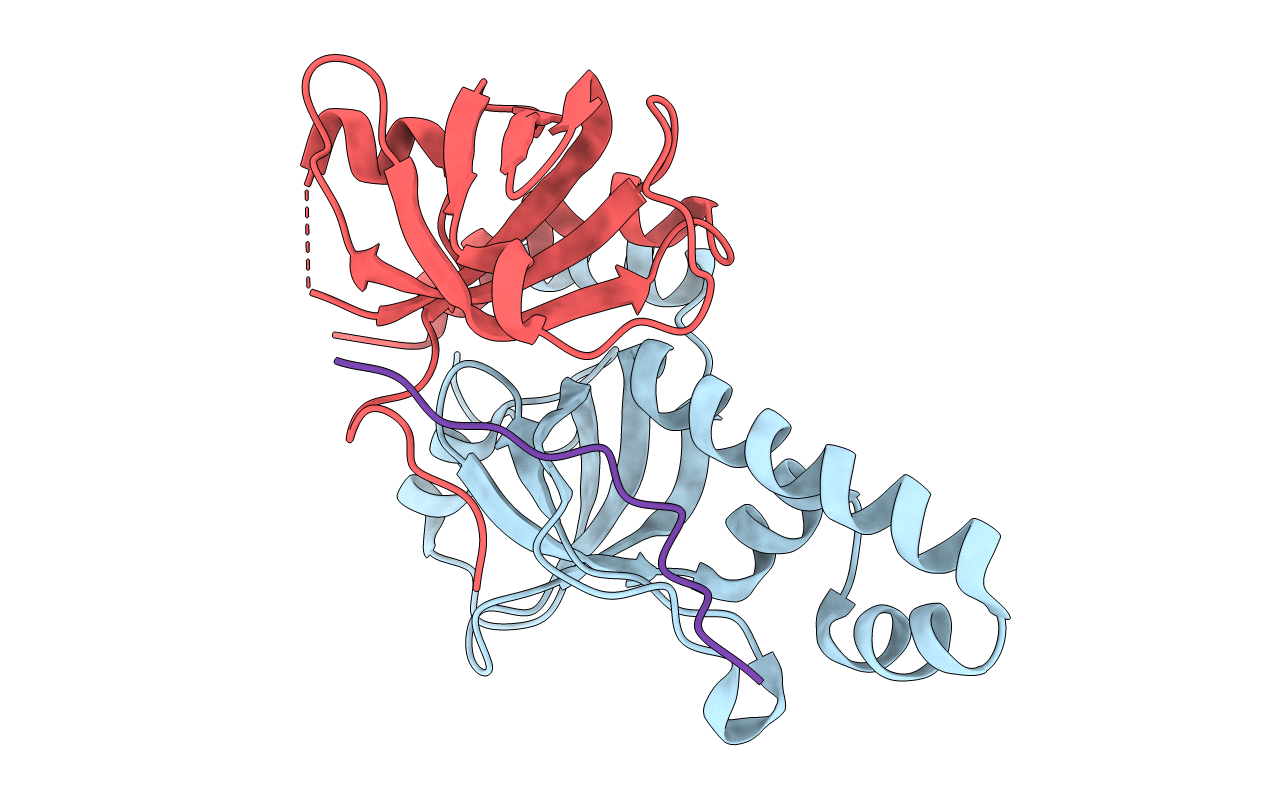
Crystal structure of the RMI core complex with MM2 peptide from FANCM
Biological Source:
Source Organism(s):
Homo sapiens (Taxon ID: 9606)
Expression System(s):
Method Details:
Experimental Method:
Resolution:
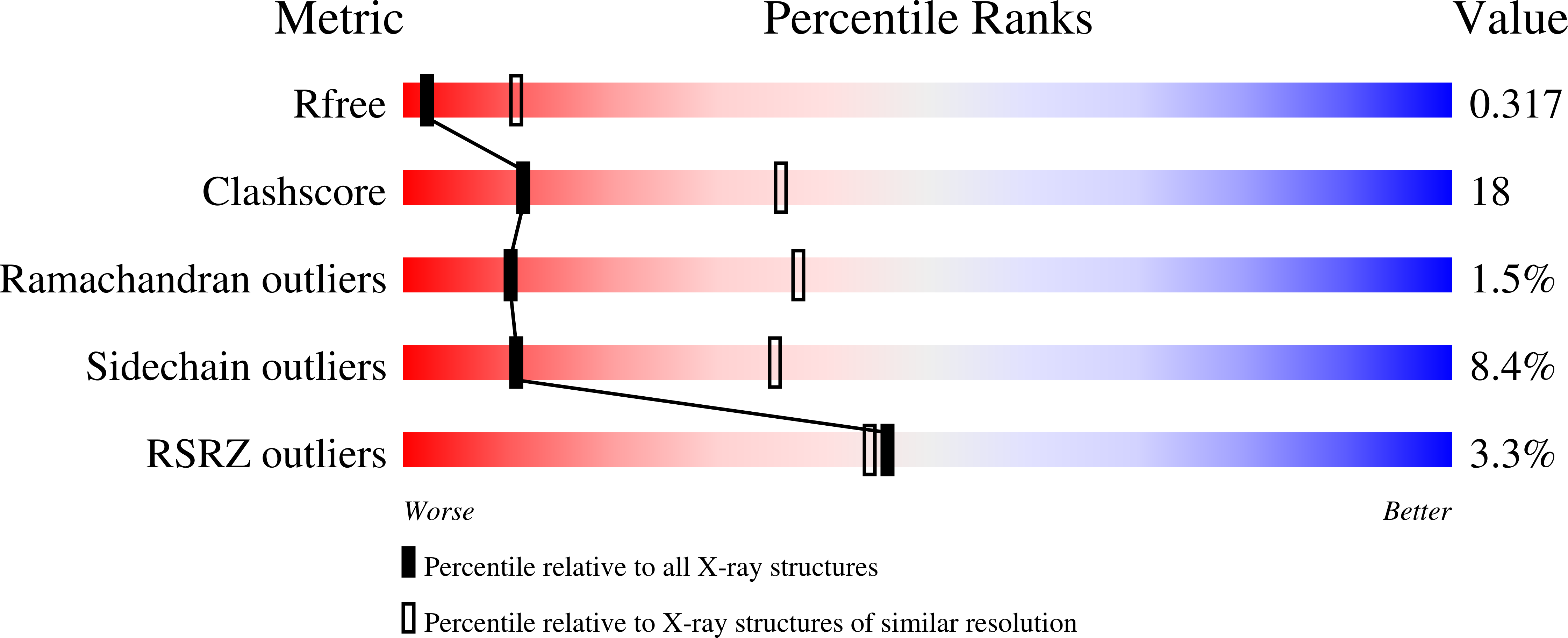
3.30 Å
R-Value Free:
0.32
R-Value Work:
0.21
R-Value Observed:
0.22
Space Group:
I 21 21 21
Macromolecular Entities
Structures with similar UniProt ID
Protein Blast
Polymer Type:polypeptide(L)
Molecule:RecQ-mediated genome instabil
Gene (Uniprot):RMI1
Chain IDs:A
Chain Length:157
Number of Molecules:1
Biological Source:Homo sapiens
Structures with similar UniProt ID
Protein Blast
Polymer Type:polypeptide(L)
Molecule:RecQ-mediated genome instabil
Gene (Uniprot):RMI2
Chain IDs:B
Chain Length:150
Number of Molecules:1
Biological Source:Homo sapiens
Structures with similar UniProt ID
Protein Blast
Polymer Type:polypeptide(L)
Molecule:Fanconi anemia group M protei
Gene (Uniprot):FANCM
Chain IDs:C
Chain Length:37
Number of Molecules:1
Biological Source:Homo sapiens
Ligand Molecules
Primary Citation
Defining the molecular interface that connects the Fanconi anemia protein FANCM to the Bloom syndrome dissolvasome.
Proc. Natl. Acad. Sci. U.S.A. 109 4437 4442 (2012)
PMID: 22392978 DOI: 10.1073/pnas.1117279109

Abstact

The RMI subcomplex (RMI1/RMI2) functions with the BLM helicase and topoisomerase IIIα in a complex called the "dissolvasome," which separates double-Holliday junction DNA structures that can arise during DNA repair. This activity suppresses potentially harmful sister chromatid exchange (SCE) events in wild-type cells but not in cells derived from Bloom syndrome patients with inactivating BLM mutations. The RMI subcomplex also associates with FANCM, a component of the Fanconi anemia (FA) core complex that is important for repair of stalled DNA replication forks. The RMI/FANCM interface appears to help coordinate dissolvasome and FA core complex activities, but its precise role remains poorly understood. Here, we define the structure of the RMI/FANCM interface and investigate its roles in coordinating cellular DNA-repair activities. The X-ray crystal structure of the RMI core complex bound to a well-conserved peptide from FANCM shows that FANCM binds to both RMI proteins through a hydrophobic "knobs-into-holes" packing arrangement. The RMI/FANCM interface is shown to be critical for interaction between the components of the dissolvasome and the FA core complex. FANCM variants that substitute alanine for key interface residues strongly destabilize the complex in solution and lead to increased SCE levels in cells that are similar to those observed in blm- or fancm-deficient cells. This study provides a molecular view of the RMI/FANCM complex and highlights a key interface utilized in coordinating the activities of two critical eukaryotic DNA-damage repair machines.

Legend

Protein

Chemical

Disease

Primary Citation of related structures
Feedback Form
Name
Email
Institute
Feedback