

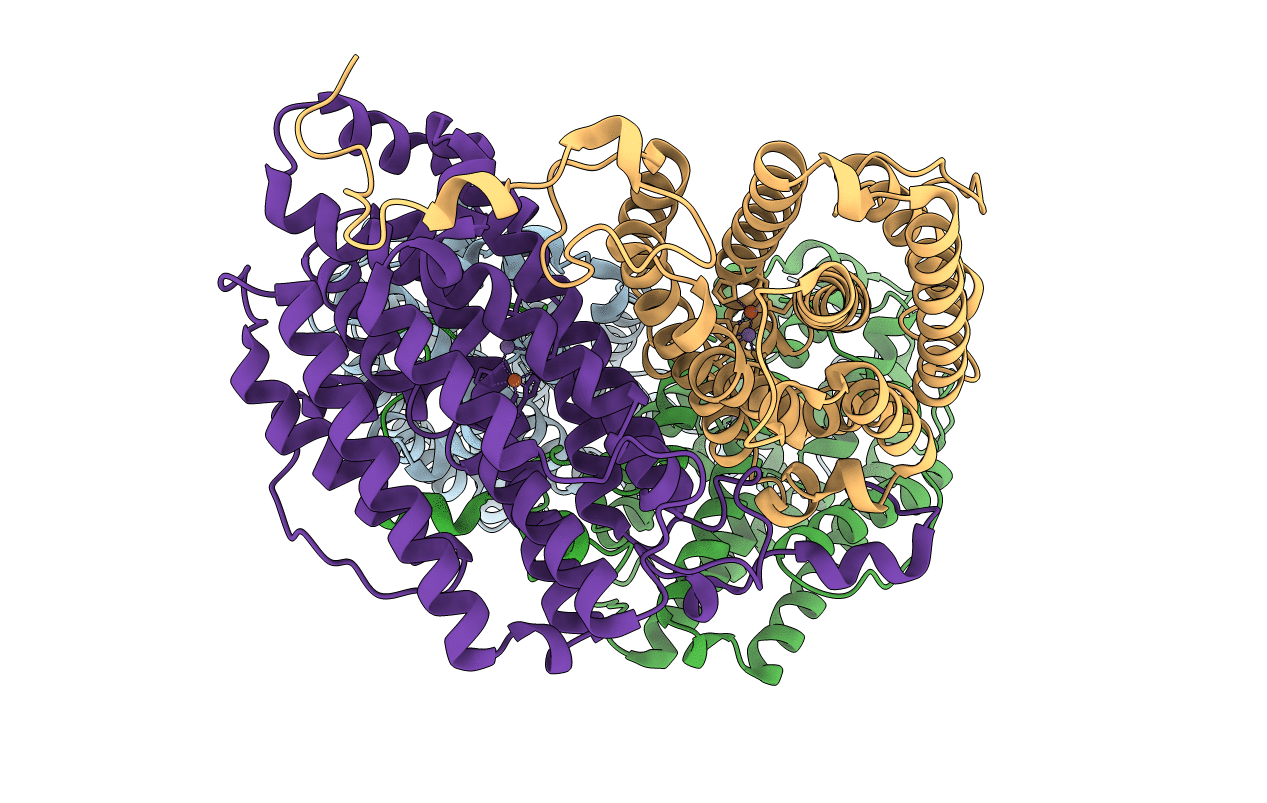
4D8G image
Deposition Date 2012-01-10
Release Date 2012-02-15
Last Version Date 2024-02-28
Entry Detail
PDB ID:
4D8G
Keywords:
Title:
Chlamydia trachomatis NrdB with a Mn/Fe cofactor (procedure 2 - low Mn)
Biological Source:
Source Organism(s):
Expression System(s):
Method Details:
Experimental Method:
Resolution:
1.75 Å
R-Value Free:
0.22
R-Value Work:
0.19
R-Value Observed:
0.19
Space Group:
P 1 21 1
Macromolecular Entities
Structures with similar UniProt ID
Protein Blast
Polymer Type:polypeptide(L)
Molecule:Ribonucleoside-diphosphate re
Gene (Uniprot):nrdB
Chain IDs:A, B, C, D
Chain Length:366
Number of Molecules:4
Biological Source:Chlamydia trachomatis
Primary Citation
Evidence that the beta subunit of Chlamydia trachomatis ribonucleotide reductase is active with the manganese ion of its manganese(IV)/iron(III) cofactor in site 1.
J. Am. Chem. Soc. 134 2520 2523 (2012)
PMID: 22242660 DOI: 10.1021/ja211314p

Abstact

The reaction of a class I ribonucleotide reductase (RNR) begins when a cofactor in the β subunit oxidizes a cysteine residue ~35 Å away in the α subunit, generating a thiyl radical. In the class Ic enzyme from Chlamydia trachomatis (Ct), the cysteine oxidant is the Mn(IV) ion of a Mn(IV)/Fe(III) cluster, which assembles in a reaction between O(2) and the Mn(II)/Fe(II) complex of β. The heterodinuclear nature of the cofactor raises the question of which site, 1 or 2, contains the Mn(IV) ion. Because site 1 is closer to the conserved location of the cysteine-oxidizing tyrosyl radical of class Ia and Ib RNRs, we suggested that the Mn(IV) ion most likely resides in this site (i.e., (1)Mn(IV)/(2)Fe(III)), but a subsequent computational study favored its occupation of site 2 ((1)Fe(III)/(2)Mn(IV)). In this work, we have sought to resolve the location of the Mn(IV) ion in Ct RNR-β by correlating X-ray crystallographic anomalous scattering intensities with catalytic activity for samples of the protein reconstituted in vitro by two different procedures. In samples containing primarily Mn(IV)/Fe(III) clusters, Mn preferentially occupies site 1, but some anomalous scattering from site 2 is observed, implying that both (1)Mn(II)/(2)Fe(II) and (1)Fe(II)/(2)Mn(II) complexes are competent to react with O(2) to produce the corresponding oxidized states. However, with diminished Mn(II) loading in the reconstitution, there is no evidence for Mn occupancy of site 2, and the greater activity of these "low-Mn" samples on a per-Mn basis implies that the (1)Mn(IV)/(2)Fe(III)-β is at least the more active of the two oxidized forms and may be the only active form.

Legend

Protein

Chemical

Disease

Primary Citation of related structures
Feedback Form
Name
Email
Institute
Feedback