

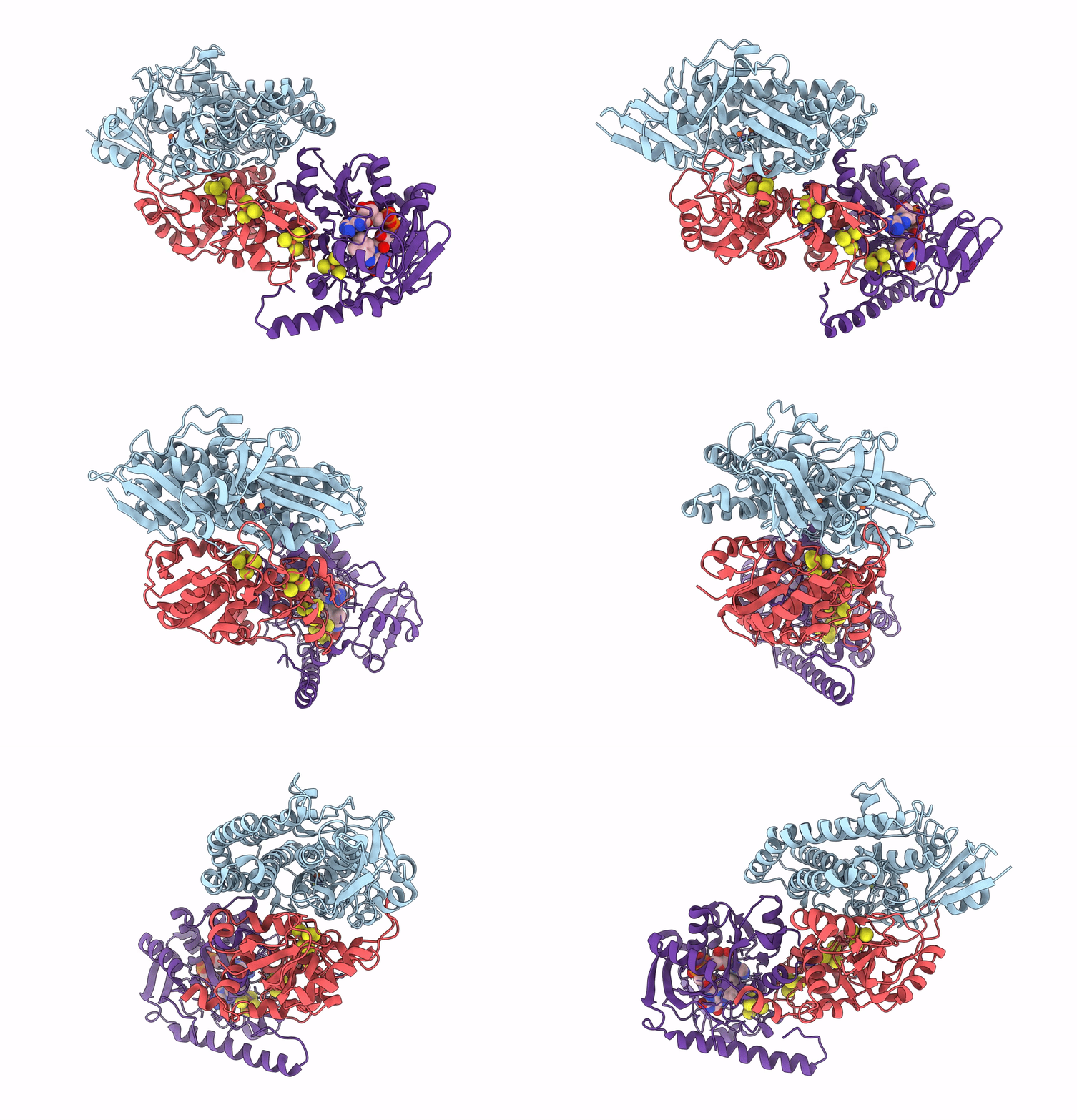
4CI0 image
Deposition Date 2013-12-05
Release Date 2014-02-26
Last Version Date 2024-11-06
Entry Detail
PDB ID:
4CI0
Keywords:
Title:
Electron cryo-microscopy of F420-reducing NiFe hydrogenase Frh
Biological Source:
Source Organism(s):
Method Details:
Experimental Method:
Resolution:
3.36 Å
Aggregation State:
PARTICLE
Reconstruction Method:
SINGLE PARTICLE

Macromolecular Entities
Structures with similar UniProt ID
Protein Blast
Polymer Type:polypeptide(L)
Molecule:F420-REDUCING HYDROGENASE, SU
Gene (Uniprot):frhA
Chain IDs:A
Chain Length:386
Number of Molecules:1
Biological Source:METHANOTHERMOBACTER MARBURGENSIS
Structures with similar UniProt ID
Protein Blast
Polymer Type:polypeptide(L)
Molecule:F420-REDUCING HYDROGENASE, SU
Gene (Uniprot):frhG
Chain IDs:B
Chain Length:275
Number of Molecules:1
Biological Source:METHANOTHERMOBACTER MARBURGENSIS
Structures with similar UniProt ID
Protein Blast
Polymer Type:polypeptide(L)
Molecule:F420-REDUCING HYDROGENASE, SU
Gene (Uniprot):frhB
Chain IDs:C
Chain Length:281
Number of Molecules:1
Biological Source:METHANOTHERMOBACTER MARBURGENSIS
Primary Citation
Atomic Model of the F420-Reducing [Nife] Hydrogenase by Electron Cryo-Electron Microscopy Using a Direct Electron Detector.
Elife 3 01963 ? (2014)
PMID: 24569482 DOI: 10.7554/ELIFE.01963

Abstact

The introduction of direct electron detectors with higher detective quantum efficiency and fast read-out marks the beginning of a new era in electron cryo-microscopy. Using the FEI Falcon II direct electron detector in video mode, we have reconstructed a map at 3.36 Å resolution of the 1.2 MDa F420-reducing hydrogenase (Frh) from methanogenic archaea from only 320,000 asymmetric units. Videos frames were aligned by a combination of image and particle alignment procedures to overcome the effects of beam-induced motion. The reconstructed density map shows all secondary structure as well as clear side chain densities for most residues. The full coordination of all cofactors in the electron transfer chain (a [NiFe] center, four [4Fe4S] clusters and an FAD) is clearly visible along with a well-defined substrate access channel. From the rigidity of the complex we conclude that catalysis is diffusion-limited and does not depend on protein flexibility or conformational changes. DOI: http://dx.doi.org/10.7554/eLife.01963.001.

Legend

Protein

Chemical

Disease

Primary Citation of related structures
Feedback Form
Name
Email
Institute
Feedback