

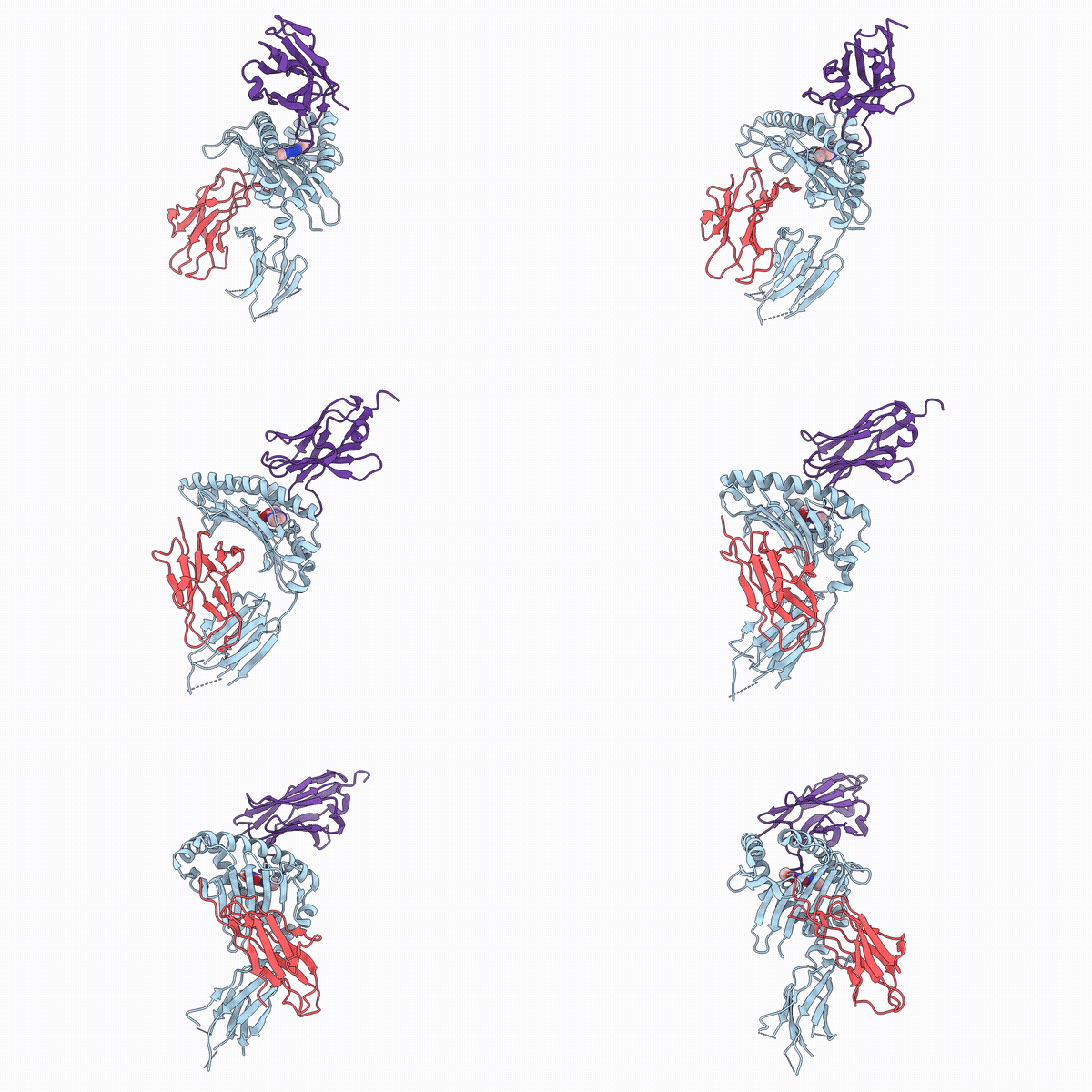
45AS image
Deposition Date 2026-08-21
Release Date 2026-10-07
Last Version Date 2026-10-07
Entry Detail
PDB ID:
45AS
Keywords:
Title:
Crystal structure of C11 nanobody in complex with human MR1-Ac-6-FP
Biological Source:
Source Organism(s):
Homo sapiens (Taxon ID: 9606)
Expression System(s):
Method Details:
Experimental Method:
Resolution:
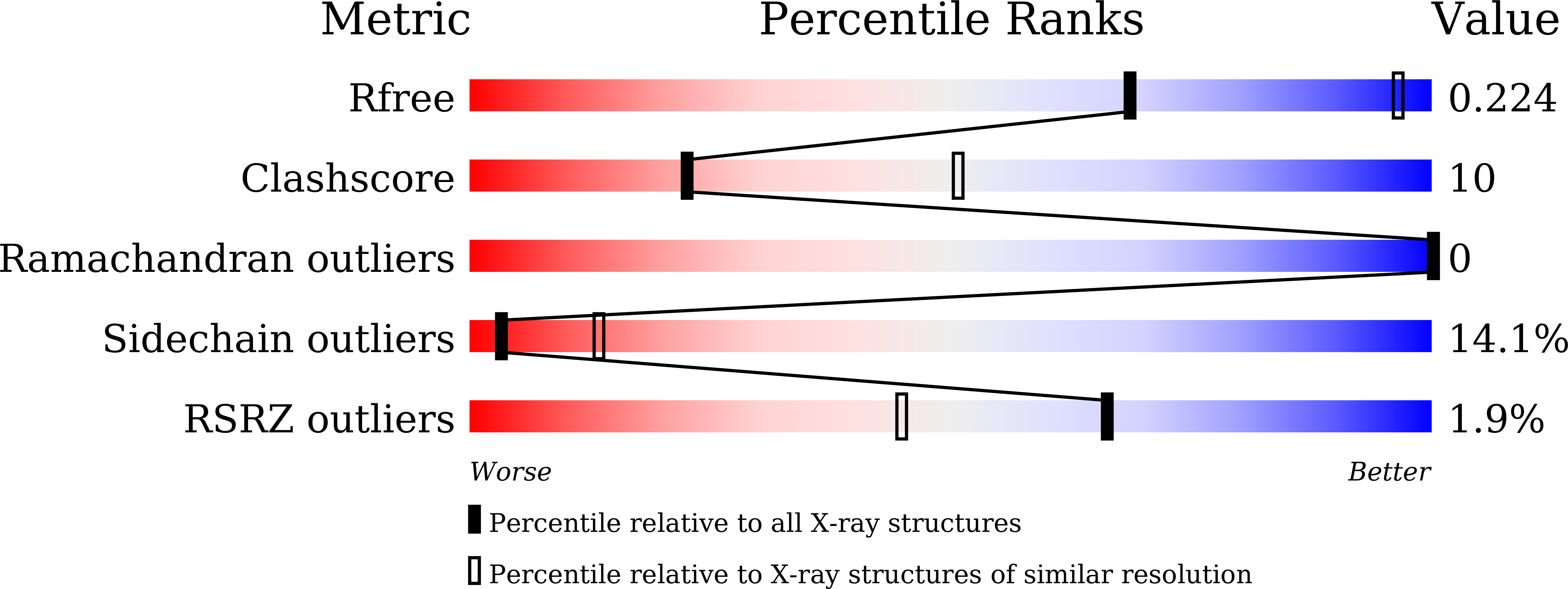
3.14 Å
R-Value Free:
0.22
R-Value Work:
0.20
R-Value Observed:
0.20
Space Group:
P 32 1 2
Macromolecular Entities
Polymer Type:polypeptide(L)
Molecule:Major histocompatibility comp
Gene (Uniprot):MR1
Chain IDs:A
Chain Length:271
Number of Molecules:1
Biological Source:Homo sapiens
Polymer Type:polypeptide(L)
Molecule:Beta-2-microglobulin
Gene (Uniprot):B2M
Chain IDs:B
Chain Length:100
Number of Molecules:1
Biological Source:Homo sapiens
Polymer Type:polypeptide(L)
Molecule:C11 nanoody
Chain IDs:C
Chain Length:128
Number of Molecules:1
Biological Source:Homo sapiens
Ligand Molecules
Primary Citation
Specific targeting of MR1-antigen complexes using nanobodies.
Sci Immunol 11 eaeb8726 eaeb8726 (2026)
PMID: 42789664 DOI: 10.1126/sciimmunol.aeb8726

Abstact

T cell receptor mimic (TCRm) antibodies that bind peptide-human leukocyte antigen complexes have great therapeutic potential. Major histocompatibility complex class I-related protein 1 (MR1) exhibits limited polymorphism and presents conserved metabolites, such as 5-OP-RU, derived from microbial riboflavin biosynthesis. Whether antibodies targeting such MR1-5-OP-RU complexes can be generated remains unclear. Using yeast display technology, nanobodies with high affinity toward the MR1-5-OP-RU complex were generated. These nanobodies can bind both mouse and human MR1-5-OP-RU and inhibit mucosal-associated invariant T (MAIT) cell responses to 5-OP-RU and bacterial challenge, demonstrating in vitro and in vivo bioactivity. We also solved the crystal structures of the lead nanobody in complex with MR1 antigens and demonstrated that the nanobody cobound MR1 and 5-OP-RU, akin to a TCRm antibody. Last, we engineered bispecific antibodies targeting both MR1-5-OP-RU and CD3 that drive broad T cell killing of bacterially infected cells as well as tumor cells treated with 5-OP-RU, providing evidence for immune redirection via MR1-targeting TCRm-based nanobodies.

Legend

Protein

Chemical

Disease

Primary Citation of related structures
Feedback Form
Name
Email
Institute
Feedback