

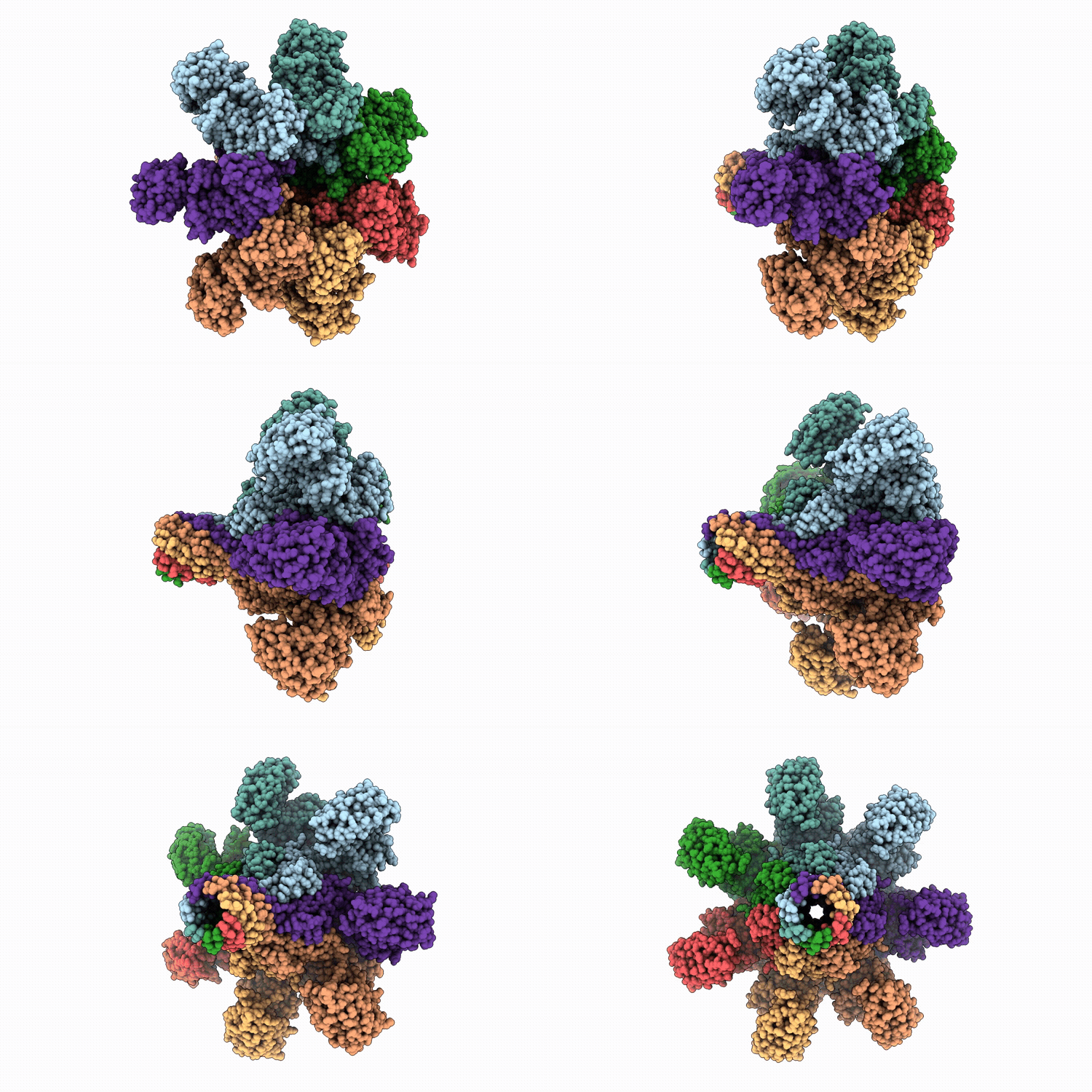
44BV image
Deposition Date 2026-07-24
Release Date 2026-08-12
Last Version Date 2026-10-14
Entry Detail
PDB ID:
44BV
Keywords:
Title:
Iota toxin Ib D452A pore
Biological Source:
Source Organism(s):
Expression System(s):
Method Details:
Experimental Method:
Resolution:
2.56 Å
Aggregation State:
PARTICLE
Reconstruction Method:
SINGLE PARTICLE
Macromolecular Entities
Polymer Type:polypeptide(L)
Molecule:Iota toxin component Ib
Mutagens:D452A
Chain IDs:A, B, C, D, E, F, G
Chain Length:530
Number of Molecules:7
Biological Source:Clostridium perfringens
Ligand Molecules
Primary Citation
Step-by-step maturation mechanism of the binary toxin pore revealed by cryo-EM analysis.
Proc.Natl.Acad.Sci.USA 123 e2627537123 e2627537123 (2026)
PMID: 42804625 DOI: 10.1073/pnas.2627537123

Abstact

Membrane pore-forming proteins (PFPs) form ring-shaped membrane-translocating oligomers on membranes, contributing to infection, immunity, and cell death functions. Binary toxins produced by some bacteria consist of an enzymatic component that acts as a toxin and a membrane-binding component that forms a pore that delivers the enzymatic component into target cells. Cryoelectron microscopy (cryo-EM) has advanced our understanding of these translocation mechanisms by revealing several binary toxin complexes' structures. However, the mechanisms underlying the initial pore formation remain unclear. We determined the structures of several oligomeric forms of the membrane-binding component Ib of the iota toxin from Clostridium perfringens at various stages of pore formation. Structural comparisons revealed how the symmetrically arranged soluble oligomer (prepore) asymmetrically matures into a transmembrane oligomer (pore). These findings enhance our understanding of mechanisms of PFP and provide a structural basis for developing nanodevices using membrane pores.

Legend

Protein

Chemical

Disease

Primary Citation of related structures
Feedback Form
Name
Email
Institute
Feedback