

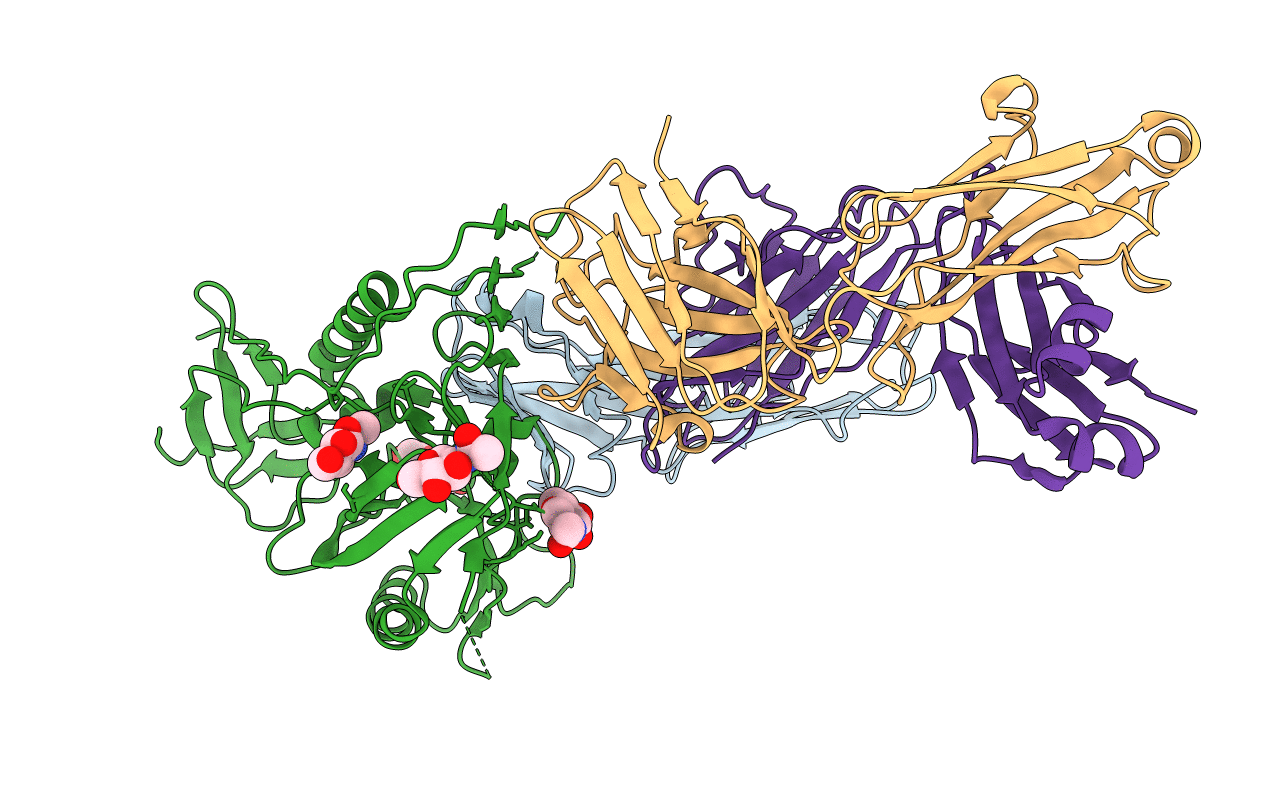
3LQA image
Deposition Date 2010-02-08
Release Date 2010-04-07
Last Version Date 2024-10-30
Entry Detail
PDB ID:
3LQA
Keywords:
Title:
Crystal structure of clade C gp120 in complex with sCD4 and 21c Fab
Biological Source:
Source Organism(s):
Homo sapiens (Taxon ID: 9606)
HIV-1 (Taxon ID: 11676)
Expression System(s):
Method Details:
Experimental Method:
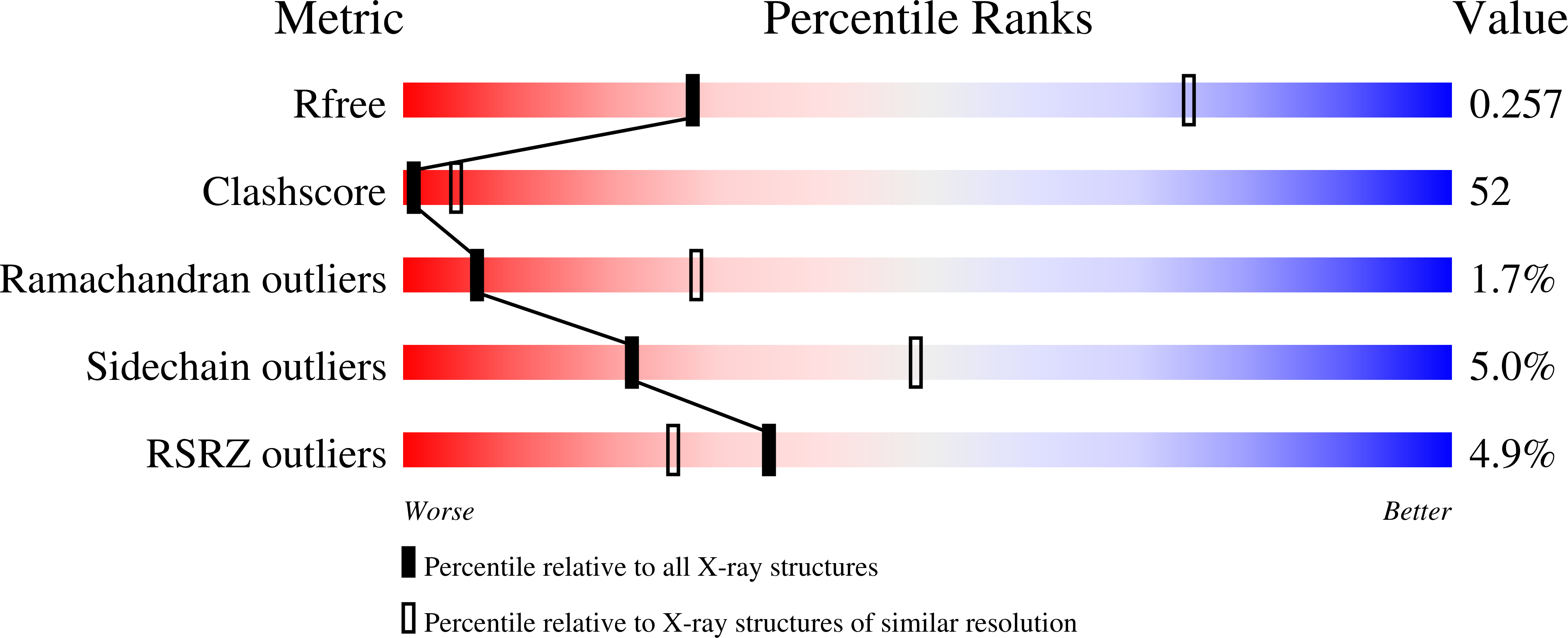
Resolution:
3.40 Å
R-Value Free:
0.32
R-Value Work:
0.23
Space Group:
C 2 2 21
Macromolecular Entities
Polymer Type:polypeptide(L)
Molecule:T-cell surface glycoprotein C
Gene (Uniprot):CD4
Chain IDs:A (auth: C)
Chain Length:192
Number of Molecules:1
Biological Source:Homo sapiens
Polymer Type:polypeptide(L)
Molecule:Envelope glycoprotein gp160
Gene (Uniprot):env
Mutagens:T89I, N226D, T232I, N285T, S329N, T388I, N447D
Chain IDs:B (auth: G)
Chain Length:332
Number of Molecules:1
Biological Source:HIV-1
Polymer Type:polypeptide(L)
Molecule:Heavy chain of anti HIV Fab f
Chain IDs:C (auth: H)
Chain Length:231
Number of Molecules:1
Biological Source:Homo sapiens
Polymer Type:polypeptide(L)
Molecule:Light chain of anti HIV Fab f
Chain IDs:D (auth: L)
Chain Length:217
Number of Molecules:1
Biological Source:Homo sapiens
Modified Residue
Compound ID Chain ID Parent Comp ID Details 2D Image
ASN B ASN GLYCOSYLATION SITE
Ligand Molecules
Primary Citation
Structure of a clade C HIV-1 gp120 bound to CD4 and CD4-induced antibody reveals anti-CD4 polyreactivity.
Nat. Struct. Mol. Biol. 17 608 613 (2010)
PMID: 20357769 DOI: 10.1038/nsmb.1796

Abstact

Strategies to combat HIV-1 require structural knowledge of envelope proteins from viruses in HIV-1 clade C, the most rapidly spreading subtype in the world. We present a crystal structure containing a clade C gp120 envelope. The structure, a complex between gp120, the host receptor CD4 and the CD4-induced antibody 21c, reveals that the 21c epitope involves contacts with gp120, a nonself antigen, and with CD4, an autoantigen. Binding studies using wild-type and mutant CD4 show that 21c Fab binds CD4 in the absence of gp120, and that binding of 21c to clade C and HIV-2 gp120s requires the crystallographically observed 21c-CD4 interaction. Additional binding data suggest a role for the gp120 V1V2 loop in creating a high-affinity, but slow-forming, epitope for 21c after CD4 binds. These results contribute to a molecular understanding of CD4-induced antibodies and provide the first visualization to our knowledge of a potentially autoreactive antibody Fab complexed with both self and nonself antigens.

Legend

Protein

Chemical

Disease

Primary Citation of related structures
Feedback Form
Name
Email
Institute
Feedback