

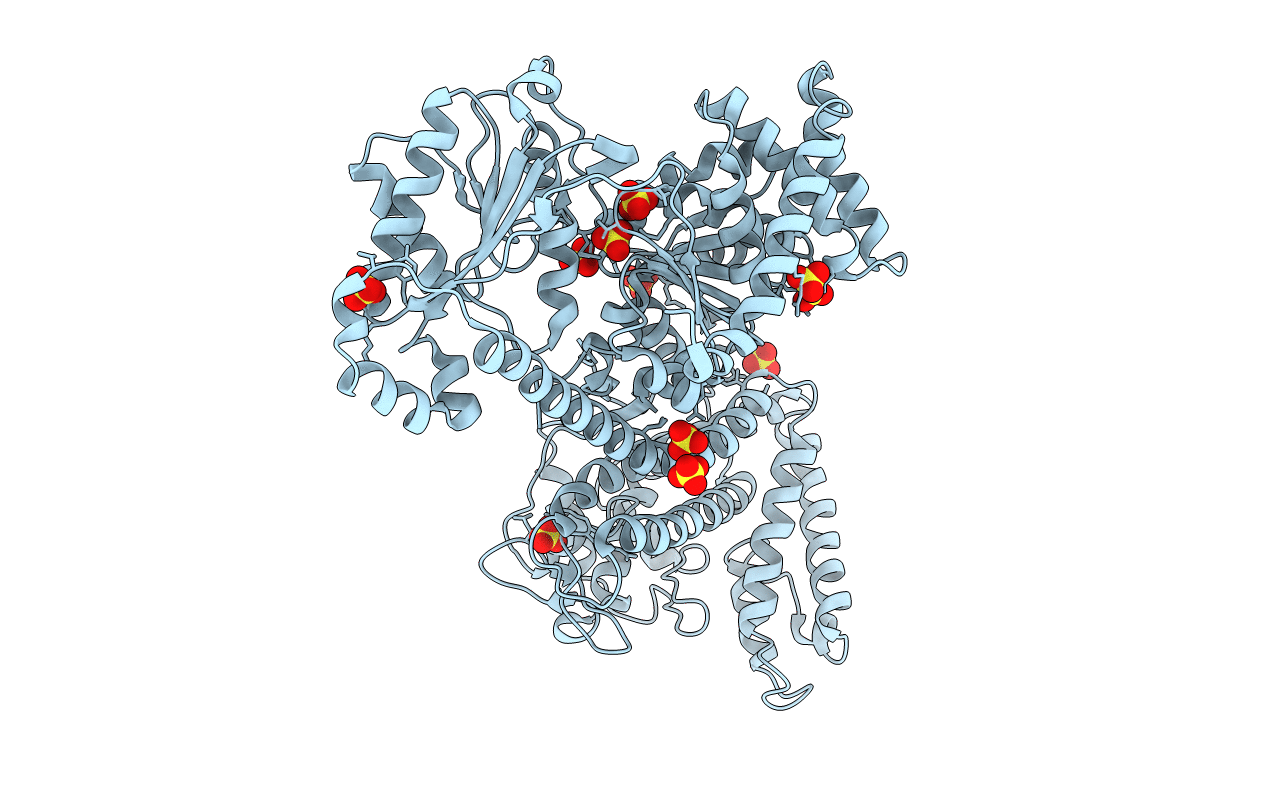
3IQM image
Deposition Date 2009-08-20
Release Date 2010-08-11
Last Version Date 2023-09-06
Entry Detail
PDB ID:
3IQM
Title:
Active site mutants of B. subtilis SecA
Biological Source:
Source Organism(s):
Expression System(s):
Method Details:
Experimental Method:
Resolution:
3.40 Å
R-Value Free:
0.26
R-Value Work:
0.20
R-Value Observed:
0.20
Space Group:
P 31 1 2

Macromolecular Entities
Structures with similar UniProt ID
Protein Blast
Polymer Type:polypeptide(L)
Molecule:Protein translocase subunit s
Gene (Uniprot):secA
Mutagens:E208Q
Chain IDs:A
Chain Length:802
Number of Molecules:1
Biological Source:Bacillus subtilis subsp. subtilis
Ligand Molecules
Primary Citation
ATPase Active-Site Electrostatic Interactions Control the Global Conformation of the 100 kDa SecA Translocase.
J.Am.Chem.Soc. 135 2999 3010 (2013)
PMID: 23167435 DOI: 10.1021/ja306361q

Abstact

SecA is an intensively studied mechanoenzyme that uses ATP hydrolysis to drive processive extrusion of secreted proteins through a protein-conducting channel in the cytoplasmic membrane of eubacteria. The ATPase motor of SecA is strongly homologous to that in DEAD-box RNA helicases. It remains unclear how local chemical events in its ATPase active site control the overall conformation of an ~100 kDa multidomain enzyme and drive protein transport. In this paper, we use biophysical methods to establish that a single electrostatic charge in the ATPase active site controls the global conformation of SecA. The enzyme undergoes an ATP-modulated endothermic conformational transition (ECT) believed to involve similar structural mechanics to the protein transport reaction. We have characterized the effects of an isosteric glutamate-to-glutamine mutation in the catalytic base, a mutation which mimics the immediate electrostatic consequences of ATP hydrolysis in the active site. Calorimetric studies demonstrate that this mutation facilitates the ECT in Escherichia coli SecA and triggers it completely in Bacillus subtilis SecA. Consistent with the substantial increase in entropy observed in the course of the ECT, hydrogen-deuterium exchange mass spectrometry demonstrates that it increases protein backbone dynamics in domain-domain interfaces at remote locations from the ATPase active site. The catalytic glutamate is one of ~250 charged amino acids in SecA, and yet neutralization of its side chain charge is sufficient to trigger a global order-disorder transition in this 100 kDa enzyme. The intricate network of structural interactions mediating this effect couples local electrostatic changes during ATP hydrolysis to global conformational and dynamic changes in SecA. This network forms the foundation of the allosteric mechanochemistry that efficiently harnesses the chemical energy stored in ATP to drive complex mechanical processes.

Legend

Protein

Chemical

Disease

Primary Citation of related structures
Feedback Form
Name
Email
Institute
Feedback