

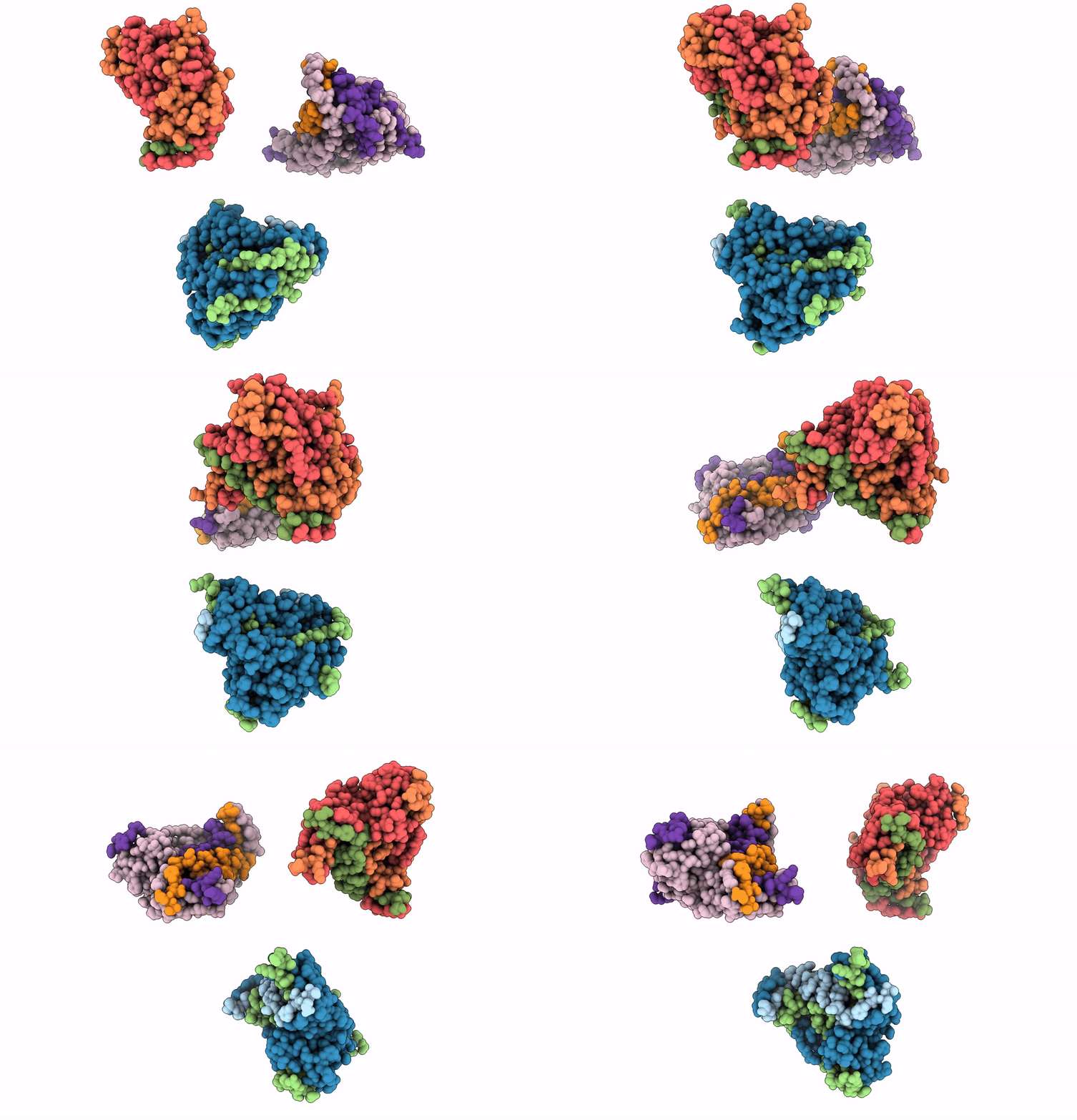
3DNO image
Deposition Date 2008-07-02
Release Date 2008-08-19
Last Version Date 2024-10-30
Entry Detail
PDB ID:
3DNO
Keywords:
Title:
Molecular structure for the HIV-1 gp120 trimer in the CD4-bound state
Biological Source:
Source Organism(s):
Expression System(s):
Method Details:
Experimental Method:
Resolution:
20.00 Å
Aggregation State:
PARTICLE
Reconstruction Method:
SINGLE PARTICLE

Macromolecular Entities
Structures with similar UniProt ID
Protein Blast
Polymer Type:polypeptide(L)
Molecule:HIV-1 envelope glycoprotein g
Gene (Uniprot):env
Chain IDs:A, D, G
Chain Length:35
Number of Molecules:3
Biological Source:HIV-1 M:B_HXB2R
Structures with similar UniProt ID
Protein Blast
Polymer Type:polypeptide(L)
Molecule:HIV-1 envelope glycoprotein g
Gene (Uniprot):env
Chain IDs:B, E, H
Chain Length:170
Number of Molecules:3
Biological Source:HIV-1 M:B_HXB2R
Structures with similar UniProt ID
Protein Blast
Polymer Type:polypeptide(L)
Molecule:HIV-1 envelope glycoprotein g
Gene (Uniprot):env
Chain IDs:C, F, I
Chain Length:83
Number of Molecules:3
Biological Source:HIV-1 M:B_HXB2R
Ligand Molecules
Primary Citation
Molecular architecture of native HIV-1 gp120 trimers.
Nature 455 109 113 (2008)
PMID: 18668044 DOI: 10.1038/nature07159

Abstact

The envelope glycoproteins (Env) of human and simian immunodeficiency viruses (HIV and SIV, respectively) mediate virus binding to the cell surface receptor CD4 on target cells to initiate infection. Env is a heterodimer of a transmembrane glycoprotein (gp41) and a surface glycoprotein (gp120), and forms trimers on the surface of the viral membrane. Using cryo-electron tomography combined with three-dimensional image classification and averaging, we report the three-dimensional structures of trimeric Env displayed on native HIV-1 in the unliganded state, in complex with the broadly neutralizing antibody b12 and in a ternary complex with CD4 and the 17b antibody. By fitting the known crystal structures of the monomeric gp120 core in the b12- and CD4/17b-bound conformations into the density maps derived by electron tomography, we derive molecular models for the native HIV-1 gp120 trimer in unliganded and CD4-bound states. We demonstrate that CD4 binding results in a major reorganization of the Env trimer, causing an outward rotation and displacement of each gp120 monomer. This appears to be coupled with a rearrangement of the gp41 region along the central axis of the trimer, leading to closer contact between the viral and target cell membranes. Our findings elucidate the structure and conformational changes of trimeric HIV-1 gp120 relevant to antibody neutralization and attachment to target cells.

Legend

Protein

Chemical

Disease

Primary Citation of related structures
Feedback Form
Name
Email
Institute
Feedback