

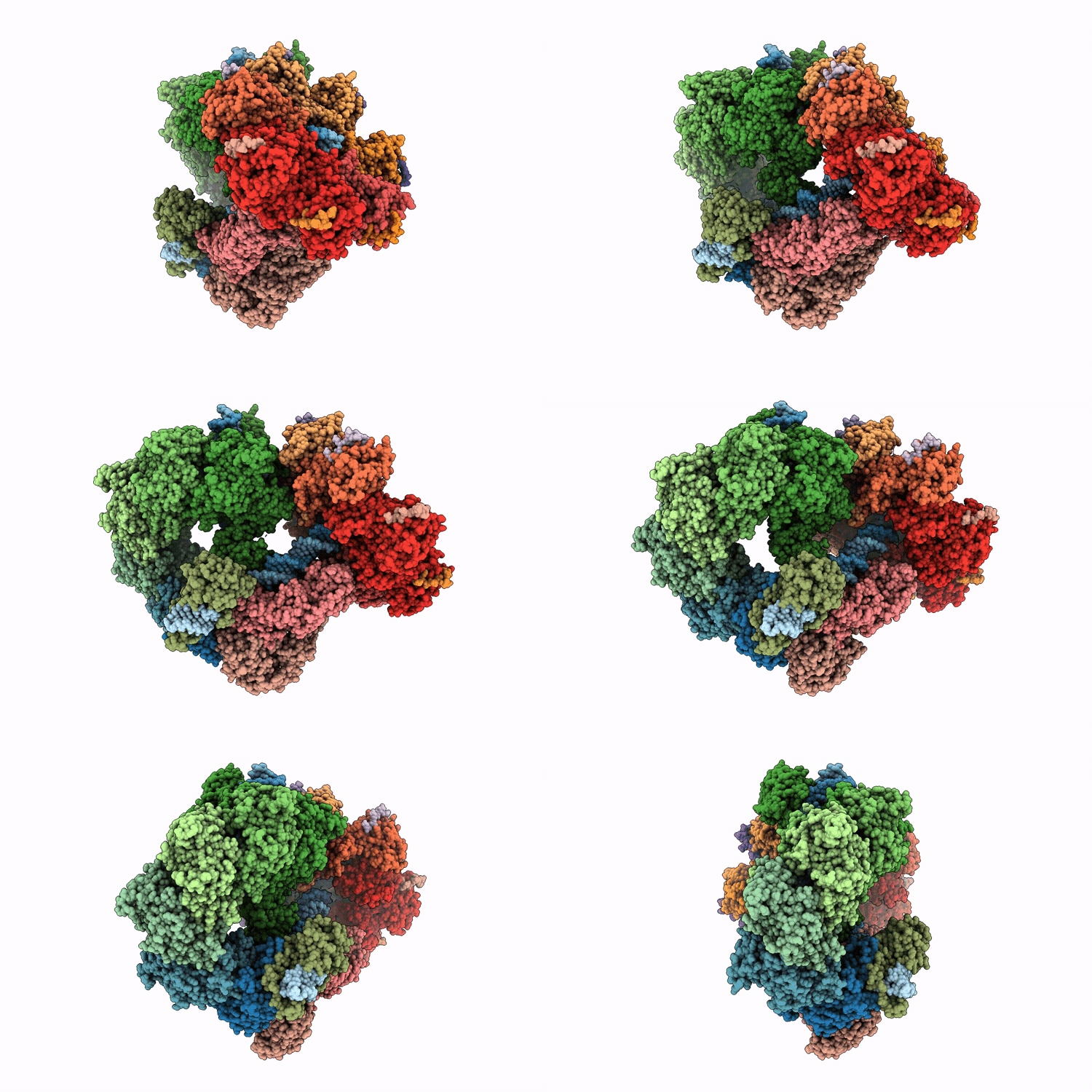
30GB image
Deposition Date 2026-04-23
Release Date 2026-06-17
Last Version Date 2026-06-17
Entry Detail
PDB ID:
30GB
Title:
Cryo-EM structure of the PseCascade-TniQ-TnsC complex bound to PseTnsB-hook motifs
Biological Source:
Source Organism(s):
Expression System(s):
Method Details:
Experimental Method:
Resolution:
2.90 Å
Aggregation State:
PARTICLE
Reconstruction Method:
SINGLE PARTICLE
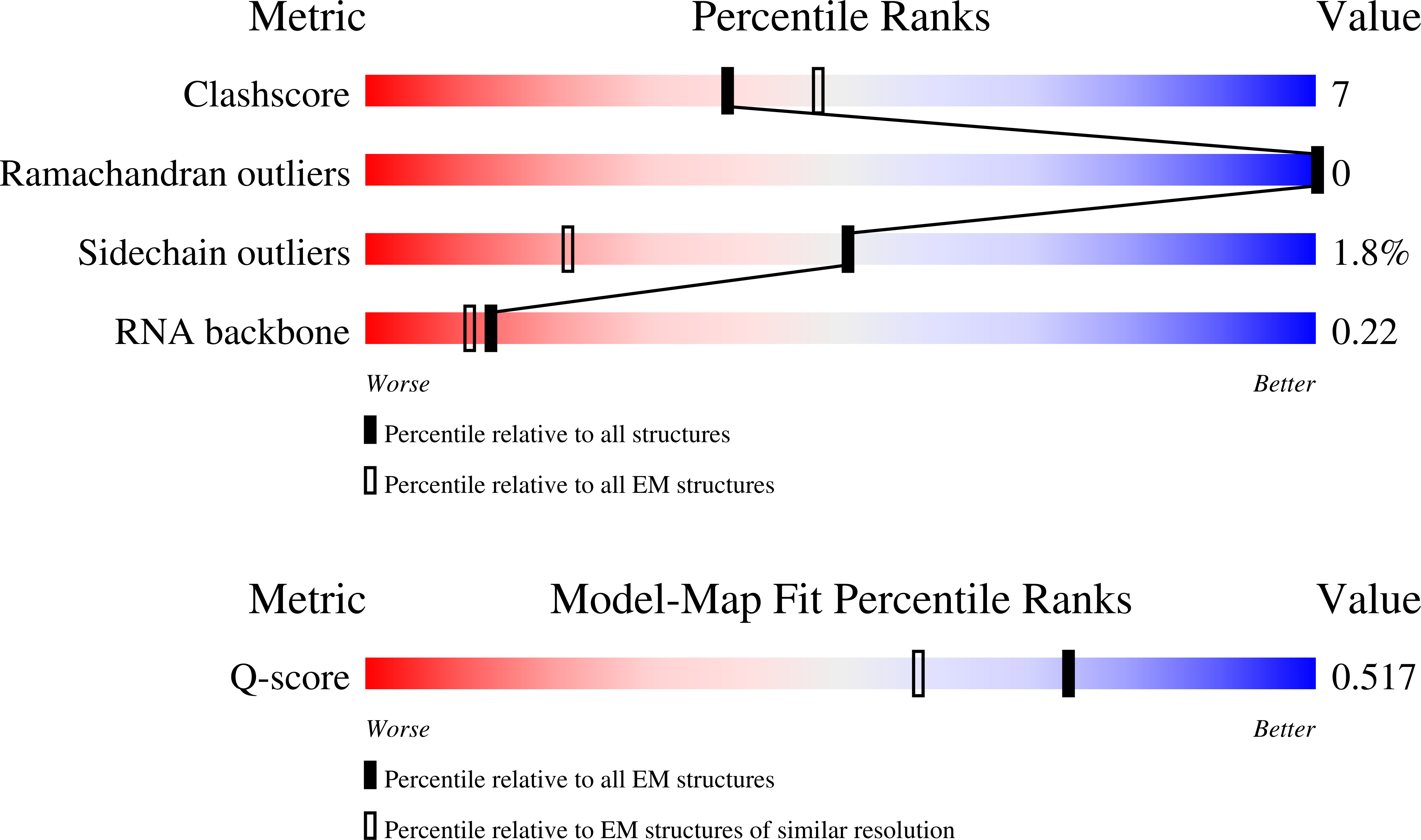
Macromolecular Entities
Polymer Type:polyribonucleotide
Molecule:CRISPR RNA
Chain IDs:A (auth: 1)
Chain Length:93
Number of Molecules:1
Biological Source:Pseudoalteromonas sp. S983
Polymer Type:polydeoxyribonucleotide
Molecule:Target DNA strand
Chain IDs:B (auth: 2)
Chain Length:120
Number of Molecules:1
Biological Source:Pseudoalteromonas sp. S983
Polymer Type:polydeoxyribonucleotide
Molecule:Non-target DNA strand
Chain IDs:C (auth: 3)
Chain Length:120
Number of Molecules:1
Biological Source:Pseudoalteromonas sp. S983
Structures with similar UniProt ID
Protein Blast
Polymer Type:polypeptide(L)
Molecule:Cas7.1
Chain IDs:D (auth: A), E (auth: B), F (auth: C), G (auth: D), H (auth: E), I (auth: F)
Chain Length:350
Number of Molecules:6
Biological Source:Pseudoalteromonas sp. S983
Structures with similar UniProt ID
Protein Blast
Polymer Type:polypeptide(L)
Molecule:Cas8
Chain IDs:J (auth: G)
Chain Length:695
Number of Molecules:1
Biological Source:Pseudoalteromonas sp. S983
Structures with similar UniProt ID
Protein Blast
Polymer Type:polypeptide(L)
Molecule:Cas6
Chain IDs:K (auth: H)
Chain Length:237
Number of Molecules:1
Biological Source:Pseudoalteromonas sp. S983
Structures with similar UniProt ID
Protein Blast
Polymer Type:polypeptide(L)
Molecule:TniQ.1
Chain IDs:L (auth: I), M (auth: J)
Chain Length:432
Number of Molecules:2
Biological Source:Pseudoalteromonas sp. S983
Structures with similar UniProt ID
Protein Blast
Polymer Type:polypeptide(L)
Molecule:AAA+ ATPase domain-containing
Chain IDs:N (auth: K), O (auth: L), P (auth: M), Q (auth: N), R (auth: O), S (auth: P), T (auth: Q)
Chain Length:333
Number of Molecules:7
Biological Source:Pseudoalteromonas sp. S983
Structures with similar UniProt ID
Protein Blast
Polymer Type:polypeptide(L)
Molecule:Maltose/maltodextrin-binding
Gene (Uniprot):malE
Chain IDs:U (auth: R), V (auth: S), W (auth: T), X (auth: U), Y (auth: V), Z (auth: W), AA (auth: X)
Chain Length:1258
Number of Molecules:7
Biological Source:Escherichia coli K-12, Pseudoalteromonas sp. S983
Primary Citation
Structural basis of RNA-guided DNA integration by type I CRISPR-associated transposases.
Biorxiv ? ? ? (2026)
PMID: 42239233 DOI: 10.64898/2026.05.18.725949

Abstact

CRISPR-associated transposases (CASTs) achieve site-specific DNA integration by coupling the RNA-guided targeting action of a nuclease-deficient CRISPR-Cas system with the assembly of a Tn7-like transpososome complex (1,2) . Understanding the detailed mechanisms of this elaborate process is paramount to engineering CAST systems into programmable genetic tools (3-6) . The type I-F Pseudoalteromonas CAST ( Pse CAST) displays the highest activity in mammalian cells to date (7) and has been the subject of extensive directed evolution (8) , but efforts to rationally engineer further improvements have been hampered by critical gaps in our understanding of transpososome assembly and activation (9) . Here we use cryo-EM structural analysis, validated by DNA transposition assays, to visualize the Pse CAST system in a series of functional states that define the stepwise mechanism of RNA-guided DNA integration. The structure of a target DNA-bound Cascade-TniQ-TnsC complex reveals that conformational changes induced by R-loop formation are coupled to target DNA stabilization and TnsC heptamerization, which in turn recruits the TnsAB transposase via conserved interactions with its C-terminal tail. Finally, the structure of the 1.2 MDa Pse CAST transpososome holocomplex reveals specific TnsC-TnsB and TnsB-target DNA interactions that drive allosteric remodelling of the TnsB catalytic site to activate donor DNA integration. Together, these findings establish a unified structural and mechanistic blueprint for RNA-guided DNA integration and lay the foundation for engineering next-generation DNA insertion systems for genome editing applications.

Legend

Protein

Chemical

Disease

Primary Citation of related structures
Feedback Form
Name
Email
Institute
Feedback