

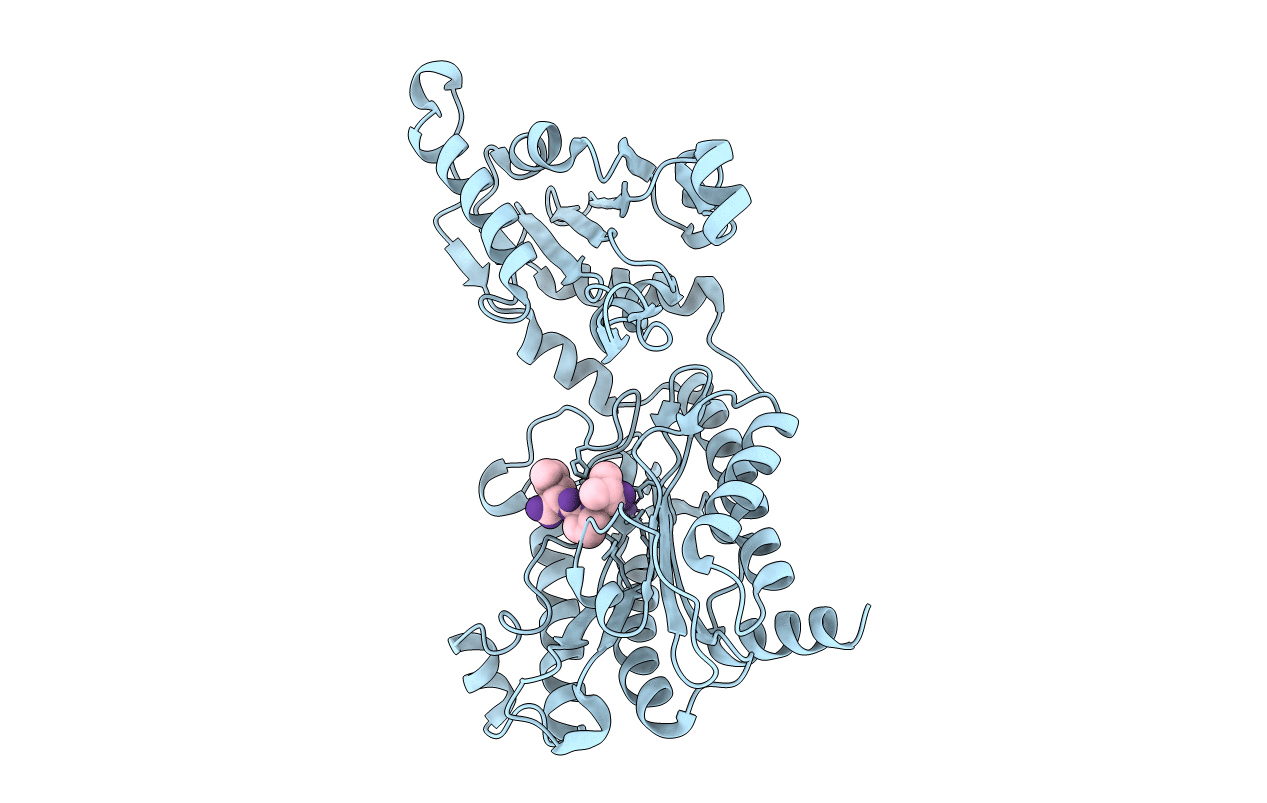
2V3X image
Deposition Date 2007-06-25
Release Date 2007-11-20
Last Version Date 2024-10-16
Entry Detail
PDB ID:
2V3X
Keywords:
Title:
His243Ala Escherichia coli aminopeptidase P in complex with substrate
Biological Source:
Source Organism(s):
ESCHERICHIA COLI (Taxon ID: 562)
Expression System(s):
Method Details:
Experimental Method:
Resolution:
1.70 Å
R-Value Free:
0.15
R-Value Work:
0.14
R-Value Observed:
0.14
Space Group:
P 64 2 2

Macromolecular Entities
Structures with similar UniProt ID
Protein Blast
Polymer Type:polypeptide(L)
Molecule:XAA-PRO AMINOPEPTIDASE
Gene (Uniprot):pepP
Mutagens:YES
Chain IDs:A
Chain Length:440
Number of Molecules:1
Biological Source:ESCHERICHIA COLI
Protein Blast
Polymer Type:polypeptide(L)
Molecule:TRIPEPTIDE (VALINE-PROLINE-LE
Chain IDs:B
Chain Length:3
Number of Molecules:1
Biological Source:ESCHERICHIA COLI
Modified Residue
Compound ID Chain ID Parent Comp ID Details 2D Image
CSO A CYS S-HYDROXYCYSTEINE
Primary Citation
Complexes of Mutants of Escherichia Coli Aminopeptidase P and the Tripeptide Substrate Valproleu.
Arch. Biochem. Biophys. 469 200 ? (2008)
PMID: 17983589 DOI: 10.1016/J.ABB.2007.10.009

Abstact

Aminopeptidase P (APPro) is a manganese-containing enzyme that catalyses the hydrolysis of the N-terminal residue of a polypeptide if the second residue is proline. Structures of APPro mutants with reduced or negligible activity have been determined in complex with the tripeptide substrate ValProLeu. In the complex of Glu383Ala APPro with ValProLeu one of the two metal sites is only partly occupied, indicating an essential role for Glu383 in metal binding in the presence of substrate. His361Ala APPro clearly possesses residual activity as the ValProLeu substrate has been cleaved in the crystals; difference electron density consistent with bound ProLeu dipeptide and a disordered Val amino acid is present at the active site. Contrary to previous suggestions, the His243Ala mutant is capable of binding substrate. The structure of the His243Ala APPro complex with ValProLeu shows that the peptide interacts with one of the active-site metal atoms via its terminal amino group. The implications of these complexes for the roles of the respective residues in APPro catalysis are discussed.

Legend

Protein

Chemical

Disease

Feedback Form
Name
Email
Institute
Feedback