

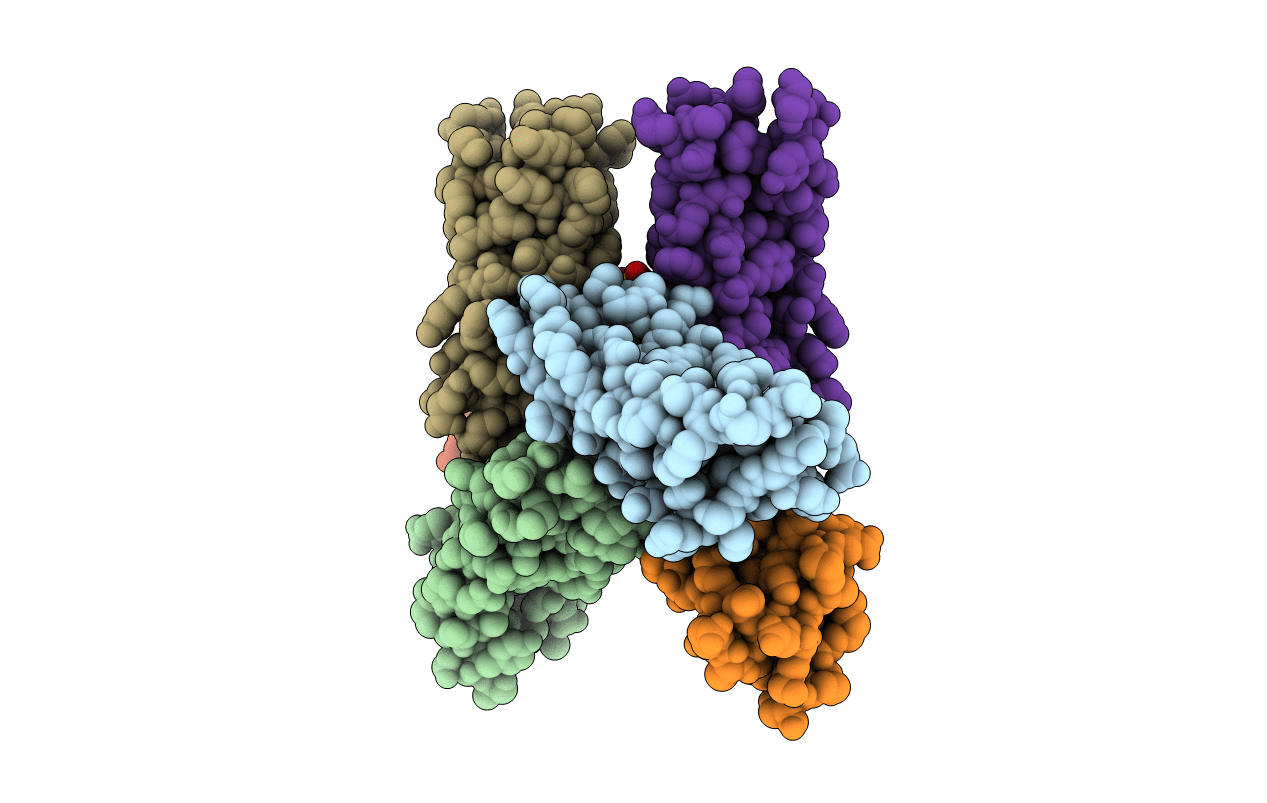
2P32 image
Deposition Date 2007-03-08
Release Date 2007-04-17
Last Version Date 2024-04-03
Entry Detail
PDB ID:
2P32
Keywords:
Title:
Crystal structure of the C-terminal 10 kDa subdomain from C. elegans Hsp70
Biological Source:
Source Organism(s):
Expression System(s):
Method Details:
Experimental Method:
Resolution:
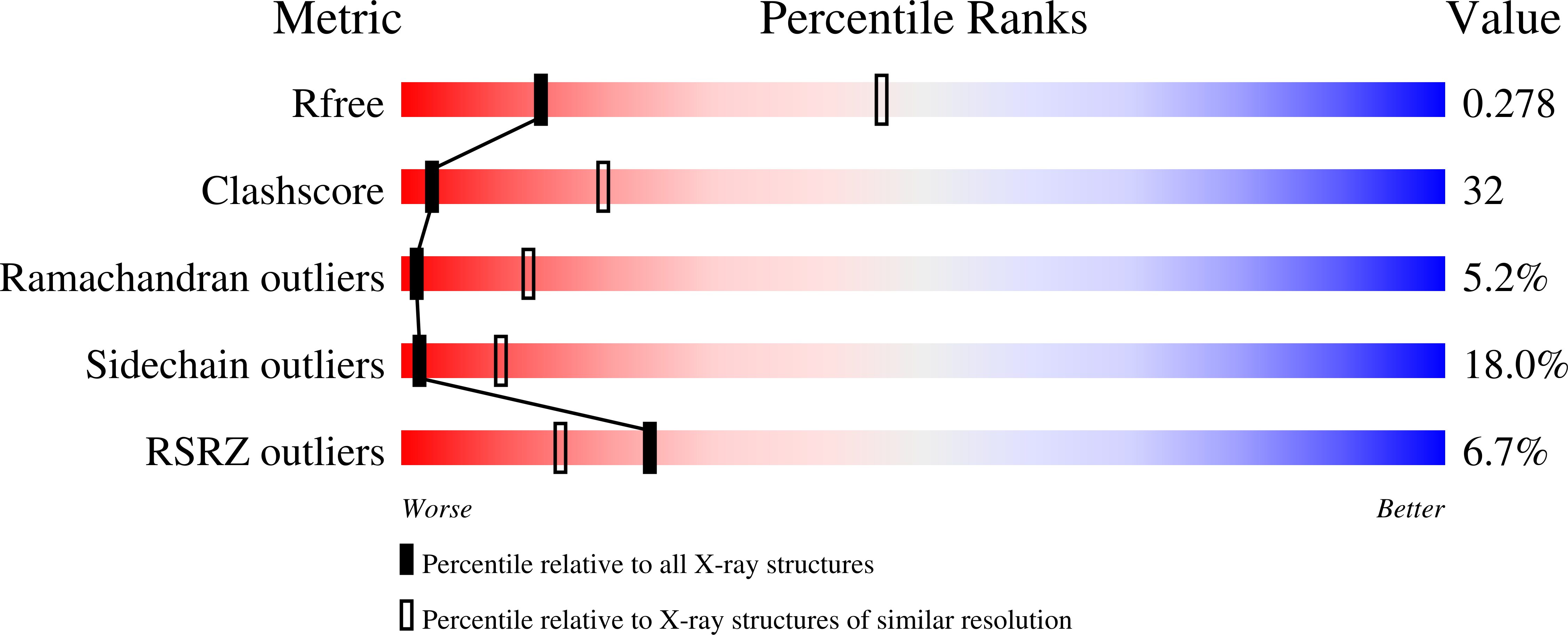
3.20 Å
R-Value Free:
0.28
R-Value Work:
0.26
Space Group:
P 42 21 2
Macromolecular Entities
Polymer Type:polypeptide(L)
Molecule:Heat shock 70 kDa protein A
Gene (Uniprot):hsp-1
Chain IDs:A, B, C, D, E, F
Chain Length:120
Number of Molecules:6
Biological Source:Caenorhabditis elegans
Ligand Molecules
Primary Citation
Crystal structure of the C-terminal three-helix bundle subdomain of C. elegans Hsp70.
Biochem.Biophys.Res.Commun. 357 105 110 (2007)
PMID: 17407764 DOI: 10.1016/j.bbrc.2007.03.107

Abstact

Hsp70 chaperones are composed of two domains; the 40 kDa N-terminal nucleotide-binding domain (NDB) and the 30 kDa C-terminal substrate-binding domain (SBD). Structures of the SBD from Escherichia coli homologues DnaK and HscA show it can be further divided into an 18 kDa beta-sandwich subdomain, which forms the hydrophobic binding pocket, and a 10 kDa C-terminal three-helix bundle that forms a lid over the binding pocket. Across prokaryotes and eukaryotes, the NBD and beta-sandwich subdomain are well conserved in both sequence and structure. The C-terminal subdomain is, however, more evolutionary variable and the only eukaryotic structure from rat Hsc70 revealed a diverged helix-loop-helix fold. We have solved the crystal structure of the C-terminal 10 kDa subdomain from Caenorhabditis elegans Hsp70 which forms a helical-bundle similar to the prokaryotic homologues. This provides the first confirmation of the structural conservation of this subdomain in eukaryotes. Comparison with the rat structure reveals a domain-swap dimerisation mechanism; however, the C. elegans subdomain exists exclusively as a monomer in solution in agreement with the hypothesis that regions out with the C-terminal subdomain are necessary for Hsp70 self-association.

Legend

Protein

Chemical

Disease

Primary Citation of related structures
Feedback Form
Name
Email
Institute
Feedback