

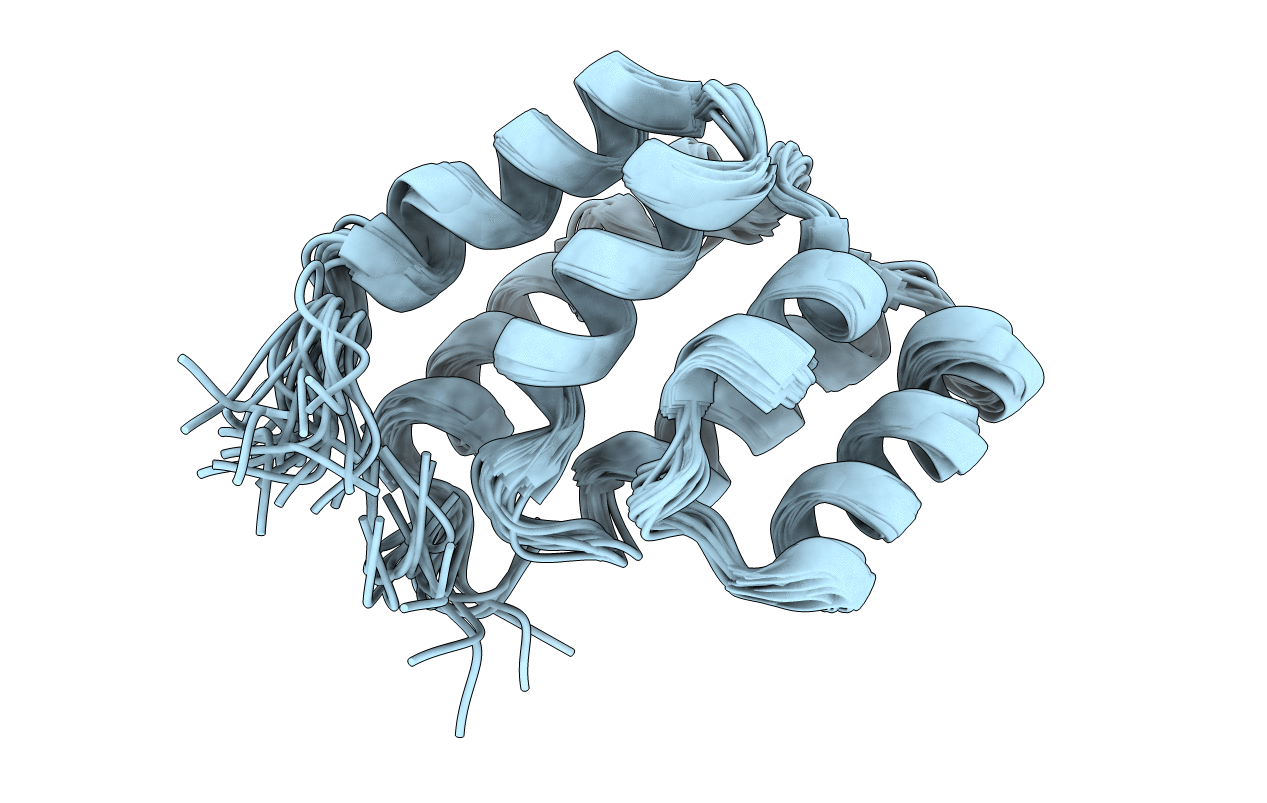
2MS8 image
Deposition Date 2014-07-25
Release Date 2015-09-02
Last Version Date 2024-05-15
Entry Detail
PDB ID:
2MS8
Keywords:
Title:
Solution NMR structure of MAVS CARD
Biological Source:
Source Organism(s):
Homo sapiens (Taxon ID: 9606)
Expression System(s):
Method Details:
Experimental Method:
Conformers Calculated:
100
Conformers Submitted:
20
Selection Criteria:
target function
Macromolecular Entities
Polymer Type:polypeptide(L)
Molecule:Mitochondrial antiviral-signa
Gene (Uniprot):MAVS
Chain IDs:A
Chain Length:102
Number of Molecules:1
Biological Source:Homo sapiens
Ligand Molecules
Primary Citation
Structure determination of helical filaments by solid-state NMR spectroscopy.
Proc. Natl. Acad. Sci. U.S.A. 113 E272 E281 (2016)
PMID: 26733681 DOI: 10.1073/pnas.1513119113

Abstact

The controlled formation of filamentous protein complexes plays a crucial role in many biological systems and represents an emerging paradigm in signal transduction. The mitochondrial antiviral signaling protein (MAVS) is a central signal transduction hub in innate immunity that is activated by a receptor-induced conversion into helical superstructures (filaments) assembled from its globular caspase activation and recruitment domain. Solid-state NMR (ssNMR) spectroscopy has become one of the most powerful techniques for atomic resolution structures of protein fibrils. However, for helical filaments, the determination of the correct symmetry parameters has remained a significant hurdle for any structural technique and could thus far not be precisely derived from ssNMR data. Here, we solved the atomic resolution structure of helical MAVS(CARD) filaments exclusively from ssNMR data. We present a generally applicable approach that systematically explores the helical symmetry space by efficient modeling of the helical structure restrained by interprotomer ssNMR distance restraints. Together with classical automated NMR structure calculation, this allowed us to faithfully determine the symmetry that defines the entire assembly. To validate our structure, we probed the protomer arrangement by solvent paramagnetic resonance enhancement, analysis of chemical shift differences relative to the solution NMR structure of the monomer, and mutagenesis. We provide detailed information on the atomic contacts that determine filament stability and describe mechanistic details on the formation of signaling-competent MAVS filaments from inactive monomers.

Legend

Protein

Chemical

Disease

Primary Citation of related structures
Feedback Form
Name
Email
Institute
Feedback