

2MGZ image
Deposition Date 2013-11-12
Release Date 2014-08-13
Last Version Date 2024-05-01
Entry Detail
PDB ID:
2MGZ
Title:
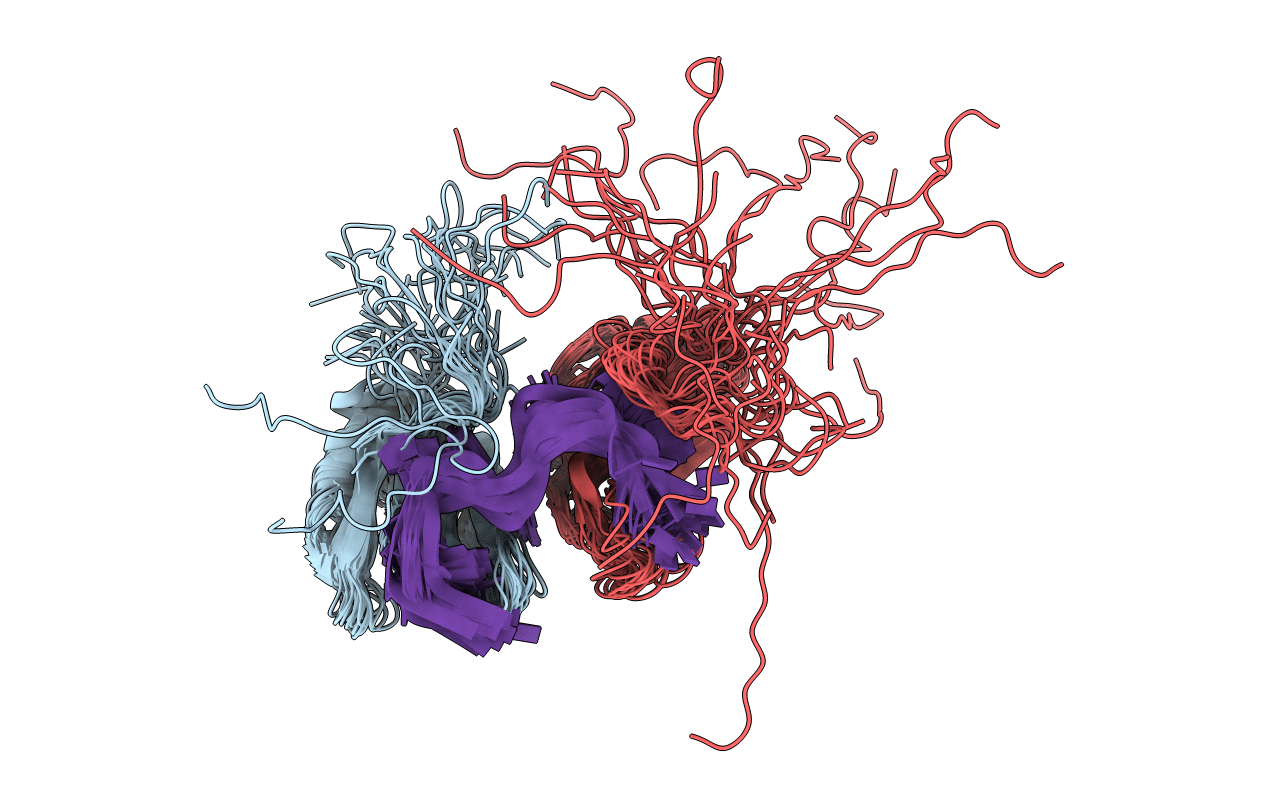
Solution structure of RBFOX family ASD-1 RRM and SUP-12 RRM in ternary complex with RNA
Biological Source:
Source Organism(s):
Expression System(s):
Method Details:
Experimental Method:
Conformers Calculated:
400
Conformers Submitted:
20
Selection Criteria:
structures with the least restraint violations
Macromolecular Entities
Structures with similar UniProt ID
Protein Blast
Polymer Type:polypeptide(L)
Molecule:Protein ASD-1, isoform a
Gene (Uniprot):asd-1
Chain IDs:A
Chain Length:94
Number of Molecules:1
Biological Source:Caenorhabditis elegans
Structures with similar UniProt ID
Protein Blast
Polymer Type:polypeptide(L)
Molecule:Protein SUP-12, isoform a
Gene (Uniprot):sup-12
Chain IDs:B
Chain Length:105
Number of Molecules:1
Biological Source:Caenorhabditis elegans
Ligand Molecules
Primary Citation
RBFOX and SUP-12 sandwich a G base to cooperatively regulate tissue-specific splicing
Nat. Struct. Mol. Biol. 21 778 786 (2014)
PMID: 25132178 DOI: 10.1038/nsmb.2870

Abstact

Tissue-specific alternative pre-mRNA splicing is often cooperatively regulated by multiple splicing factors, but the structural basis of cooperative RNA recognition is poorly understood. In Caenorhabditis elegans, ligand binding specificity of fibroblast growth factor receptors (FGFRs) is determined by mutually exclusive alternative splicing of the sole FGFR gene, egl-15. Here we determined the solution structure of a ternary complex of the RNA-recognition motif (RRM) domains from the RBFOX protein ASD-1, SUP-12 and their target RNA from egl-15. The two RRM domains cooperatively interact with the RNA by sandwiching a G base to form the stable complex. Multichromatic fluorescence splicing reporters confirmed the requirement of the G and the juxtaposition of the respective cis elements for effective splicing regulation in vivo. Moreover, we identified a new target for the heterologous complex through an element search, confirming the functional significance of the intermolecular coordination.

Legend

Protein

Chemical

Disease

Primary Citation of related structures
Feedback Form
Name
Email
Institute
Feedback