

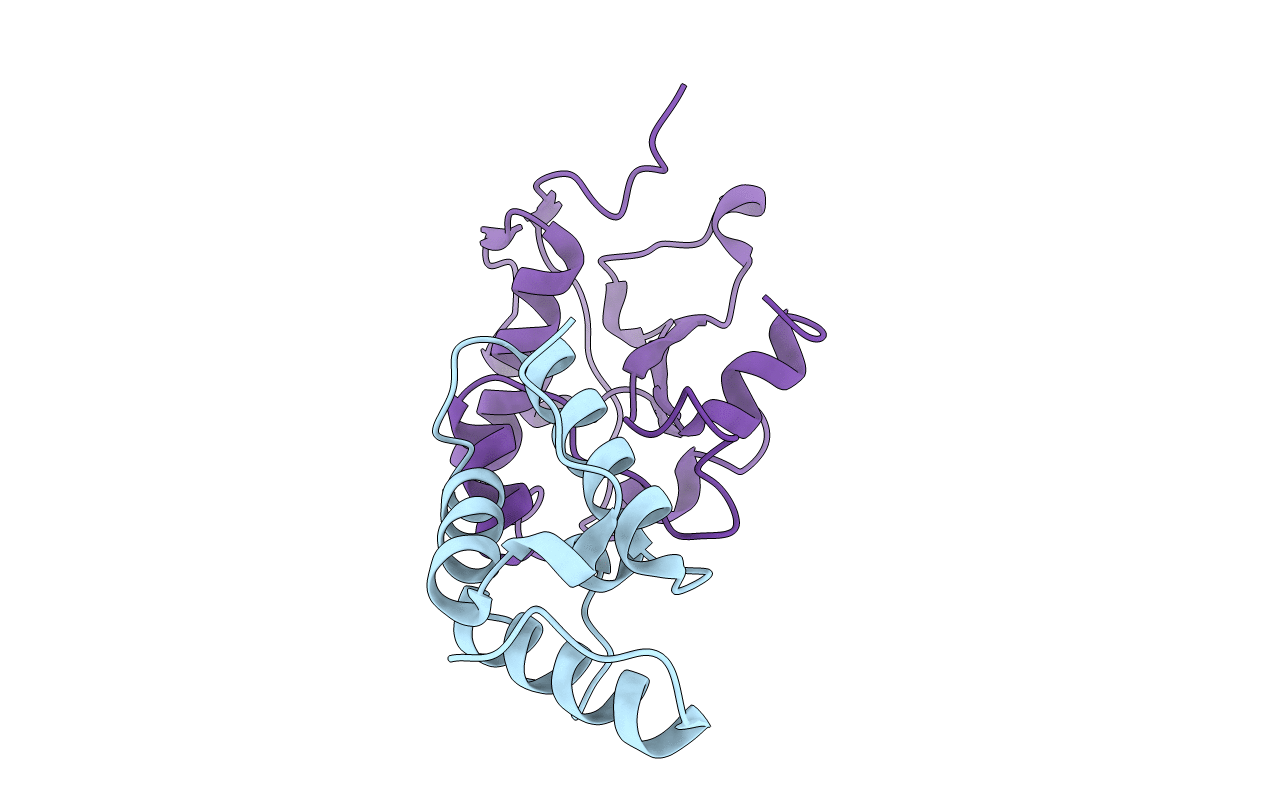
2K5X image
Deposition Date 2008-07-01
Release Date 2008-12-09
Last Version Date 2024-05-29
Entry Detail
PDB ID:
2K5X
Title:
Chemical shift structure of COLICIN E9 DNASE domain with its cognate immunity protein IM9
Biological Source:
Source Organism(s):
Escherichia coli (Taxon ID: 562)
Expression System(s):
Method Details:
Experimental Method:
Conformers Calculated:
500
Conformers Submitted:
1
Selection Criteria:
structures with the lowest energy
Macromolecular Entities
Structures with similar UniProt ID
Protein Blast
Polymer Type:polypeptide(L)
Molecule:Colicin-E9 immunity protein
Gene (Uniprot):imm
Chain IDs:A
Chain Length:86
Number of Molecules:1
Biological Source:Escherichia coli
Structures with similar UniProt ID
Protein Blast
Polymer Type:polypeptide(L)
Molecule:Colicin-E9
Gene (Uniprot):col
Chain IDs:B
Chain Length:134
Number of Molecules:1
Biological Source:Escherichia coli
Ligand Molecules
Primary Citation
Structure Determination of Protein-Protein Complexes Using NMR Chemical Shifts: Case of an Endonuclease Colicin-Immunity Protein Complex
J. Am. Chem. Soc. 130 15990 15996 (2008)
PMID: 18980319

Abstact

Nuclear magnetic resonance (NMR) spectroscopy provides a range of powerful techniques for determining the structures and the dynamics of proteins. The high-resolution determination of the structures of protein-protein complexes, however, is still a challenging problem for this approach, since it can normally provide only a limited amount of structural information at protein-protein interfaces. We present here the determination using NMR chemical shifts of the structure (PDB code 2K5X) of the cytotoxic endonuclease domain from bacterial toxin colicin (E9) in complex with its cognate immunity protein (Im9). In order to achieve this result, we introduce the CamDock method, which combines a flexible docking procedure with a refinement that exploits the structural information provided by chemical shifts. The results that we report thus indicate that chemical shifts can be used as structural restraints for the determination of the conformations of protein complexes that are difficult to obtain by more standard NMR approaches.

Legend

Protein

Chemical

Disease

Primary Citation of related structures
Feedback Form
Name
Email
Institute
Feedback