

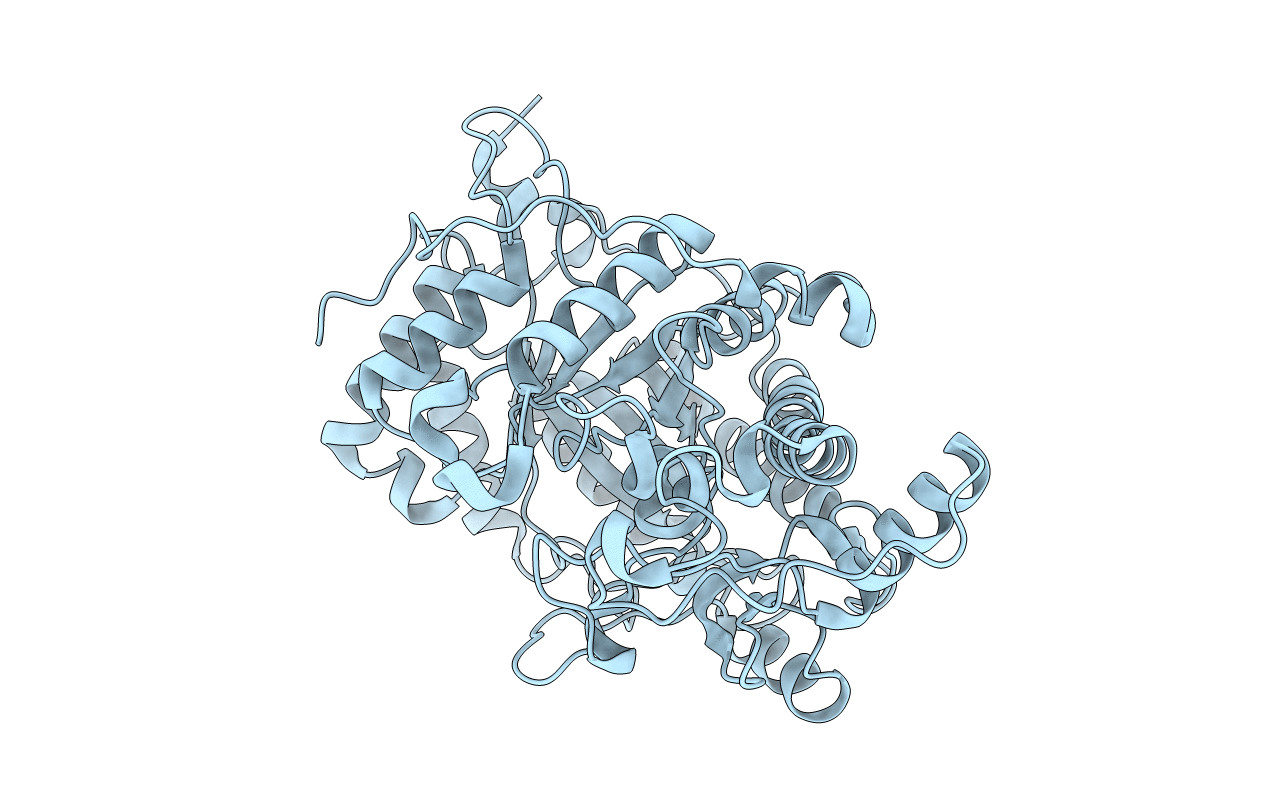
2DQX image
Deposition Date 2006-06-01
Release Date 2007-05-08
Last Version Date 2023-10-25
Entry Detail
PDB ID:
2DQX
Keywords:
Title:
mutant beta-amylase (W55R) from soy bean
Biological Source:
Source Organism(s):
Glycine max (Taxon ID: 3847)
Expression System(s):
Method Details:
Experimental Method:
Resolution:
2.20 Å
R-Value Free:
0.25
R-Value Work:
0.20
R-Value Observed:
0.20
Space Group:
P 31 2 1

Macromolecular Entities
Polymer Type:polypeptide(L)
Molecule:Beta-amylase
Gene (Uniprot):LOC547931
Mutagens:W55R
Chain IDs:A
Chain Length:495
Number of Molecules:1
Biological Source:Glycine max
Primary Citation
Kinetic and structural analysis of enzyme sliding on a substrate: multiple attack in beta-amylase
Biochemistry 46 792 798 (2007)
PMID: 17223700 DOI: 10.1021/bi061605w

Abstact

Beta-amylase (EC 3.2.1.2) is starch-hydrolyzing exo-type enzyme that can catalyze the successive liberation of beta-maltose from the nonreducing ends of alpha-1,4-linked glucopyranosyl polymers. There is a well-known phenomenon called multiple or repetitive attack where the enzyme releases several maltose molecules in a single enzyme-substrate complex. In order to understand it further, we examined the beta-amylase-catalyzed reaction using maltooligosaccharides. The Monte Carlo method was applied for simulation of the beta-amylase-catalyzed reaction including the multiple attack mechanism. Through site-directed mutagenesis, we have successfully prepared a mutant enzyme which may be simulated as a multiple attack action reduced one with retaining significant hydrolytic activity. From the results of X-ray structure analysis of the mutant enzyme, it was clarified that one carboxyl residue plays a very important role in the multiple attack. The multiple attack action needs the force of enzyme sliding on the substrate. In addition, it is important for the multiple attack that the enzyme and substrate have the characteristics of a stable productive substrate-enzyme complex through a hydrogen bond between the nonreducing end of the substrate and the carboxyl residue of the enzyme.

Legend

Protein

Chemical

Disease

Primary Citation of related structures
Feedback Form
Name
Email
Institute
Feedback