

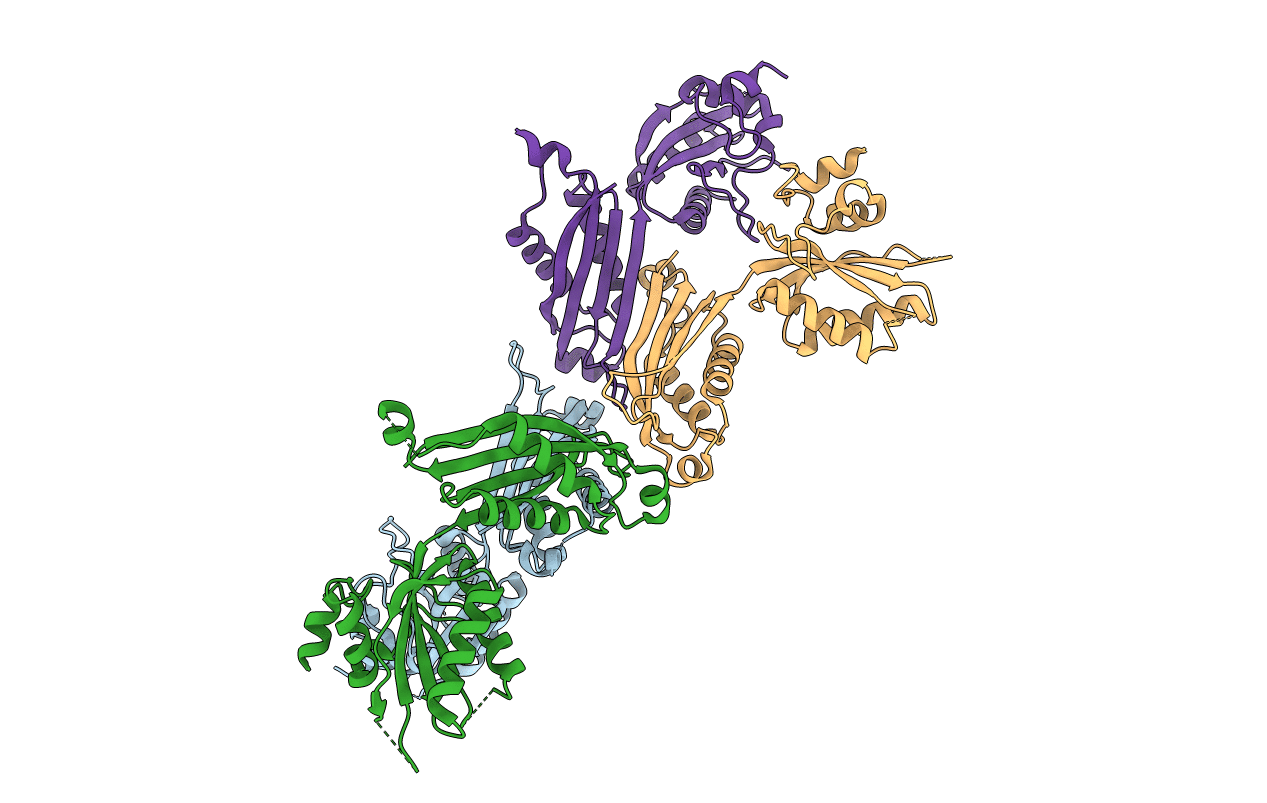
2CG8 image
Deposition Date 2006-02-28
Release Date 2006-06-21
Last Version Date 2023-12-13
Entry Detail
PDB ID:
2CG8
Title:
The bifunctional dihydroneopterin aldolase 6-hydroxymethyl-7,8- dihydropterin synthase from Streptococcus pneumoniae
Biological Source:
Source Organism(s):
Expression System(s):
Method Details:
Experimental Method:
Resolution:
2.90 Å
R-Value Free:
0.24
R-Value Work:
0.21
R-Value Observed:
0.21
Space Group:
P 41 21 2

Macromolecular Entities
Structures with similar UniProt ID
Protein Blast
Polymer Type:polypeptide(L)
Molecule:DIHYDRONEOPTERIN ALDOLASE 6-H
Gene (Uniprot):sulD
Chain IDs:A, B, C, D
Chain Length:270
Number of Molecules:4
Biological Source:STREPTOCOCCUS PNEUMONIAE
Ligand Molecules
Primary Citation
Crystal Structure of the Bifunctional Dihydroneopterin Aldolase/6-Hydroxymethyl-7,8-Dihydropterin Pyrophosphokinase from Streptococcus Pneumoniae.
J. Mol. Biol. 360 644 ? (2006)
PMID: 16781731 DOI: 10.1016/J.JMB.2006.05.038

Abstact

The enzymes dihydroneopterin aldolase (DHNA) and 6-hydroxymethyl-7,8-dihydropterin pyrophosphokinase (HPPK) catalyse two consecutive steps in the biosynthesis of folic acid. Neither of these enzymes has a counterpart in mammals, and they have therefore been suggested as ideal targets for antimicrobial drugs. Some of the enzymes within the folate pathway can occur as bi- or trifunctional complexes in bacteria and parasites, but the way in which bifunctional DHNA-HPPK enzymes are assembled is unclear. Here, we report the determination of the structure at 2.9 A resolution of the DHNA-HPPK (SulD) bifunctional enzyme complex from the respiratory pathogen Streptococcus pneumoniae. In the crystal, DHNA is assembled as a core octamer, with 422 point group symmetry, although the enzyme is active as a tetramer in solution. Individual HPPK monomers are arranged at the ends of the DHNA octamer, making relatively few contacts with the DHNA domain, but more extensive interactions with adjacent HPPK domains. As a result, the structure forms an elongated cylinder, with the HPPK domains forming two tetramers at each end. The active sites of both enzymes face outward, and there is no clear channel between them that could be used for channelling substrates. The HPPK-HPPK interface accounts for about one-third of the total area between adjacent monomers in SulD, and has levels of surface complementarity comparable to that of the DHNA-DHNA interfaces. There is no "linker" polypeptide between DHNA and HPPK, reducing the conformational flexibility of the HPPK domain relative to the DHNA domain. The implications for the organisation of bi- and trifunctional enzyme complexes within the folate biosynthesis pathway are discussed.

Legend

Protein

Chemical

Disease

Primary Citation of related structures
Feedback Form
Name
Email
Institute
Feedback