

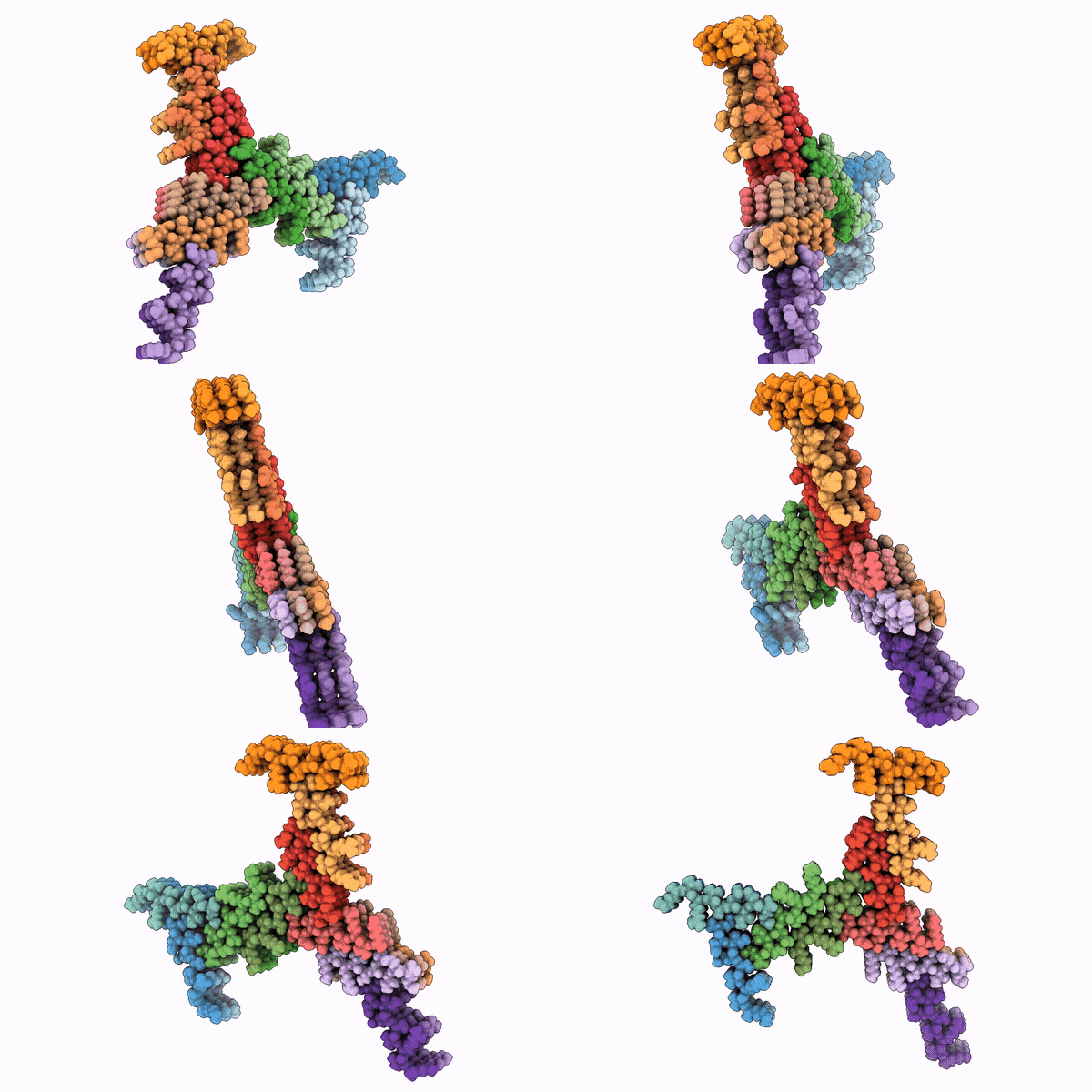
28XG image
Deposition Date 2026-02-26
Release Date 2026-10-07
Last Version Date 2026-10-07
Entry Detail
PDB ID:
28XG
Title:
DIT3 nanofibril
Biological Source:
Source Organism(s):
Method Details:
Experimental Method:
Resolution:
1.78 Å
Aggregation State:
HELICAL ARRAY
Reconstruction Method:
HELICAL
Macromolecular Entities
Structural Superimposition Protein Blast
Polymer Type:polypeptide(L)
Molecule:nanofibril peptide (KVRVSQINM
Chain IDs:A (auth: G2), B (auth: E2), C (auth: F2), D (auth: G1), E (auth: E1), F (auth: F1), G, H (auth: E), I (auth: F), J (auth: I2), K (auth: K2), L (auth: I1), M (auth: K1), N (auth: I), O (auth: K), P (auth: D2), Q (auth: B2), R (auth: C2), S (auth: H2), T (auth: A2), U (auth: D1), V (auth: B1), W (auth: C1), X (auth: H1), Y (auth: A1), Z (auth: D), AA (auth: B), BA (auth: C), CA (auth: H), DA (auth: A)
Chain Length:9
Number of Molecules:30
Biological Source:synthetic construct
Ligand Molecules
Primary Citation
Sequence-encoded hexagonal lattices in multichannel peptide nanofibrils.
Nature 657 935 943 (2026)
PMID: 42778700 DOI: 10.1038/s41586-026-11016-2

Abstact

Structural complexity in biological matter arises from molecular information that encodes supramolecular assembly across length scales(1-3). Here we show that minimal nine-residue peptides can encode discrete lateral interaction motifs that direct supramolecular organization. These motifs generate hexagonal pores and hierarchically tile into multichannel nanofibrils with defined topology. Sequence-encoded amphiphilicity combines a cross-beta-dimer, an inversion point and a trimeric junction to create complementary interfaces that couple lateral growth to axial stacking, yielding honeycomb lattices with continuous approximately 5-nm solvent-accessible nanochannels. Cryo-electron microscopy resolves the supramolecular architecture and shows that lattice symmetry and pore geometry are preserved across variants. Systematic perturbations establish sequence-structure rules linking residue position to supramolecular symmetry, lattice propagation and channel topology. Molecular dynamics simulations and vibrational spectroscopy show that the channels remain water accessible and show sequence-tunable hydration. These findings establish that a minimal, sequence-encoded interaction hierarchy can programme long-range supramolecular order, providing a general framework for how short peptides can encode complex, symmetry-defined architectures(4-12).

Legend

Protein

Chemical

Disease

Primary Citation of related structures
Feedback Form
Name
Email
Institute
Feedback