

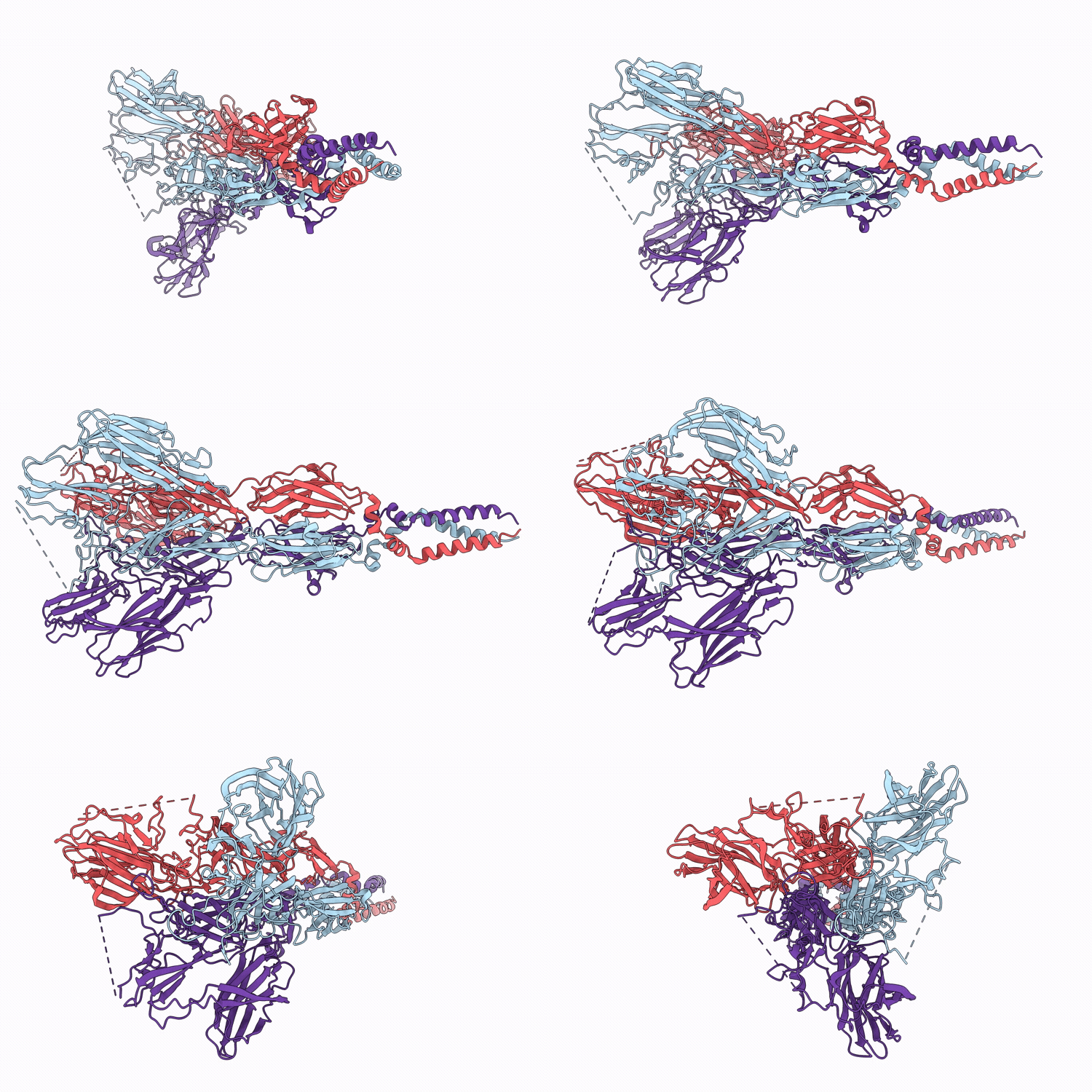
26CI image
Deposition Date 2026-04-25
Release Date 2026-08-12
Last Version Date 2026-08-19
Entry Detail
PDB ID:
26CI
Keywords:
Title:
F2-pyocin FNIII and AHS
Biological Source:
Source Organism(s):
Expression System(s):
Method Details:
Experimental Method:
Resolution:
2.63 Å
Aggregation State:
PARTICLE
Reconstruction Method:
SINGLE PARTICLE
Macromolecular Entities
Polymer Type:polypeptide(L)
Molecule:F2-pyocin-tail-fiber
Chain IDs:A, B (auth: C), C (auth: G)
Chain Length:1204
Number of Molecules:3
Biological Source:Pseudomonas aeruginosa
Ligand Molecules
Primary Citation
F-Type Pyocin Versus Phage lambda Tail: Conserved Hub, Divergent Fibers.
Adv Sci ? e77063 e77063 (2026)
PMID: 42573577 DOI: 10.1002/advs.77063

Abstact

Bacteriocins are ribosomally synthesized antimicrobial peptides or proteins that offer an alternative to conventional antibiotics against multidrug-resistant pathogens. Phage tail-like bacteriocins (tailocins) are classified into rigid R-type and flexible F-type variants. While R-type pyocins from Pseudomonas aeruginosa are well-characterized, F-type pyocins remain poorly understood, especially with respect to the molecular mechanisms for their Gram-negative bactericidal activity. Here, we report cryo-electron microscopy structures of the F-type pyocin from P. aeruginosa ATCC 15442 at 2.29-3.26 A resolution, encompassing three modular components: the tail cap, tail tip, and tail fiber. Structural comparisons with bacteriophage lambda reveal a conserved tail tip architecture, including the baseplate hub proteins, distal tail protein, tail assembly protein, and tape measure protein. Unexpectedly, we identify three trimeric side fibers that attach not to the distal tail protein, as in canonical systems, but to the alpha-helical shaft of the central fiber, indicating a previously unrecognized attachment mode. The receptor-binding domain of the side fiber shares structural similarity with LPS-recognizing domains of R-type pyocins. Together, these results define the structural basis of F-type pyocin assembly and host recognition, reveal conserved and unique features relative to phage lambda, and provide a framework for engineering tailocins as precision antimicrobials against drug-resistant P. aeruginosa.

Legend

Protein

Chemical

Disease

Primary Citation of related structures
Feedback Form
Name
Email
Institute
Feedback