

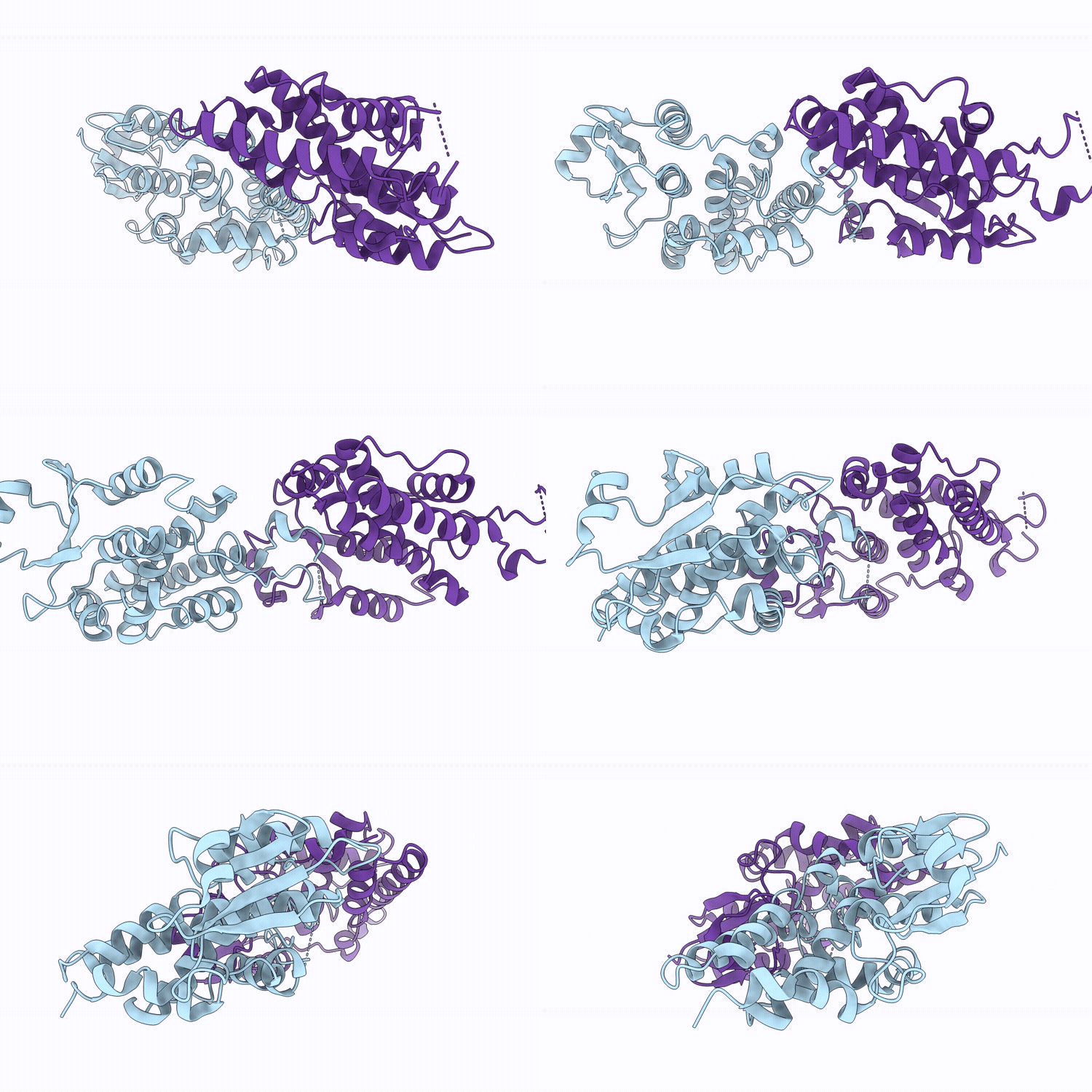
24UG image
Deposition Date 2026-03-20
Release Date 2026-06-17
Last Version Date 2026-06-17
Entry Detail
PDB ID:
24UG
Keywords:
Title:
Human CLIC1 mutant-Y214A
Biological Source:
Source Organism(s):
Homo sapiens (Taxon ID: 9606)
Expression System(s):
Method Details:
Experimental Method:
Resolution:
2.50 Å
R-Value Free:
0.24
R-Value Work:
0.18
R-Value Observed:
0.18
Space Group:
P 1 21 1

Macromolecular Entities
Structures with similar UniProt ID
Protein Blast
Polymer Type:polypeptide(L)
Molecule:Chloride intracellular channe
Gene (Uniprot):CLIC1
Mutagens:Y214A
Chain IDs:A, B
Chain Length:243
Number of Molecules:2
Biological Source:Homo sapiens
Primary Citation
A cryptic-site ligand stabilizes a non-canonical interface and blocks membrane insertion of the chloride intracellular channel CLIC1.
J.Biol.Chem. 302 113113 113113 (2026)
PMID: 42103216 DOI: 10.1016/j.jbc.2026.113113

Abstact

Human chloride intracellular channel 1 (HsCLIC1) is a dimorphic protein that exists in both soluble enzymatic and membrane-integrated ion channel forms. It is overexpressed in many cancers, yet developing specific inhibitors has been challenging, leaving CLIC proteins largely untargeted. Here, we identified a non-canonical ligand binding site on the soluble enzymatic form of HsCLIC1 and demonstrate that it is druggable with the small molecule inhibitor NSC602247. This cryptic site was discovered using multi-solvent molecular dynamics (MD) simulations followed by virtual screening and molecular docking. Using surface plasmon resonance and microscale thermophoresis, we show that NSC602247 binds to HsCLIC1 with micromolar affinity ( approximately 6 muM) and inhibits the proliferation of HT29 colorectal cancer cells. To understand the mechanism of inhibition, we determined the crystal structure of the HsCLIC1-NSC602247 complex. Mechanistically, NSC602247 binding induces oligomerization of soluble HsCLIC1 and reduces its membrane expression, as revealed using flow cytometry. Our data clearly indicate that NSC602247 inhibits HT29 growth by sequestering the protein in a soluble state, thereby blocking its membrane translocation. These findings validate a novel cryptic site on CLIC1 and present a new mechanistic paradigm for inhibiting its pathological function by preventing membrane insertion, offering a promising strategy for targeted therapeutic development.

Legend

Protein

Chemical

Disease

Primary Citation of related structures
Feedback Form
Name
Email
Institute
Feedback