

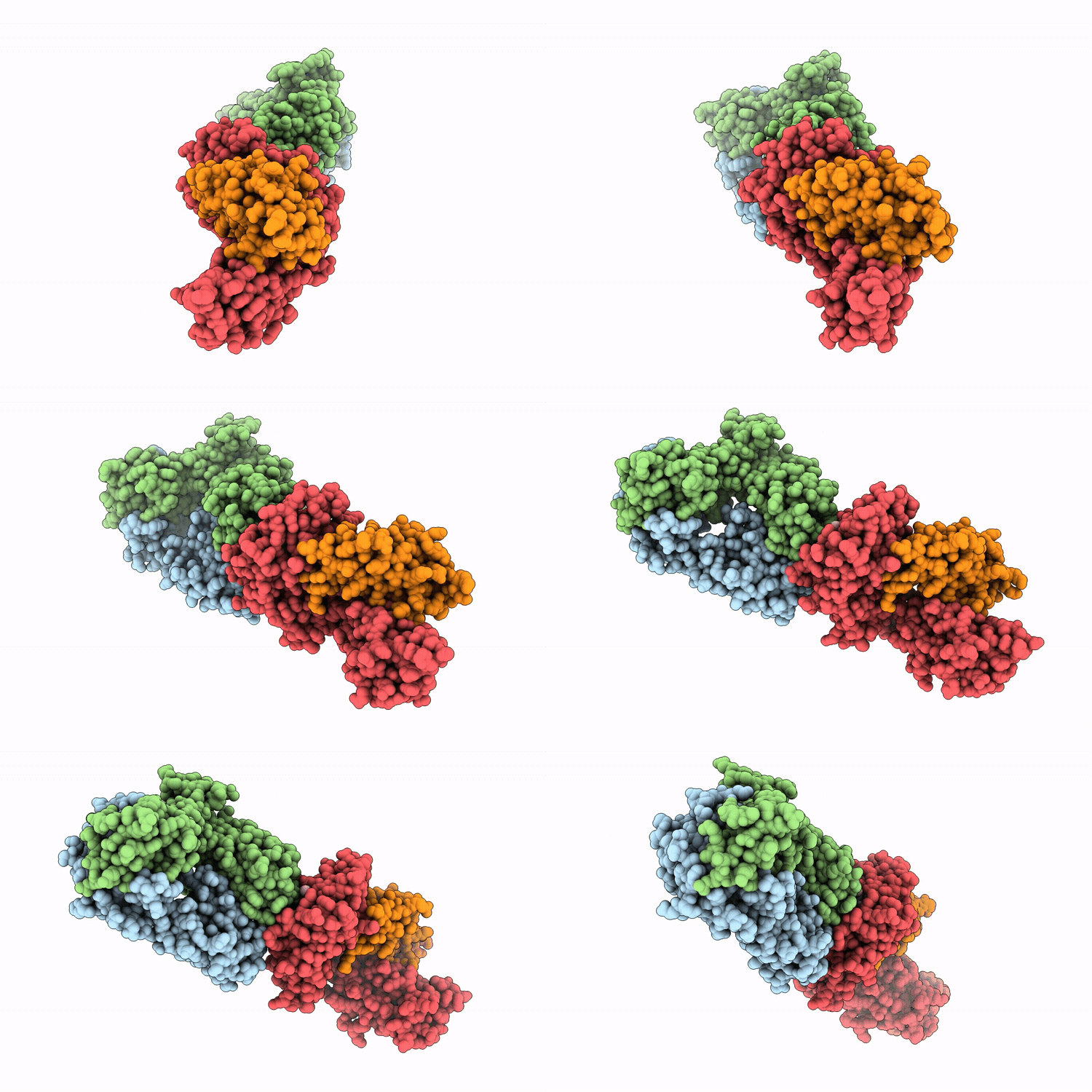
24ST image
Deposition Date 2026-03-19
Release Date 2026-07-01
Last Version Date 2026-07-01
Entry Detail
PDB ID:
24ST
Keywords:
Title:
Crystal Structure of the cross-restricted 14D7 TCR and HLA-B*81:01 bound to HIV-1 Gag TL9 peptide
Biological Source:
Expression System(s):
Method Details:
Experimental Method:
Resolution:
2.70 Å
R-Value Free:
0.24
R-Value Work:
0.19
Space Group:
P 21 21 21
Macromolecular Entities
Protein Blast
Polymer Type:polypeptide(L)
Molecule:Alpha chain 14D7 TCR
Chain IDs:A
Chain Length:204
Number of Molecules:1
Biological Source:Homo sapiens
Protein Blast
Polymer Type:polypeptide(L)
Molecule:Beta chain 14D7 TCR
Chain IDs:E (auth: B)
Chain Length:242
Number of Molecules:1
Biological Source:Homo sapiens
Structures with similar UniProt ID
Protein Blast
Polymer Type:polypeptide(L)
Molecule:MHC class I antigen
Chain IDs:B (auth: C)
Chain Length:273
Number of Molecules:1
Biological Source:Homo sapiens
Structures with similar UniProt ID
Protein Blast
Polymer Type:polypeptide(L)
Molecule:Beta-2-microglobulin
Gene (Uniprot):B2M
Chain IDs:C (auth: D)
Chain Length:99
Number of Molecules:1
Biological Source:Homo sapiens
Structures with similar UniProt ID
Protein Blast
Polymer Type:polypeptide(L)
Molecule:Capsid protein p24
Gene (Uniprot):gag
Chain IDs:D (auth: E)
Chain Length:9
Number of Molecules:1
Biological Source:Human immunodeficiency virus type 1 group M subtype B (isolate WMJ22)
Primary Citation
Conserved non-canonical recognition with distinct structural solutions underlies dual-HLA recognition of HIV-1 Gag TL9.
Int.J.Biol.Macromol. 369 152866 152866 (2026)
PMID: 42229649 DOI: 10.1016/j.ijbiomac.2026.152866

Abstact

Dual-reactive T cell receptors (TCRs) that recognize the HIV-1 Gag TL9 epitope presented by both HLA-B*81:01 and HLA-B*42:01 are associated with improved immune control. However, whether such TCRs rely on a single universal recognition blueprint or adopt distinct structural solutions remains unclear. Here, we characterize 14D7, an additional dual-reactive TL9-specific TCR, and compare its structural features with those of the previously reported T18A clonotype. The 14D7-HLA-B*81:01-TL9 structure reveals a conserved non-canonical recognition framework shared with T18A: in both TCRs, CDR3beta primarily engages the HLA alpha2 helix rather than the peptide, while CDR2beta compensates via critical peptide contacts. However, 14D7 adopts a distinct CDR3 loop conformation, likely reflecting differences in V/J gene usage and junctional rearrangement, demonstrating that dual-reactive TCRs can achieve cross-reactivity through related but non-identical molecular solutions. AlphaFold 3 modeling further suggests that, like T18A, 14D7 actively remodels the TL9 conformation in the HLA-B*42:01 context toward a state resembling that observed in the HLA-B*81:01-bound complex. Surface plasmon resonance analysis revealed differential affinity profiles across HLA backgrounds, with greater tolerance to common escape variants in the HLA-B*81:01 context. Structural comparison further suggests that polymorphic HLA residues, particularly at positions 143 and 163, reshape the peptide- and TCR-facing interaction network and thereby influence tolerance to epitope variation. Together, these findings show that dual-reactive TCRs operate within a conserved non-canonical recognition framework while retaining flexibility at the level of CDR3 loop configuration, providing a refined structural basis for HIV-specific cross-reactive T cell immunity.

Legend

Protein

Chemical

Disease

Primary Citation of related structures
Feedback Form
Name
Email
Institute
Feedback