

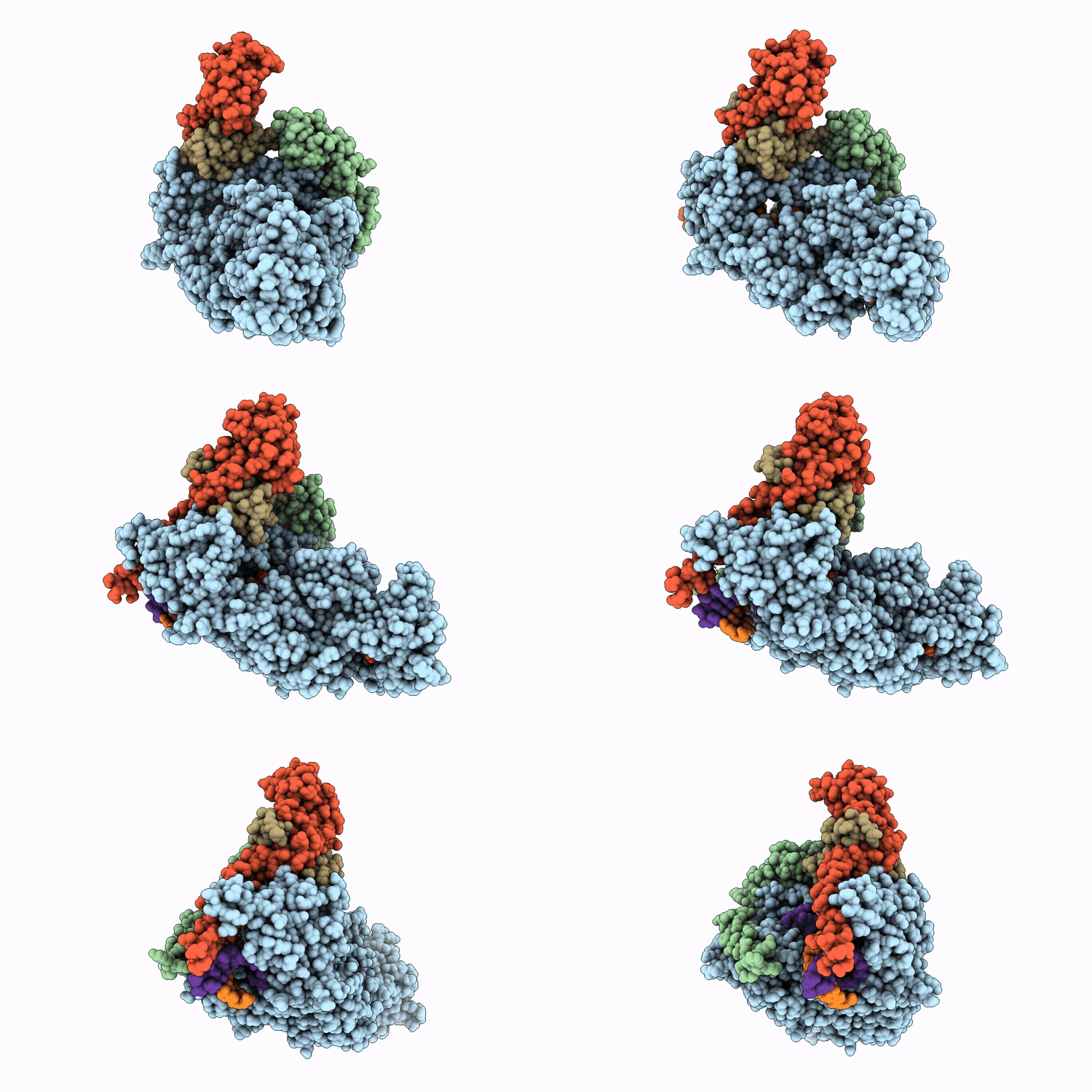
24EW image
Deposition Date 2026-03-02
Release Date 2026-06-03
Last Version Date 2026-06-24
Entry Detail
PDB ID:
24EW
Title:
SARS-CoV-2 polymerase with incorporated and pre-incorporated AT-9052-Sp
Biological Source:
Method Details:
Experimental Method:
Resolution:
2.39 Å
Aggregation State:
PARTICLE
Reconstruction Method:
SINGLE PARTICLE
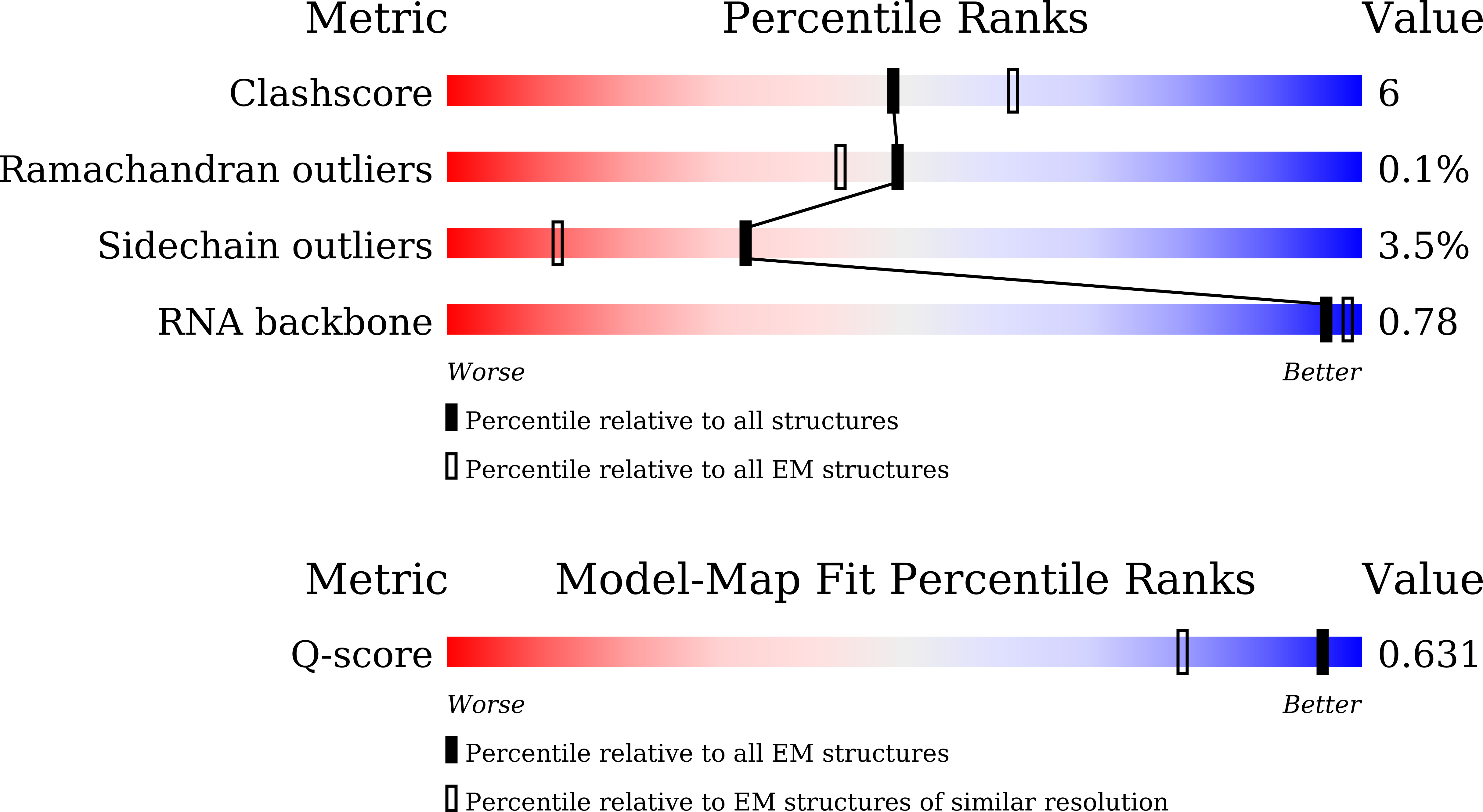
Macromolecular Entities
Polymer Type:polypeptide(L)
Molecule:RNA-directed RNA polymerase
Gene (Uniprot):rep
Chain IDs:E (auth: A)
Chain Length:956
Number of Molecules:1
Biological Source:Severe acute respiratory syndrome coronavirus 2
Polymer Type:polypeptide(L)
Molecule:Non-structural protein 8
Gene (Uniprot):rep
Chain IDs:A (auth: B), F (auth: D)
Chain Length:220
Number of Molecules:2
Biological Source:Severe acute respiratory syndrome coronavirus 2
Polymer Type:polypeptide(L)
Molecule:Non-structural protein 7
Gene (Uniprot):rep
Chain IDs:B (auth: C)
Chain Length:110
Number of Molecules:1
Biological Source:Severe acute respiratory syndrome coronavirus 2
Polymer Type:polyribonucleotide
Molecule:RNA (5'-R(P*AP*UP*UP*AP*AP*GP
Chain IDs:C (auth: I)
Chain Length:20
Number of Molecules:1
Biological Source:synthetic construct
Polymer Type:polyribonucleotide
Molecule:RNA (5'-R(P*CP*CP*CP*CP*AP*UP
Chain IDs:D (auth: J)
Chain Length:30
Number of Molecules:1
Biological Source:synthetic construct
Primary Citation
Consecutive catalytic steps of viral RNA polymerase and exonuclease suggest a way to overcome intrinsic nucleotide analogue resistance.
Proc.Natl.Acad.Sci.USA 123 e2605725123 e2605725123 (2026)
PMID: 42263136 DOI: 10.1073/pnas.2605725123

Abstact

Nucleotide analogues (NAs) have been successfully used for the treatment of various RNA virus infections by selectively targeting the viral RNA-dependent RNA polymerase (RdRp) for incorporation into the viral genome. However two major families of human-infecting RNA viruses, Coronaviridae (CoV) and Arenaviridae, encode exonuclease domains that may recognize and remove incorporated NAs, thus providing natural resistance against some of these drugs. Both polymerization and excision reactions are mechanistically centered on the nucleotide alpha-phosphate, enabling the potential for sequential inhibition of both RNA synthesis and repair. Here, we provide structural evidence of inversion of configuration at the phosphorus center during polymerization, demonstrating that the SARS-CoV-2 RdRp proceeds through an S(N)2 mechanism. A 2.39 A resolution cryo-EM structure of a ternary replication complex bound to RNA and an alpha-thio-modified NTP shows that incorporation of the preferred S(P) isomer at the 3' end of the RNA yields a phosphorothioate linkage in the R(P) configuration. This R(P)-phosphorothioate RNA product shows reduced cleavage by both the SARS-CoV-2 and three arenavirus RNA exonucleases, revealing a stereochemical preference opposite to that of structurally related DNA exonucleases. This observation contradicts the prevailing assumption that sulfur substitution at the metal-coordinating oxygen universally blocks catalysis. Instead, RNA exonuclease stereoselectivity appears to be shaped not only by metal-sulfur interactions but also by the geometry of nucleophile activation. These findings provide mechanistic insights into phosphoryl transfer in viral polymerases and exonucleases and highlight opportunities to counteract intrinsic nuclease-mediated resistance against antiviral nucleotide analogues.

Legend

Protein

Chemical

Disease

Primary Citation of related structures
Feedback Form
Name
Email
Institute
Feedback