

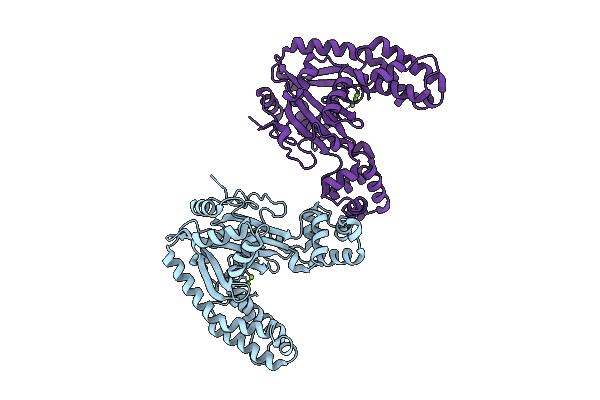
22ZA image
Deposition Date 2026-01-28
Release Date 2026-03-11
Last Version Date 2026-03-11
Entry Detail
PDB ID:
22ZA
Keywords:
Title:
crystal structures of RipN from Ralstonia solanacearum
Biological Source:
Expression System(s):
Method Details:
Experimental Method:
Resolution:
2.28 Å
R-Value Free:
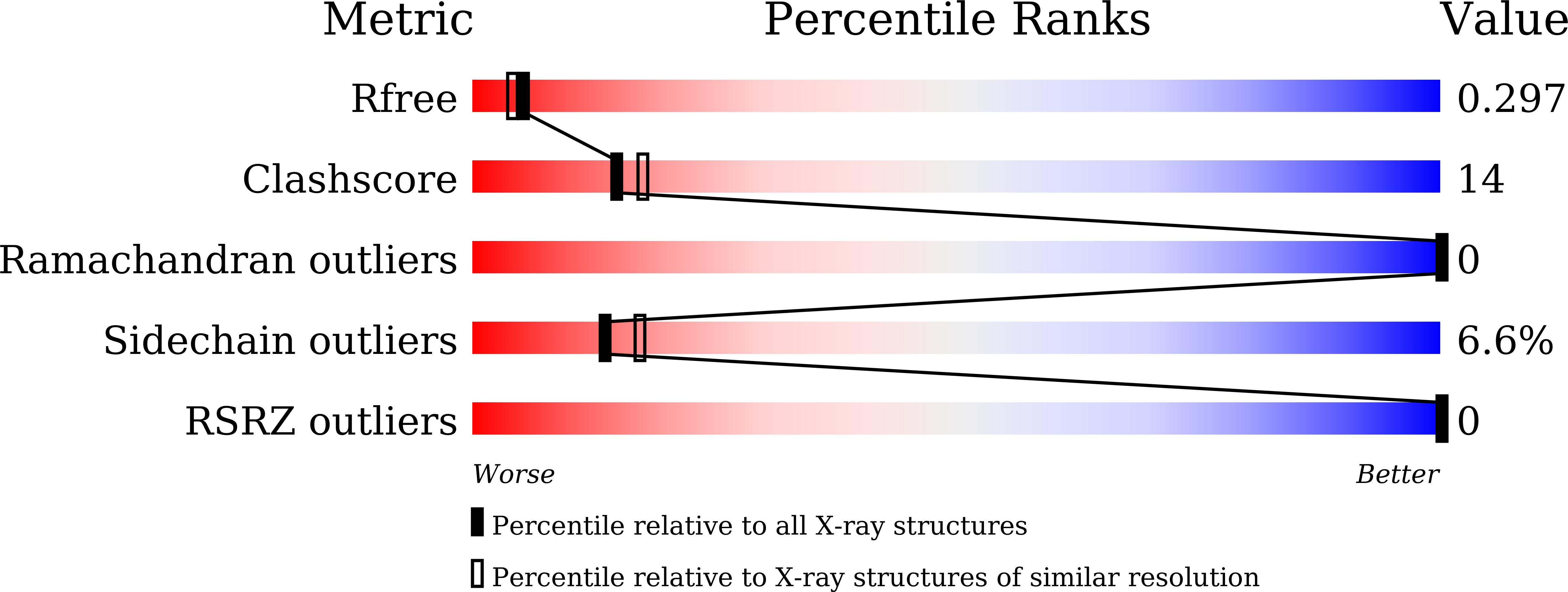
0.29
R-Value Work:
0.26
R-Value Observed:
0.26
Space Group:
P 32 2 1
Macromolecular Entities
Structures with similar UniProt ID
Protein Blast
Polymer Type:polypeptide(L)
Molecule:Type III effector protein
Gene (Uniprot):RSp1130
Chain IDs:A, B
Chain Length:482
Number of Molecules:2
Biological Source:Ralstonia nicotianae (strain ATCC BAA-1114 / GMI1000)
Ligand Molecules
Primary Citation
Structural basis of dinucleotide substrate recognition and catalysis by the Nudix effector RipN from Ralstonia solanacearum.
Biochem.Biophys.Res.Commun. 808 153433 153433 (2026)
PMID: 41702187 DOI: 10.1016/j.bbrc.2026.153433

Abstact

The type III secreted effector RipN from Ralstonia solanacearum is a Nudix hydrolase that suppresses plant immunity by targeting host dinucleotide metabolism. Although RipN preferentially hydrolyzes NADH, the structural basis of its substrate specificity and catalytic mechanism has remained unclear. Here, we report the crystal structures of the full-length RipN and a truncated mutant, RipN(E220A)DeltaN81. RipN adopts a Nudix fold featuring a composite substrate-binding pocket formed by the conserved catalytic core and surrounding structural elements. CASTp analysis indicates that this cavity is well suited to accommodate bulky dinucleotide substrates. Molecular docking analyses reveal that NADH, ADP-ribose and FAD share a conserved binding mode centered on the adenosyl diphosphate scaffold, which is coordinated indirectly through Mg(2+) ions. We further identify Tyr318 and Glu384 as key substrate-discriminating residues that mediate base-specific interactions and steric exclusion, enabling RipN to efficiently hydrolyze NADH while excluding closely related metabolites such as NADPH and UDP-glucose. Based on structural and docking data, we propose a Glu220-dependent, Mg(2+)-assisted catalytic mechanism involving activation of a conserved water molecule for phosphoanhydride bond cleavage. Together, these findings provide mechanistic insight into how RipN selectively targets host dinucleotide metabolites and illustrate how a conserved Nudix scaffold is adapted for effector-specific functions.

Legend

Protein

Chemical

Disease

Primary Citation of related structures
Feedback Form
Name
Email
Institute
Feedback