

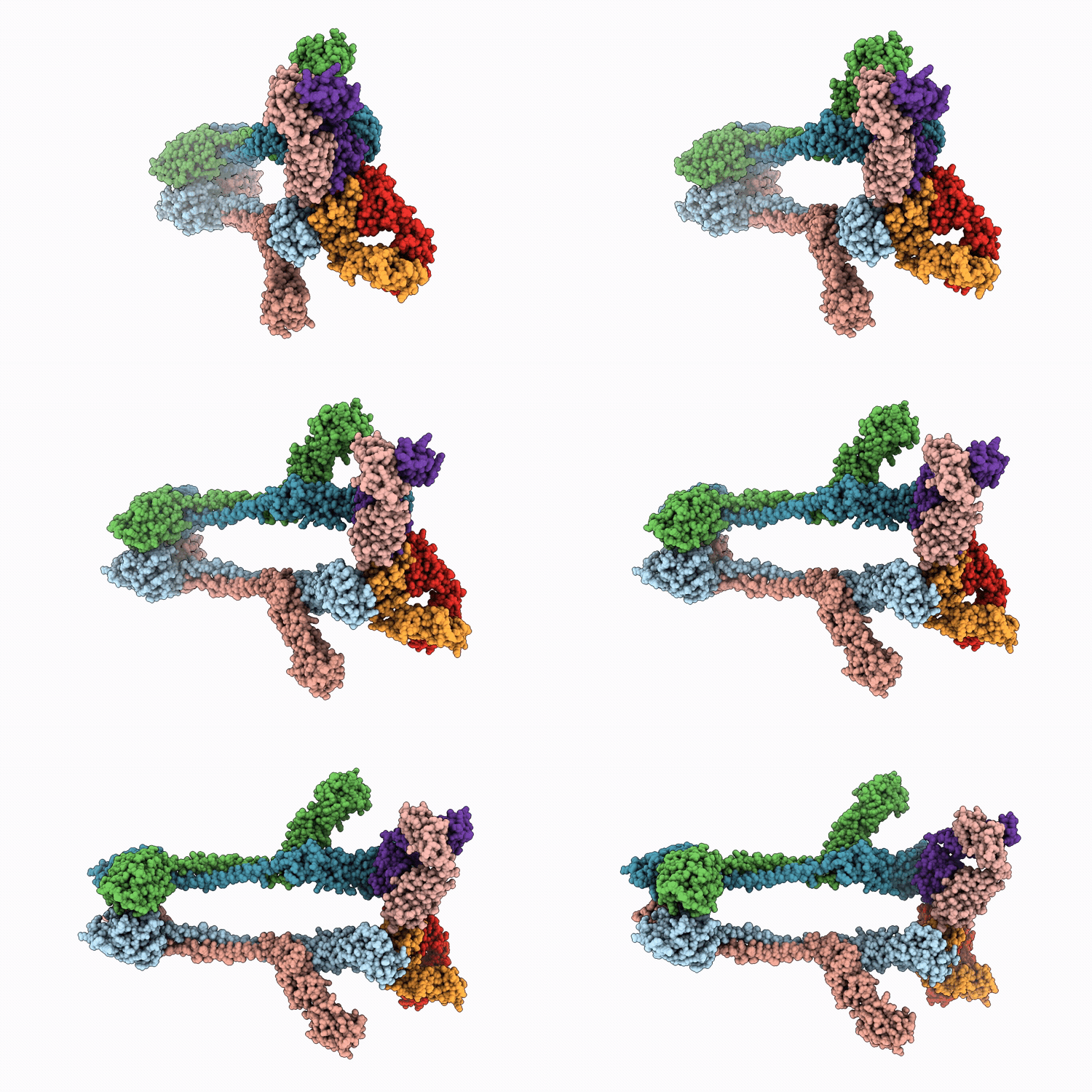
22KK image
Deposition Date 2026-01-14
Release Date 2026-08-26
Last Version Date 2026-08-26
Entry Detail
PDB ID:
22KK
Keywords:
Title:
Cryo-EM structure of the BTNL3-BTNL8-TCR complex
Biological Source:
Source Organism(s):
Homo sapiens (Taxon ID: 9606)
Expression System(s):
Method Details:
Experimental Method:
Resolution:
3.10 Å
Aggregation State:
PARTICLE
Reconstruction Method:
SINGLE PARTICLE
Macromolecular Entities
Polymer Type:polypeptide(L)
Molecule:Butyrophilin-like protein 3
Gene (Uniprot):BTNL3
Chain IDs:A (auth: B), C (auth: A)
Chain Length:466
Number of Molecules:2
Biological Source:Homo sapiens
Polymer Type:polypeptide(L)
Molecule:Butyrophilin-like protein 8
Gene (Uniprot):BTNL8
Chain IDs:B (auth: C), D
Chain Length:500
Number of Molecules:2
Biological Source:Homo sapiens
Polymer Type:polypeptide(L)
Molecule:TCR
Chain IDs:E (auth: G), G (auth: I)
Chain Length:293
Number of Molecules:2
Biological Source:Homo sapiens
Polymer Type:polypeptide(L)
Molecule:TCR
Chain IDs:F (auth: H), H (auth: J)
Chain Length:322
Number of Molecules:2
Biological Source:Homo sapiens
Ligand Molecules
Primary Citation
Butyrophilin-like 3 and 8 tetramers clamp V gamma 4V delta 1 T cell receptors for antigen-independent activation.
Immunity ? ? ? (2026)
PMID: 42546693 DOI: 10.1016/j.immuni.2026.07.004

Abstact

BTNL3 and BTNL8, butyrophilin-like (BTNL) family receptors, are predominantly expressed on intestinal epithelial cells. The BTNL3-BTNL8 complex selectively activates human Vgamma4(+) T cells, which play critical roles in intestinal immune homeostasis and tissue damage repair. Here, we report the structure of the BTNL3-BTNL8-Vgamma4Vdelta1 T cell receptor (TCR) complex. The structure reveals that BTNL3-BTNL8 forms an antigen-independent tetramer, in contrast to the phosphoantigen-driven association of BTN2A1-BTN3A1. Two BTNL3-BTNL8 heterodimers clamp a head-to-head TCR homodimer to form a 2:2:2 BTNL3:BTNL8:Vgamma4Vdelta1 TCR complex, with the Vgamma4 HV4 and CDR2 loops jointly engaging BTNL3. Structural alignment indicates that the CD1d binding site on TCR overlaps spatially with one monomer within a TCR dimer, suggesting that TCR dimerization sterically precludes simultaneous engagement of CD1d molecules. Together, our results elucidate the structural mechanism of BTNL3-BTNL8-mediated engagement and activation of Vgamma4Vdelta1 TCR, offering insights into gammadelta TCR signaling initiation.

Legend

Protein

Chemical

Disease

Primary Citation of related structures
Feedback Form
Name
Email
Institute
Feedback