

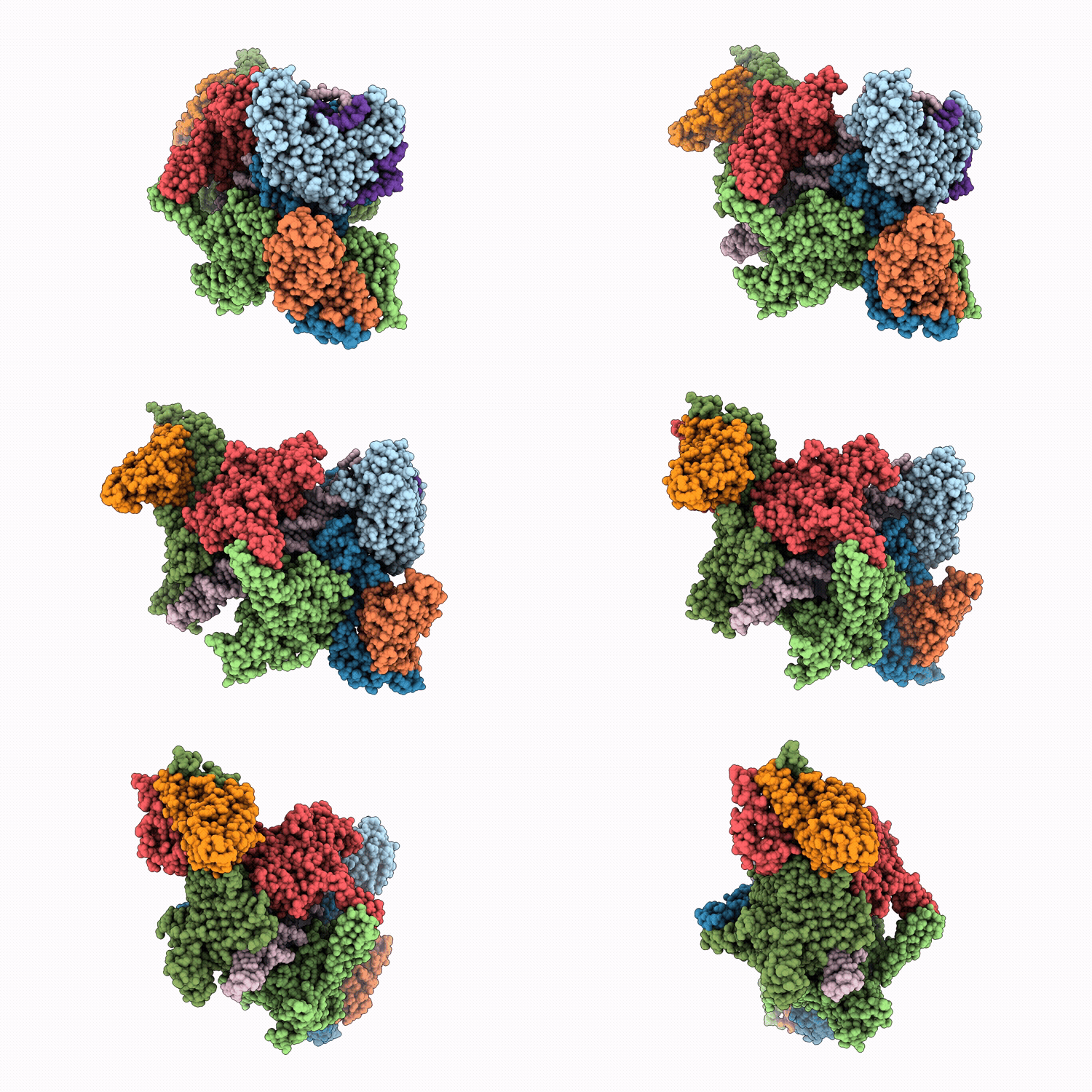
22EU image
Deposition Date 2026-01-08
Release Date 2026-07-29
Last Version Date 2026-08-12
Entry Detail
PDB ID:
22EU
Title:
Cryo-EM structure of Retron Ec78 complex (trans)
Biological Source:
Source Organism(s):
Escherichia coli (Taxon ID: 562)
Expression System(s):
Method Details:
Experimental Method:
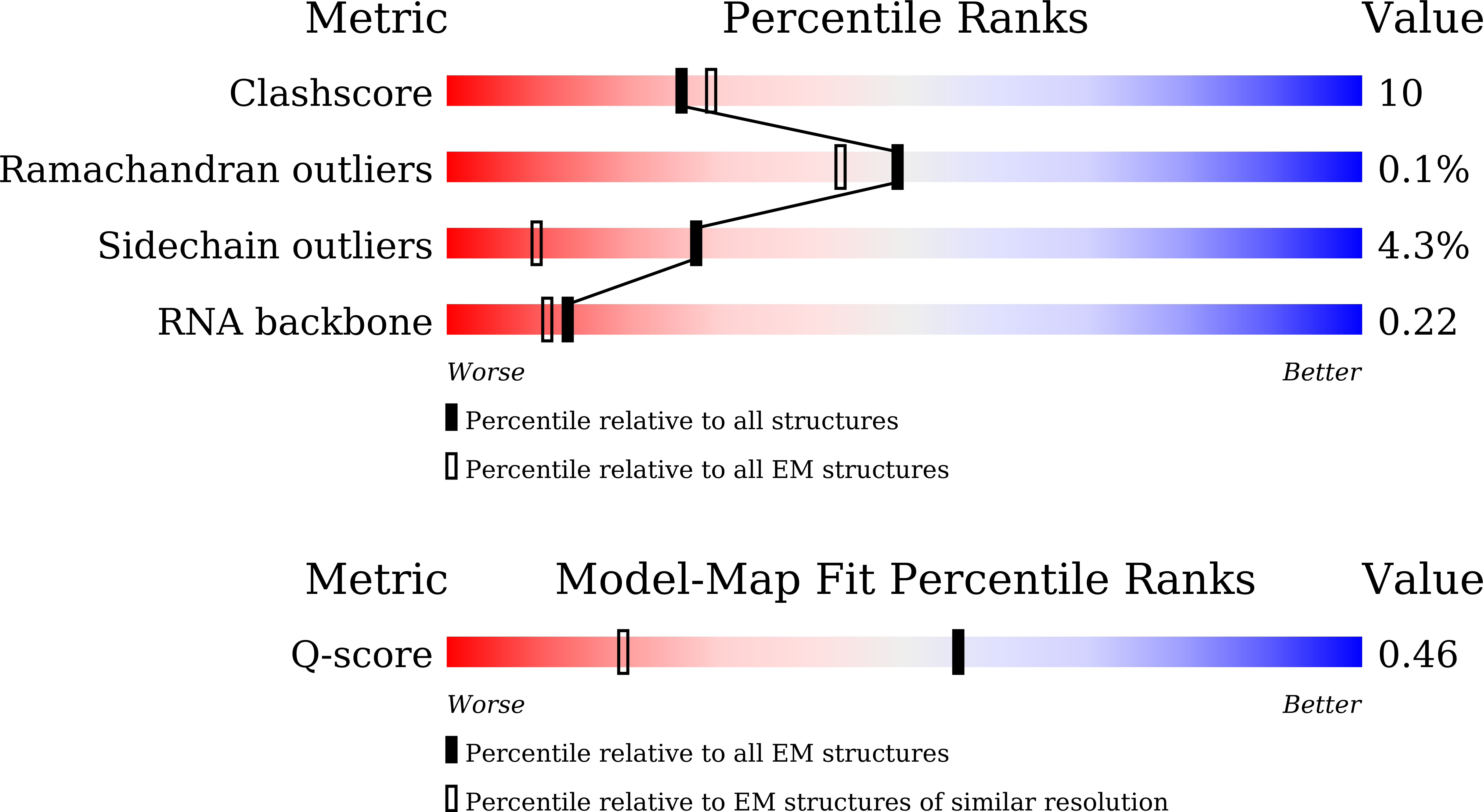
Resolution:
2.67 Å
Aggregation State:
PARTICLE
Reconstruction Method:
SINGLE PARTICLE
Macromolecular Entities
Polymer Type:polypeptide(L)
Molecule:Retron
Chain IDs:A
Chain Length:310
Number of Molecules:1
Biological Source:Escherichia coli
Polymer Type:polypeptide(L)
Molecule:PtuA
Chain IDs:B, C, D, E
Chain Length:551
Number of Molecules:4
Biological Source:Escherichia coli
Polymer Type:polypeptide(L)
Molecule:PtuB
Chain IDs:F, G
Chain Length:215
Number of Molecules:2
Biological Source:Escherichia coli
Polymer Type:polydeoxyribonucleotide
Molecule:DNA (74-MER)
Chain IDs:H (auth: M)
Chain Length:74
Number of Molecules:1
Biological Source:Escherichia coli
Polymer Type:polyribonucleotide
Molecule:RNA (66-MER)
Chain IDs:I (auth: N)
Chain Length:66
Number of Molecules:1
Biological Source:Escherichia coli
Primary Citation
Dual-inhibitory mechanism of the bacterial retron Ec78 antiphage defense system.
Proc.Natl.Acad.Sci.USA 123 e2610082123 e2610082123 (2026)
PMID: 42531023 DOI: 10.1073/pnas.2610082123

Abstact

Retrons are prokaryotic defense modules that protect bacteria from phage infection through abortive infection. The retron Ec78 system employs a two-component effector complex PtuAB to execute this defense. Despite recent advances in structural research, the molecular mechanism by which PtuAB effector is regulated remains unknown. Here, we reveal that PtuAB is subject to a dual-inhibitory mechanism mediated by ATP/ADP and the RT-msDNA antitoxin. ATP/ADP binds nucleotide-binding domain (NBD) of PtuAB and induces the assembly of an inactive tetrameric complex, whereas the RT-msDNA stabilizes an inhibited conformation of Ec78 complex and stimulates ATP turnover to prime PtuAB for rapid activation. Structural analyses show that RT-msDNA dissociation and nucleotide release from PtuA induce conformational rearrangements in the NBD of PtuA and a downward displacement of a key beta-loop-beta motif, driving disassembly of the PtuAB tetramer through an allosteric mechanism and thereby activating its tRNA(Tyr) cleavage activity. Our findings uncover how nucleotides-specifically ATP and ADP-regulate the activity of this abortive infection system, and establish a dual-inhibition model of retron Ec78 system, expanding the understanding of the regulation mechanism of PtuAB activation in prokaryotic immune systems.

Legend

Protein

Chemical

Disease

Primary Citation of related structures
Feedback Form
Name
Email
Institute
Feedback