

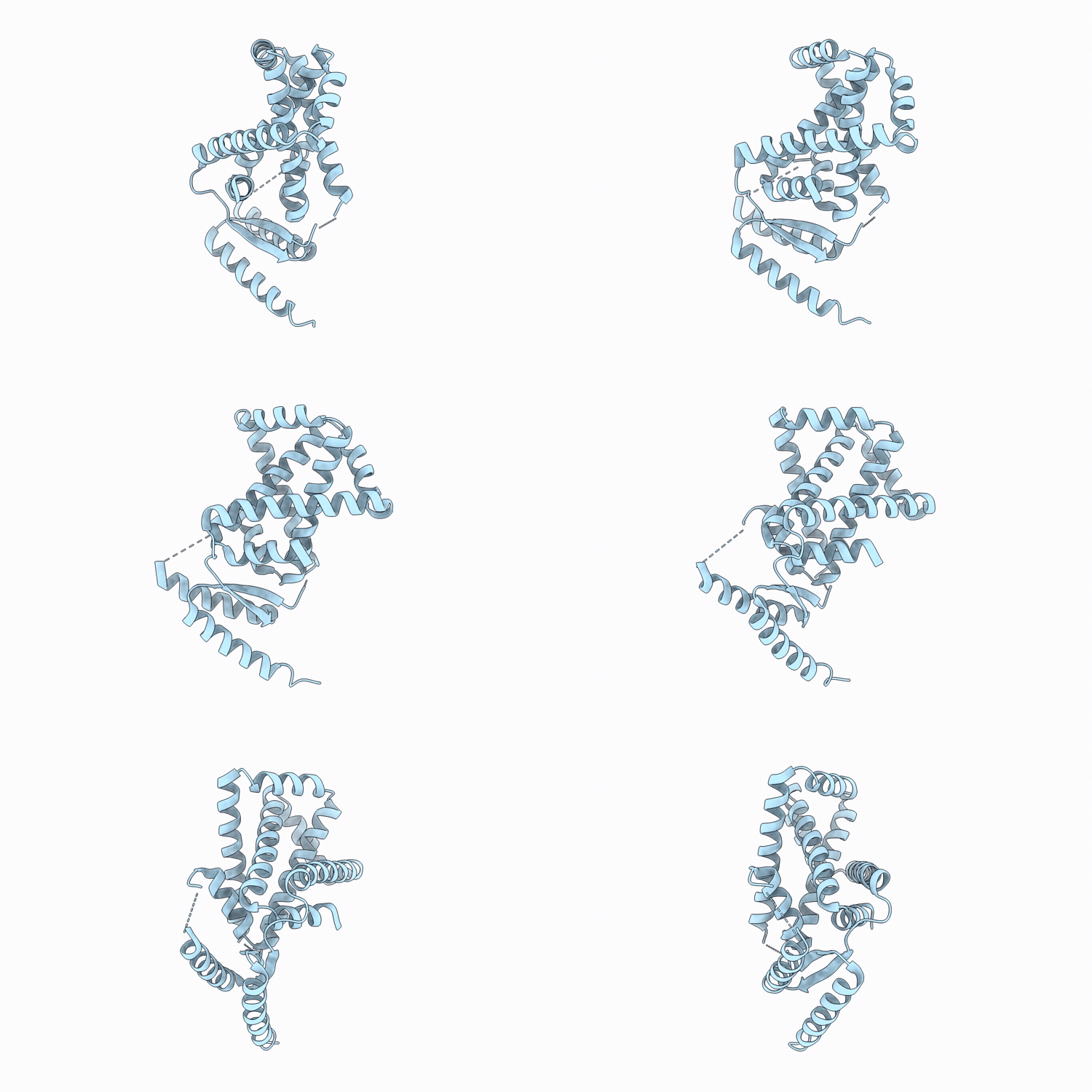
21GI image
Deposition Date 2025-12-11
Release Date 2026-07-01
Last Version Date 2026-07-01
Entry Detail
PDB ID:
21GI
Keywords:
Title:
Crystal Structure of a Designed Protein Three-twist Knot
Biological Source:
Source Organism(s):
Expression System(s):
Method Details:
Experimental Method:
Resolution:
2.28 Å
R-Value Free:
0.27
R-Value Work:
0.23
R-Value Observed:
0.23
Space Group:
P 21 21 21
Macromolecular Entities
Protein Blast
Polymer Type:polypeptide(L)
Molecule:A designed protein Three-twis
Chain IDs:A
Chain Length:256
Number of Molecules:1
Biological Source:Helicobacter pylori
Primary Citation
Computational design and cellular synthesis of two protein topological isomers: Solomon link vs. three-twist knot.
Proc.Natl.Acad.Sci.USA 123 e2537891123 e2537891123 (2026)
PMID: 42301778 DOI: 10.1073/pnas.2537891123

Abstact

Chemical topology has emerged as a unique dimension in protein engineering, motivating the pursuit of topologically nontrivial protein architectures for functional advantages, such as enhanced stability and rich dynamics. However, the structural diversity of artificial mechanically interlocked proteins remains limited. Here, we report the computational design and cellular synthesis of a pair of topological isomers via symmetric assembly of orthogonal entangling motifs. By fusing two C(2) symmetric entangling motifs, i.e., p53dim and HP0242, in specific arrangements, we programmed the formation of multiple crossings, which upon cyclization yielded a protein Solomon link and a protein three-twist knot. The fusion patterns and linker lengths were systematically optimized to direct the formation of the intended topologies. Their successful cellular synthesis was validated through biophysical and structural analyses, including sodium dodecyl sulfate-polyacrylamide gel electrophoresis, size exclusion chromatography, and liquid chromatography-mass spectrometry. Notably, we report the crystal structure of an artificial protein three-twist knot. Both the Solomon link and the three-twist knot displayed increased structural compactness and stability relative to their controls with lower topological complexity (e.g., Hopf link, trefoil knot, and linear forms), as evidenced by their superior thermal stability and resistance to chemical denaturation. This modular design strategy provides a rational and extensible route to diverse mechanically interlocked proteins and could be generalized to access even more complex architectures, such as protein chainmail-like nanocages and woven protein frameworks.

Legend

Protein

Chemical

Disease

Primary Citation of related structures
Feedback Form
Name
Email
Institute
Feedback