

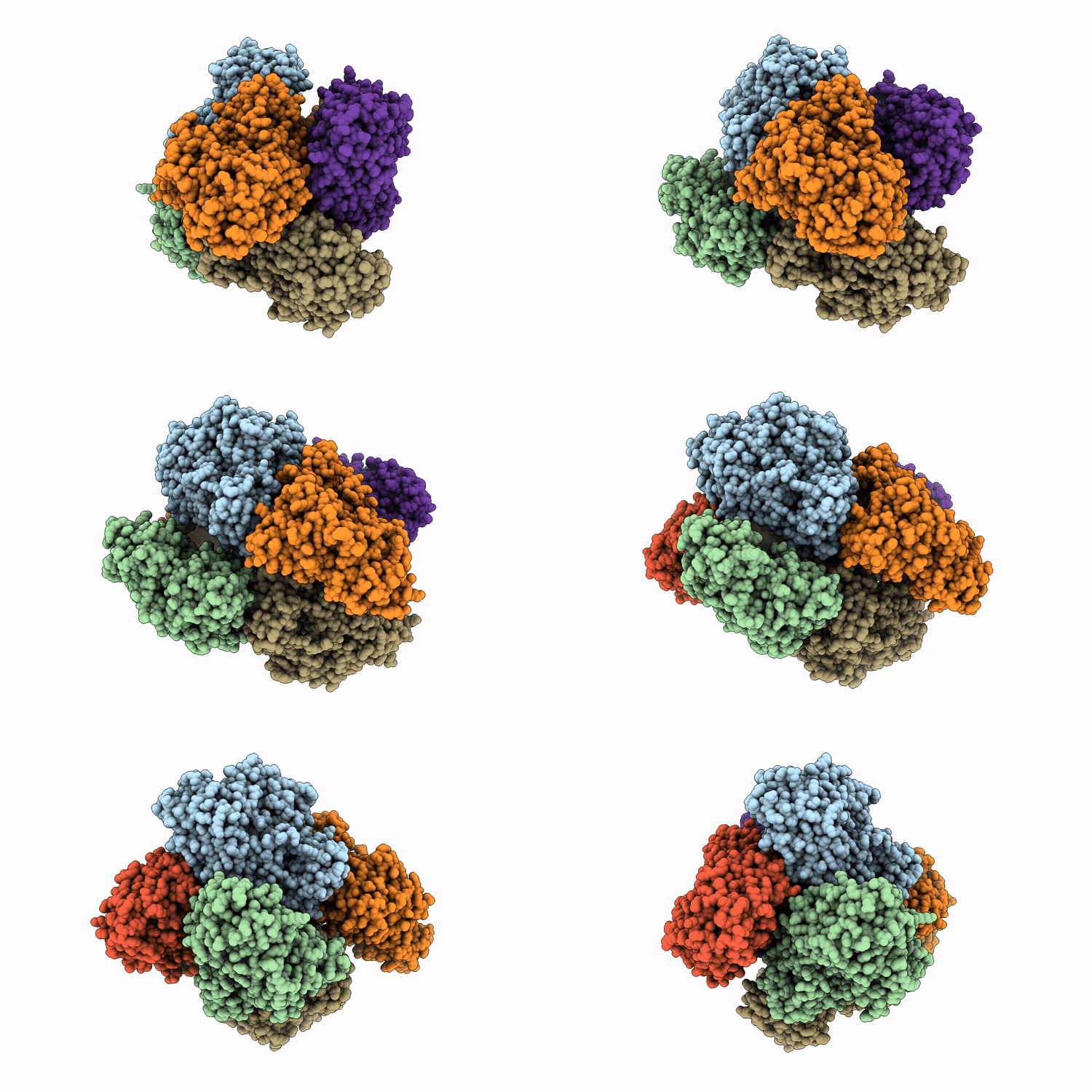
21DH image
Deposition Date 2025-12-09
Release Date 2026-03-18
Last Version Date 2026-03-18
Entry Detail
PDB ID:
21DH
Keywords:
Title:
Crystal structure of MBP-fused Monobody P' in complex with HPPU
Biological Source:
Source Organism(s):
Expression System(s):
Method Details:
Experimental Method:
Resolution:
2.57 Å
R-Value Free:
0.24
R-Value Work:
0.21
R-Value Observed:
0.21
Space Group:
C 2 2 21

Macromolecular Entities
Structures with similar UniProt ID
Protein Blast
Polymer Type:polypeptide(L)
Molecule:Maltose/maltodextrin-binding
Gene (Uniprot):malE
Mutagens:A324V
Chain IDs:A, B, C, D, E, F
Chain Length:487
Number of Molecules:6
Biological Source:Escherichia coli K-12, synthetic construct
Ligand Molecules
Peptide-like Molecules
PRD_900018
Primary Citation
Crystallization and X-ray structure of a highly aggregation-prone monobody engineered for high-affinity small-molecule recognition.
Acta Crystallogr. Sect. F Struct. Biol. Cryst. Commun. 82 75 82 (2026)
PMID: 41660693 DOI: 10.1107/S2053230X26000798

Abstact

Monobodies, engineered protein scaffolds derived from the fibronectin type III domain, are powerful alternatives to conventional antibodies. While the native scaffold is robust, engineering the variable loops can often compromise solubility and promote aggregation. Here, we report the crystallization and structure determination at 2.57 A resolution of a monobody (Mb-P') engineered to bind the synthetic small molecule HPPU [1-(4-hydroxyphenyl)-3-phenylurea] with nanomolar affinity. Although Mb-P' exhibited severe polydispersity and heterogeneous oligomerization in solution, N-terminal fusion with maltose-binding protein (MBP) using an optimized linker successfully yielded monodisperse species and diffraction-quality crystals. The crystal structure exhibited pseudo-D(3) symmetry in the asymmetric unit, in which the MBP moiety interacts with and partially covers the F and G beta-strands of the monobody. This steric masking suggests that MBP acts as a solubility enhancer by shielding the aggregation-prone surface patches generated by loop engineering. Our results demonstrate that this fusion strategy effectively enables structural studies of aggregation-prone proteins obtained from engineered scaffolds.

Legend

Protein

Chemical

Disease

Primary Citation of related structures
Feedback Form
Name
Email
Institute
Feedback